GE 9FA (DLN 2.0+) Gas Fuel System

N

Thread Starter

niazbibiyana

Hello Everyone,

I am new on GE gas turbine. I understand GE codes, their P&IDs, every systems. But I am much confused on "Gas fuel system". Here I am uploading GE gas fuel system P&ID and giving the link:

http://www.mediafire.com/view/1g880ejf8ojdils/Gas_Fuel_P&ID.pdf

My curiosities are on :

1. In Safety shutoff valve (SSOV) , VS4-4 , 2 vent lines are shown on P&ID, one is from valve upper portion and another is from bottom portion (Of course I marked at uploaded P&ID with red arrow). My question is, why we need these vent lines, If we ignore those, what problem can happen?

2. In same page, in the D5, PM1, PM4 assembly, 3 pressure transmitters (PDT 96GN-1, 96GN-2, 96GN-3) are in used. (Of course I marked at uploaded P&ID with red arrow). My curiosity is, why these sensors are in used? actually which differential pressure are they measuring ? Any control is given on the based on their measurement?

3. In the Strainer, a differential pressure switch is used, (PDS 63FGD-1). I already noticed on GE "DEVICE SUMMERY" , the increasing pressure is 15 PSID. (Of course I marked at uploaded P&ID with red arrow). My question is is differential pressure is higher than 15 PSI, what will happen? GT will Trip? or anything will happen?

I know, in this group, there are some intelligent people about "Instrumentation and Control" and also "Mechanical Engineer". As I am a operations engineer, I expect better answer from them. Of course I will be grateful to them. :)

I of course already read the GE document on Gas fuel system. About above topics, I could not get satisfied answers from that document. Thats why, I have asked those questions in this group.

Have a nice day, Thank you all.
 
niazbibiyana and Vincent05,

A lot of the answers to these questions can be obtained by going out to the areas where the devices are located and following tubing/piping lines and, in some cases, applying what one finds to what one knows about hazardous areas and enclosures, AND referring to the sequencing/application code running in the Speedtronic turbine control panel at the site.

The latter is difficult--at first--but is the best way to become familiar with the site-specific characteristics that everyone wants to know; they don't want general statements, they want to know how their turbine operates--and that can ONLY be determined by looking at the drawings and sequencing/application code of the Speedtronic turbine control panel at their site.

Many systems and functions and schemes undergo--and underwent--a lot of changes during the time of development and production, and I can assure you that DLN (Dry Low NOx) systems--even though the OEM claims it's a "mature" technology--is still undergoing design analysis, modification and improvement today, and will continue to do so for a long time.

As units were built and installed the system underwent change, and through TILs (Technical Information Letters) and the like, they continue to undergo change over time. Some of the DLN technologies have "stabilized" and haven't changed much in the last few years--especially those that are no longer in production (like DLN 2.0). But, a lot of questions like a couple of these aren't documented because it's assumed people are familiar with hazardous area classifications and basic piping fundamentals and principles. And, in most cases, by using the P&IDs and the Device Summary and the Control Specification and the sequencing/application code running in the Speedtronic turbine control panel the answers can be "devined" or deduced in many cases--especially the ones about, "What does [this or that] do at my site?" All we can provide for many of those types of questions is general answers and refer the questioner to the Speedtronic turbine control system at their site. A lot of site-implemented changes were done to turbines during commissioning that modified as-shipped sequencing/application code--and without being to examine the running sequencing/application code at the site it's virtually impossible to answer with any specificity.

1) These are valve packing leak-off lines, and by directing them to the atmospheric vent that prevents combustible gas from collecting in the Gas Valve Compartment and possibly leading to an explosion. All valve packing leaks--some more than others; so by enclosing the area around the packing boxes and then piping (tubing) the area to an atmospheric vent away from possible ignition sources that eliminates the leaking gases from collecting in the compartment where they would be more hazardous.

If a large amount of gas fuel is noticed to be coming out of the "goose-neck" atmospheric vent then the source of the gas fuel coming out of the atmospheric vent should be identified and resolved as excessive packing leaks, or, in this case, a leaking solenoid-operated vent valve (VA13-8) can be problematic and should be corrected.

2) These differential pressure transmitters are typically used to calculate the amount of fuel flowing in each of the three manifold/nozzle assemblies. To be certain of how they're being used at your site--whether or not they actually perform any control or control loop feedback functions, or any other alarming or protection functions--you really need to look at the sequencing/application code running in the Speedtronic turbine control at your site. DLN 2.0 was kind a work-in-progress, and so the sequencing/application code was not very static and was continually being changed (slightly in some cases; greatly in others) until it was replaced with DLN 2.6. But, in general, when independent gas control valves (GCV-1, GCV-2 & GCV-3, in this case) were used there was some kind of flow-rate monitoring done, primarily for monitoring purposes. (I don't recall it ever being used for control purposes, but just as kind of a "check" to ensure that actual fuel flow-rate splits were close to desired fuel flow-rate splits--and before you ask, I don't recall ever seeing a calculated flow-rate split for each manifold/system; the sensors were installed so that if problems arose the data could be collected and used by OEM personnel for troubleshooting).

3) Again, to be certain of exactly what will happen when the strainer differential pressure exceeds 15 psid at YOUR site you will have to look at the sequencing/application code running in the Speedtronic turbine control system at your site. I'm pretty sure a Process Alarm will be annunciated when the diff pressure exceeds 15 psid--but if there's other actions (either immediately, or after a time delay, or if the pressure continues to increase) the only way to tell is to examine the sequencing/application code running in the Speedtronic turbine control panel at your site.

A high strainer differential pressure means there is dirt/debris in the natural gas which has been captured in the strainer, and enough dirt/debris will cause one of two things to happen: first, the flow can be restricted such that load will be restricted--or worse, the desired pressure drops across the various nozzles will not be as desired which can cause problems with both emissions and combustion hardware problems. Second, the strainer may rupture if the differential is high enough and exists for long enough, causing the dirt and debris to flow downstream into the control valves, manifolds, and fuel nozzles, which can lead to plugged fuel nozzle orifices and emissions/combustion hardware problems.

Hope this helps!
 
N

niazbibiyana

Dear CSA Sir,

Many Many thanx. I made this thread only for you, because, few days ago, you asked me for full P&ID of GAS FUEL SYSTEM. It is really highly appreciated about all of you answers. I eagerly Waited for your answers. Have a nice day..

Again thanx
 
niazbibiyana,

Thanks for the feedback; glad to be of help.

But, as you can read, you still have a lot of work to do at site to fully understand how things work at your site.

And, it would be most helpful if you could tell us what version (Mark V; Mark VI; Mark Ve) of Speedtronic turbine control panel the site uses.
 
N

niazbibiyana

Dear CSA sir,

Thanx for your fast reply. In our site, We have speedtronic version of Mark VIe.

But as per your previous answer, "These differential pressure transmitters are typically used to calculate the amount of fuel flowing in each of the three manifold/nozzle assemblies." As I asked about the function of PDT 96GN-1, 96GN-2, 96GN-3.

But in GAS FUEL manual about those differential transducers, they said," When a gas passage is being purged, a minimum gas purge pressure ratio must be maintained to ensure positive airflow across all the fuel nozzles. This pressure ratio is sufficient to overcome any combustion can-to-can pressure variation. The differential pressure transmitters measure the gas manifold pressure relative to compressor discharge pressure. These pressures are used for monitoring and alarm in the control system. "

So, my question is why should we maintain positive airflow across all fuel nozzle? if there is large pressure variation in any combustion can-to-can what type of problem can be happened?

I am now almost familiar about all equipment in our site. I just curious to know their functions. :) :D.

Have a nice day sir.

NIAZ
 
niazbibiyana,

Differential pressure transducers (transmitters) are frequently used as part of flow-monitoring equipment (by measuring differential pressure across an orifice (or orifices, in the case of fuel nozzles).

Without purge air flowing in the gas fuel manifolds/nozzles when there is no gas fuel flowing, hot combustion gases can flow "backwards" through nozzles and into the manifolds around the axial compressor casing and cause a lot of damage--a LOT of damage. The purge air also serves to cool the fuel nozzle tips when there is no gas fuel flowing through them (even though it's at CTD--Compressor Discharge Temperature--it's still lower than the temperature inside the combustor when fuel is burning).

As you noted, if the difference in combustor pressures is too great then backflow of hot combustion gases through nozzles from a combustor at higher pressure to a combustor with lower pressure will be more likely to occur--<i>if there is no purge air flow</i> (which is at a higher pressure than combustor pressure (inside the liner--which we've discussed before)).

So, purge air is very, very important. It's so important for some turbines (but not ALL turbines) that the turbine control systems monitor the differential pressure across the nozzles/manifolds to ensure there is flow in the proper direction(s)--always into the combustor whether it's gas fuel or purge air. The turbine control system may alarm a low differential, or it might cause the load to be reduced, or it might result in a turbine shutdown (orderly reduction of load and speed all the way to Cooldown), or even a turbine trip.

This is another possible use of the differential pressure transmitters--in fact, the output of the same transmitters can be used for multiple purposes, but only a review of the application code running in the Mark VIe at your site will reflect exactly how the output(s) are being used at your site. Again, control schemes have changed over the production lives of the turbines, and will continue to do so.

Good to hear you seem to be developing a relationship with someone who has knowledge of the turbine control system (because it was probably a Mark V or Mark VI before it because a Mark VIe, and it's likely that little has changed, though some things probably did, when the control system was upgraded to Mark VIe--that's one of the ways improved control and protection schemes get implemented, during control system upgrades).

A large pressure variation in one or more combustors usually occurs when there's a serious problem with the fuel nozzles (multiple orifices/nozzles are plugged), or the combustion liners are damaged (cracking which can become small to large holes), or there's a problem with the transition pieces or the seals between the combustion liner and the transition pieces (the "hula skirt" seals); etc. This results in a very different hot gas path temperature entering the first stage turbine nozzles from that combustor (or combustors) which means the turbine exhaust temperatures will be very different. Exhaust temperature differentials are called "exhaust temperature spreads"--high spreads mean high differential temperatures. Very high exhaust temperature spreads will result in a turbine trip--to protect the combustors from even further damage caused by combustion problems which will also cause high combustor differential pressures (with respect to each other).

Hope this helps!
 
Hi Gents, I have GE gas Turbine 6B (MS6001) , during 45 degree environment Temp. at 27MW (75% of load ) back to L-L Mode , in return must be Premixed mode . I need your advise please . Thank you
 
@Lu RPP,

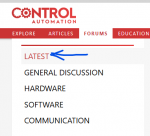
Your question really belongs in a separate thread, one you create. At the top of the Control.com window you will see a Menu bar; click on 'Forums' and you will see this part of a window:

1727101102677.png

Click on 'Latest' and you will be taken to the top-level Forums view of Control.com and the top of the page will look like this:

1727101285812.png


Click on 'Post New Thread' and you can create a new thread with your question. MANY people get hung up on the choice of a sub-forum to post their question in--DON'T worry about it. Very few people actually look in specific forums for specific topics and just use the 'Search' feature at the top of the Forums view to search ALL forums for their keywords or terms. And, the moderators don't enforce where any question is posted. So, if you could post in 'Power Generation' that would be great, but no matter where you post others will be able to see your questions and provide responses.

BEFORE you create your new thread, I want you to include the answers to these questions, please, so I don't have to type them again for you to answer them. (And, remember: The more information you provide in your original post the better the quality of the initial responses you will get....)

1) What alarms were annunciated when the machine transferred from Premix Steady State to Lean-Lean mode (if any)?

2) What alarms were present before the machine transferred combustion modes?

(PLEASE try and include this information if nothing else!)

3) What turbine control system is in use on the machine?

4) Was Base Load selected and active when this happened, or was Pre-Select Load being used?

5) Was the frequency of the system the machine was synchronized to stable at the time of the transfer or was it oscillating (meaning the load of the machine and the machine speed was also fluctuating)? (I presume the machine is synchronized to a grid or power system with other machines, if not, please describe the condition the machine was/is operating in--Part Load, Droop Speed Control, External Load Control, Pre-Selected Load Control, Base Load, etc.)

6) Are the exhaust temperature spreads higher than normal (and what are TTXSP1 and TTXSP1 and TTXSPL; again, I presume you are using a GE Mark* turbine control system)?

7) When was the last time the DLN system was tuned, and what was the ambient temperature (approximately) when it was being tuned?

8) Was the gas fuel supply pressure stable and at or near normal when the combustion mode transfer occurred, or was the gas fuel pressure low and/or the pressure was fluctuating, and if it was fluctuating, how much was it fluctuating?

9) Does the machine have any type of inlet air cooling (for example, evaporative cooling, or???), and was it working (and working properly) at the time?

10) How long since the last schedule maintenance outage, and which outage was it (Combustion Inspection; Hot Gas Path Inspection; Major Inspection)?

I presume you have already tried lowering load to get into Lean-Lean Positive status and then increasing the load again to attempt to transfer into Premix Steady State. Have you? What happened when you did this?

The MORE information you can provide, even if you think the questions aren't relevant, the better the quality of the response(s) will be. 45 deg C is a pretty high ambient temperature and I'm not sure how well DLN-I combustion systems will perform--and remain in Premix Steady State reliably--without tuning the DLN-I system at such an elevated temperature. Some of the answers to the above question may be helpful in formulating future responses. If the grid was experiencing frequency excursions, even small ones (plus-or-minus 0.2 Hz or more) AND the machine was operating with BASE LOAD selected and active it might be difficult to maintain combustion stability. Same with gas fuel supply pressure--if it wasn't stable that can cause unexpected combustion mode transfers. If the machine was last tuned at a temperature much closer to the turbine nameplate rating (above or below) and it's been stable until now that could also be part of the problem. If it's been a long time since the tune, and the gas valves have been "calibrated" that could introduce some error into the actual fuel flows and cause combustion instability.

DLN-I is touted as a "mature" technology, and while it's been around for a long time (almost 30-plus years) it's still not really bulletproof--especially at ambient temperature extremes. AND, even though it's been around for a long time, MANY machines have to be tuned for summer and winter operation (so, twice per year). We don't know if 45 deg C is "normal" or the "new normal" or unusual. We don't know what the normal lowest ambient temperatures the machine experiences are.

I presume you understand that the higher the ambient temperature is above the turbine nameplate rating temperature the lower the load will be when operating at or near Base Load. And, when the ambient temperature is high the air density is low and affects load and can have an impact on combustion stability, also.

Anyway, without good answers to most of the above questions there's not much more I can offer. Yes; you've written to a World Wide Web forum with some experts who can probably offer some information which may be of help, but, DLN-I, and GE-design heavy duty gas turbines in general, are complicated systems/machines where many things all have to be working properly for them to be reliable and operate optimally. So, information is key--and the more information you can provide in your original post the better the responses are likely to be.

Finally, I'm not sure precisely what you're asking. If you've tried lowering load and loading up again to get back into Premix Steady State combustion mode and it's not working (and you've tried it more than once), then it's very likely something else is going on--and the answers to the questions above would be very important.
 
@Lu RPP,

So, if I read your reply correctly, you were able to get back into Premix Steady State by lowering load and then loading up again.

Was it successful on the first attempt? How many times did you try this--once, twice, thrice?

GE does have some optional logic/application code to initiate a transfer into Premix Steady State without the need to lower load, but as with most things they think very highly of the option and charge a lot of money for it. And, I don't think it's available for all the Mark* turbine control systems.

Anyway, if it was possible to get the machine back into Premix Steady State--that's good. And, lowering load and reloading again IS the normal method of getting back into Premix Steady State (because there is no other way to do it unless GE installs the option in the Mark*).
 
Top