Facebook
 Google
 GitHub
 Linkedin
AI-Powered Depalletization: the Key to Grocery’s Automated Future
Advanced 3-D imaging and pattern recognition algorithms are required for robotic depalletization systems to deal with the different shapes, sizes, and textures of packaging materials using in grocery logistics.
E-commerce has long been a popular avenue for consumers to purchase non-essential retail products, from tech and apparel to personal care and furniture. However, recent data suggests that another, arguably more pivotal category is rising in e-commerce: food and beverage. In fact, by 2026, experts predict that grocery will be the largest e-commerce category, representing nearly 20% of all online sales.
Demonstration of Random Mixed Robotic Depalletization. Video used courtesy of Plus One Robotics.
Transporting, storing, and distributing food to consumers is no simple task. Grocery leaders must start assessing how they’ll uplevel their operations today to meet increased demand tomorrow. Perhaps the most important component of this equation will be automation — and, more specifically, using AI and warehouse robots to unpack groceries from their pallets, a process known as depalletization.
Grocery’s Digital Future
Before the pandemic, many consumers regularly did their shopping in person. However, COVID-19 disrupted traditional shopping habits; nearly overnight, e-commerce popularity skyrocketed. In 2020 alone, e-commerce spending rose by 43%.
Flash forward to today, and e-commerce spending still represents a significant proportion of retail sales. In Q2 of 2024, e-commerce sales comprised 21.7% of overall consumer spending, compared to 21.3% in Q2 of 2020. Moreover, even traditionally “in-person-only” categories like grocery are becoming more popular among digital consumers thanks to third-party marketplaces, curbside delivery services, and in-store pickup.
Since the pandemic, grocery retailers have upgraded their digital interfaces to satisfy increasing demand. Now, most grocers allow consumers to quickly toggle between products to compare quality, feature, and price. These features make online grocery shopping more attractive to many consumers, especially Millennials and members of Gen Z.
That’s great news for grocery retailers. However, increased consumer demand necessitates even greater efficiency in the supply chain. To keep pace with changing consumer behaviors, grocery retailers must reassess their logistics operations soon.
The Challenge of Grocery Depalletization
The food and beverage supply chain must quickly prepare for the influx of digital consumer demand. As part of that challenge, they’ll need to rethink difficult pieces of their logistics operations, including depalletization.
Pallets arriving at fulfillment centers are often packed with mixed products—everything from beverage cans to shrink-wrapped boxes of pasta to delicate produce. These items come in all shapes and sizes and with varying packaging materials.
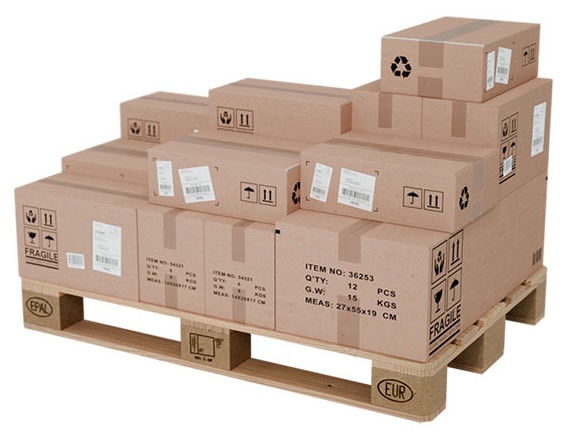
Example of a pallet loaded with mixed products. Image used courtesy of Plus One Robotics
Furthermore, food and beverage goods vary widely in terms of storage requirements. Just think: You wouldn’t want to store a head of organic lettuce in the same way you would store a six-pack of Poppi.
For years, human workers have overcome these obstacles by relying on their innate capabilities of sight and touch to make frequent judgment calls about package handling, but the process isn’t painless. Repetitive motion and heavy packages lead to exhaustion, decreasing productivity, and job turnover or scheduling issues with human workers lead to inefficiencies. However, the same capabilities aren’t always available for traditional depalletization robots. Certain robots may struggle with densely packed and shrink-wrapped items, leading to slower processing times, higher error rates, and even potential product damage. Inefficiency at this stage can cascade, creating delays in order picking, packing, and shipping.
At scale, these inefficiencies can prevent retailers from hitting necessary key performance indicators (KPIs) related to throughput, especially when coupled with the pressure of rising e-commerce demand.
AI-Powered Depalletization and Human Standardization
AI-powered automation, including depalletization solutions, supplies a level of “intelligence” that enables robots to parse their environment more reliably. These capabilities have proven critical for meeting rising demand. As a result, experts predict that 90% of all food and beverage items will come into contact with AI during their supply chain journey by 2027.
By leveraging computer vision and machine learning (ML), AI-powered depalletizers can “see” and understand the items they are processing, even in challenging conditions where items are tightly packed, wrapped in plastic, or stacked in irregular configurations. For example, many AI-driven depalletization systems currently use advanced 3-D imaging and pattern recognition algorithms to identify individual products, no matter how densely packed. These systems can distinguish between different shapes, sizes, and textures of packaging materials, enabling the robot to make real-time adjustments as it picks and sorts items from the pallet.
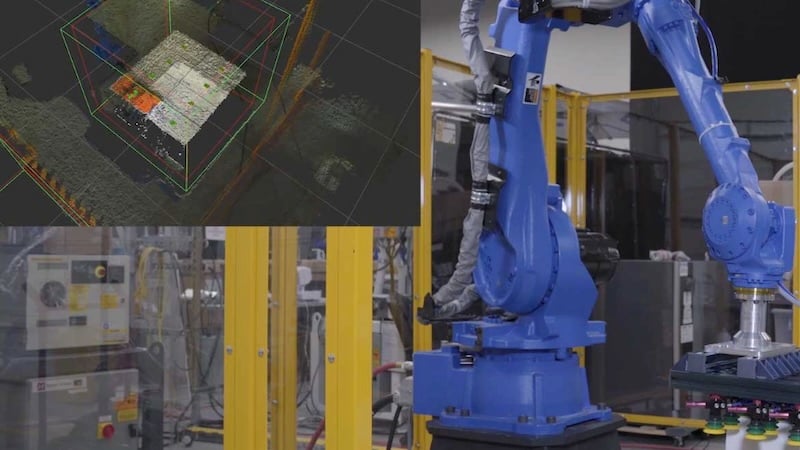
AI-enabled vision control for robot depalletizing. Image used courtesy of Plus One Robotics
While AI brings precision and adaptability to complex tasks like depalletization, warehouse environments remain unpredictable, especially in the food and beverage industry. This becomes even more complex when you consider seasonality. Items vary based on customer preference and promotional activities, and seasonal goods come and go. Thus, in 2025, the optimal warehouse must combine automation and AI-based systems with human oversight to reliably and accurately meet consumer demand.
In practice, the convergence of AI decision-making and human oversight will differ from warehouse to warehouse. One option is to train current warehouse workers to become robot managers (or “crew chiefs”). These individuals can monitor the progress of multiple robots at once, flagging issues when they arise and providing necessary context to any system encountering an error or unexpected stimulus. As with any manager, the Crew Chief keeps her team of robots fully utilized and maximizes productivity.
Regardless of the specifics, grocery leaders should expect human-AI collaboration to become much more common—and critical—to supply chain success in years to come.
The Road to Automation in 2025
We’re increasingly learning that a blend of automation, AI, and human oversight is the most practical way to create a reliable supply chain. Automation supplies the manual labor component of warehouse operations, while AI fills in the logistical gaps, enabling systems to operate with a higher degree of autonomy. But no system is perfect. That’s where humans come in: to fill the gaps and ensure that a small hiccup never becomes debilitating.
As e-commerce demand in the grocery category increases, relying on this general principle (automation + AI + humans) will become even more essential. And the earlier that leaders start trialing these capabilities, the better—both for their bottom line and our world’s food and beverage supply chain.
Related Content