Facebook
 Google
 GitHub
 Linkedin
Brain-Inspired NeurOSmart System Improves Robot Safety
Fraunhofer’s NeurOSmart system uses neuromorphic computing and integrated LiDAR sensors to improve safety and efficiency in human-robot collaboration.
Researchers at Fraunhofer Society have introduced the NeurOSmart system, a neuromorphic computing platform designed to improve safety and efficiency in human-robot collaboration. By integrating LiDAR sensing with a brain-inspired analog processor, the system processes environmental data directly at the sensor level. This edge-based approach reduces latency and energy consumption while allowing robots to detect and respond to human movements in real time, advancing safer and more responsive industrial automation systems.
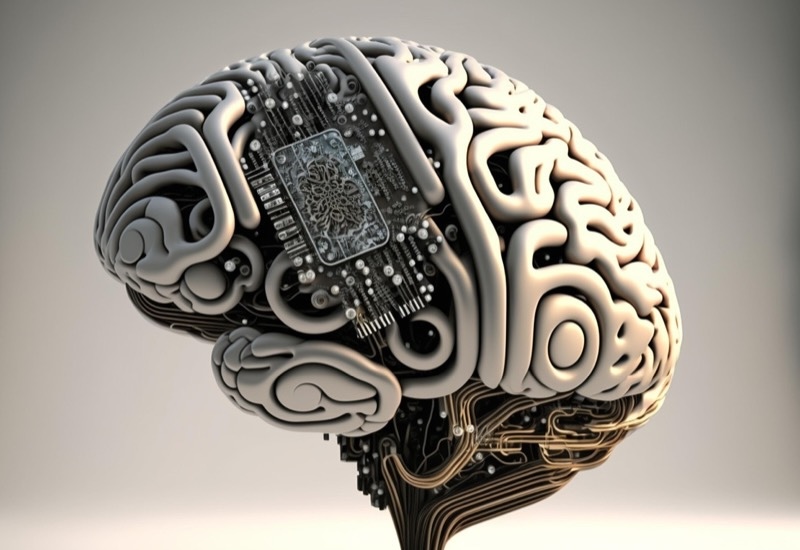
Fraunhofer draws on the functioning of the human brain to advance the efficiency and responsiveness of robotic systems. Image used courtesy of Pixabay
Sensors, Safety, and Data
Human beings take in multiple sensory inputs every moment of every second, and the capacity to decode this information, act upon it, store it, and pre-process it to predict an outcome and/or execute a future task is a biomechanical wonder.
When we turn to analogous capacities of robotic systems, outfitted with sensors, visual systems, and human-modelled, AI-guided processing systems, we see significant advancements and further challenges in achieving the level of efficiency and processing power that the human brain achieves. Arguably, though, the creation of large language models and highly advanced deep learning models for analyzing large, multifarious data is extremely powerful and can beat the human brain in certain areas of performance.
Advancements in robotic systems have created highly mobile, safety-conscious, sensor-loaded, and adaptive technologies. More sensors mean more data to transmit and process efficiently, so robotics can react to stimuli in their environment dynamically, in real-time, and in a way that maintains safe operating distances with human co-workers.
NeuroSmart
The Fraunhofer Society’s NeurOSmart flagship project is a product of the combined research and collaboration of five of the society's institutes (ISIT, IPMS, IMS, IWU, and IAIS). The NeurOSmart Project is dedicated to developing truly innovative smart hybrid commuting architectures (with sensor-based data processing) that enable robotic systems to respond dynamically and reduce energy inefficiencies.
One particular aspect of the integrative NeurOSmart system is the use of an analogue-neuromorphic HPC (High-Performance Computing) chip that models the biomechanics of the human brain using analogue circuits rather than conventional digital logic. Using such a chip means that memory and processing occupy the same space. A key feature of this HPC chip is that it removes something known as the "Von Neumann bottleneck", which is manifested as a delay in data transmission between the RAM and the CPU. The key to how this is achieved is the storage of data within analogue circuit elements, such as memristors.
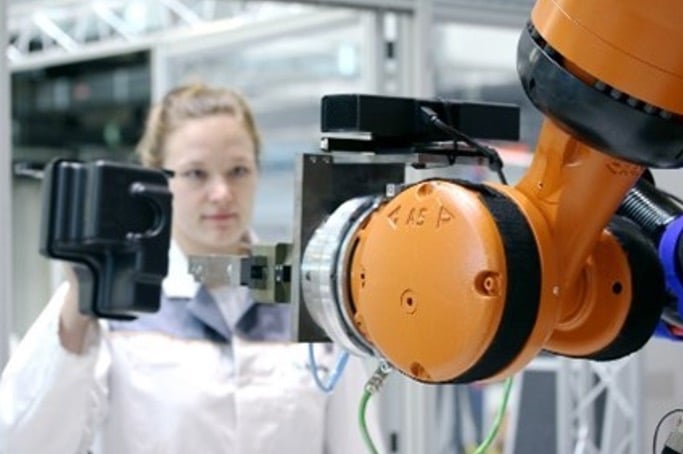
Helping robotic systems “think” and respond as humans do is a key step towards enhancing the safety of human-robot collaborative workflows. Image used courtesy of Fraunhofer IWU
The NeurOSmart system also employs a scanning LiDAR (Light Detection and Ranging) system, which serves as the eyes of the system and is innovative in that it is integrated with the brain, or HPC chip.
High-resolution LiDAR scanning is achieved using movable MEMS (Micro-Electro-Mechanical Systems) mirrors that direct the scanning laser across the workstation, after which a 3D image is generated. The researchers used piezoelectric aluminum scandium nitride (AlScN) to construct the mirrors, and the minimum thickness (1 micrometer) provides more efficient actuation and helps reduce power consumption.
The intelligence of the NeurOSmart system is manifested in sensor-chip integration, where data is processed in line with incoming sensor data. AI-guided preprocessing differentiates the data to make sense of the immediate environment and to classify a robot arm from a human hand or arm. And all of this happens directly in the sensor component of the NeurOSmart system.
One very important benefit of the integrated “eyes-brain” edge processing of the NeurOSmart system is that it reduces the computational load otherwise imposed on the factory’s network, thereby reducing power consumption to as little as needed to power a light bulb.
Taking a slightly deeper dive into the structure of the HPC chip, its computational units are interconnected across the wafer in a way that mimics the brain’s interconnected neurons and brain areas. This is the physical nature of neuromorphic computing.
The complex AI algorithms that work alongside this biomechanically inspired setup process external information from the robot arm’s environment within milliseconds. Fraunhofer scientists virtually mimicked real-world situations, training the AI to maintain a rigorous standard of worker safety.