Facebook
 Google
 GitHub
 Linkedin
LEGO-Inspired Designs: Shape-Shifting Robots and Interlocking Building Blocks
Researchers at the Max Planck Institute and Massachusetts Institute of Technology have developed LEGO-inspired innovations focused on reconfigurability for environmental adaptability and sustainability.
Many engineers played with LEGO bricks as kids, and it shows. The idea behind making a reconfigurable item from standardized parts goes way behind the early days of machine tools and is now impacting robotics, construction materials, and many other markets.
Researchers at the Max Planck Institute have designed LEGO-inspired robots made from hexagonal tiles. Video used courtesy of the Robotic Materials Department at MPI-IS
HEXEL Module Robots
Researchers at the Max Planck Institute for Intelligent Systems (MPI-IS) have developed automatically reconfigurable robots inspired by LEGO bricks. These robots are made from stiff, lightweight, hexagonal tiles (hence the name HEXEL), each of which has magnets along their edges. As needed, the hexagonal tiles couple and decouple magnets to cause the robot to take different shapes.
To perform the shape changes, artificial "muscles" have been placed under the tiles. These muscles are controlled with an electronic pulse, just like animal muscle. This pulse causes the "muscles" to contract or flex, breaking or connecting the magnetic connection between the tiles. So far, by using this system of muscles and tiles, researchers have been able to make the robot crawl through narrow passageways and over obstacles.
The researchers at MPI-IS have designed these robots with the aerospace industry in mind, as carrying multiple robots adds weight. A reconfigurable robot can serve multiple roles, perhaps performing repairs in space, where the needed repair may call for an extremely customized set of tasks in an environment that is hostile to humans. In the future, robots like this may be able to perform rescue missions, adapting to the environment and scaling obstacles as needed.

3D printed glass bricks on display at MIT. Image used courtesy of the Massachusetts Institute of Technology
3D Printed Glass Bricks
Once again, taking inspiration from LEGOs, engineers at the Massachusetts Institute of Technology (MIT) have developed a novel interlocking brick made from recycled glass. The idea behind this design is that recycled glass could be formed into bricks and used in building construction. At the end of the building's life, the bricks could simply be disassembled, the damaged ones discarded (or recycled), and the intact ones used in the next construction project.
The bricks themselves are shaped like a figure eight, making them able to interlock. Individually, they have similar compressive strength to concrete blocks, which can be hard to envision. Most people think about glass windows or bottles and the ease in which they are broken. As it turns out, glass can be quite strong under compressive loads; when subject to impact, tension, or shear, glass is weaker. Compressive loads are the norm for most building applications, and the others are rarely encountered.
The glass used to construct these bricks is 3D printed from the molten state. This gives engineers tight control over their physical properties and dimensions. It also closes the loop on the recyclability of the material. When a glass brick has been damaged, it can be ground, melted and reprinted many times over.
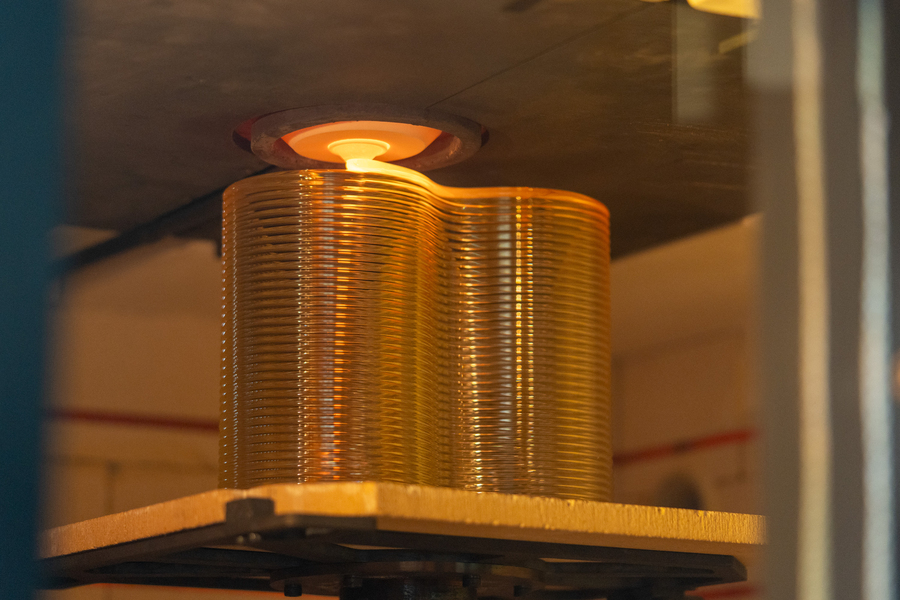
Molten glass being 3D printed into a figure eight design. Image used courtesy of the Massachusetts Institute of Technology
LEGO-Inspired Innovations
From the early days of machine tools and replaceable parts on muskets and wagons, the advantages of configurable, standardized parts have been well understood. LEGO turned it into a children's toy, which inspired many new designs as these children grew into engineers. From IKEA furniture to customizable spacecraft repair robots to glass building blocks, reconfigurable components will continue to be used in new ways.