Facebook
 Google
 GitHub
 Linkedin
Get a GRIP With Tape Measure Inspired Robotic Gripping
Researchers at the University of California San Diego have designed a robotic gripper inspired by measuring tape. This gripping method has potential for use in agricultural applications, like soft fruit picking, and beyond.
Automation means taking a repetitive human action and replacing it with a mechanical action. This process involves replacing both the hardware, such as human fingers and hands with robotic grippers, and the software, such as human brain power and feedback mechanisms with algorithms.
While inspired by human components, sometimes it is worth taking a step back and thinking about each task differently. Unscrewing a bottle cap can be performed with human hands, but that isn’t the only way to perform this task.
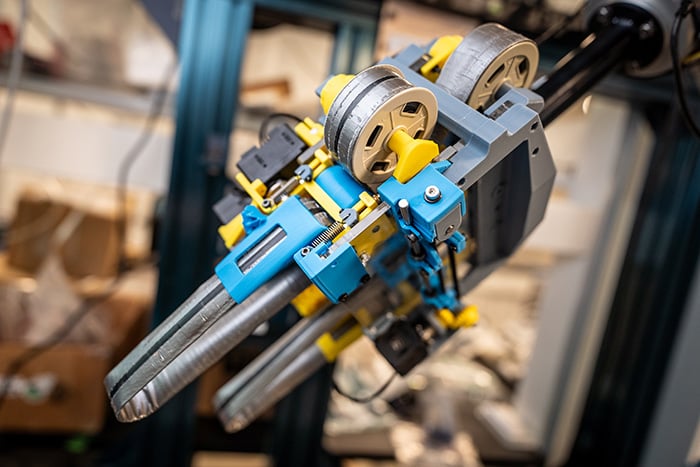
The GRIP-tape robot gripper works by using two measuring tape-like “fingers” that extend, retract, and rotate. Image used courtesy of the University of California at San Diego
It’s cliche to use the phrase “thinking outside the box,” but that is exactly what researchers at the University of California (UC) San Diego did. They created a novel gripper that is not shaped like a human hand at all and barely takes inspiration from one. Instead, it uses two sets of steel tape, like those found in a tape measure, to expand or retract and perform gripping options. The two tapes pinch the object, and their expanding or retracting motion moves the object.
Grasping and Rolling In-Plane (GRIP)-Tape
The idea for the GRIP-tape robot gripper was born from playing with steel measuring tape. After a certain length, they bend on themselves, but up to that length, they are stiff and sturdy. Place two of them side by side, increase the friction on the tape surface, and now these tapes can be used to grip objects.
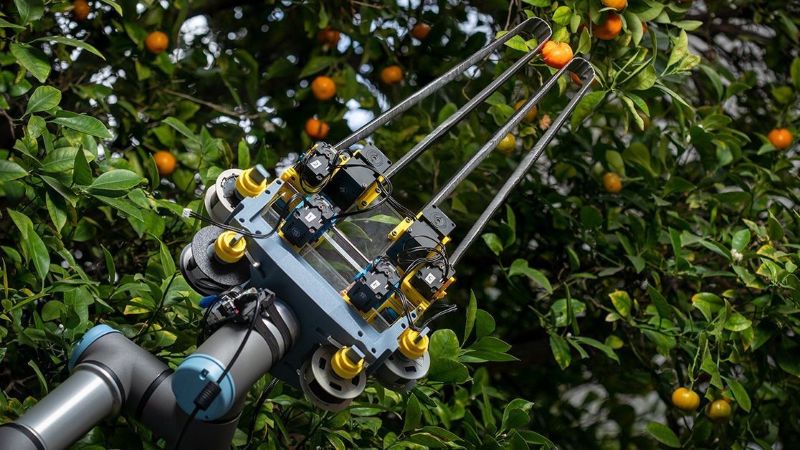
GRIP-tape can pick soft fruits and vegetables, thanks to its soft yet stiff measuring-tape design. Image used courtesy of the University of California at San Diego
Two reels of steel tape are bent, forming a U-shape. Each reel is controlled by an independent electric motor, causing the tape to rotate around the bend in a clockwise or counterclockwise direction, depending on the motor’s direction. Objects can be pulled into the grip by running the left one counterclockwise and the right one clockwise or ejected from the grip by reversing each motor. If both motors are running in a clockwise direction, the net result will be a tightening screw motion, and a loosening screw motion is achieved by running them in a counterclockwise direction.
Another added feature is that both tapes can be expanded or retracted entirely, meaning the gripper can be stored with a compact form factor. The robot’s reach is only limited by the stiffness of the tape.
GRIP-tape can automate everyday tasks like changing a lightbulb and using a screwdriver. Video used courtesy of the University of California at San Diego
A Robot Gripping Solution
So far, GRIP-tape is in the initial testing phases in the laboratory. A video hosted at UC San Diego shows the robot opening spice bottles, turning screwdrivers, and picking fruit, though many other similar tasks are possible.
Novel approaches in robotics can benefit from out-of-the-box thinking. Human hands work great for various tasks, but if every gripper needed to look like a hand, without consideration for the task itself, the design choices are limited. The GRIP-tape robot gripper is proof of this; it uses simple motion to perform tasks that are much more complicated using a hand-shaped gripper.