Facebook
 Google
 GitHub
 Linkedin
Cutting the Spin: Fluke Streamlines Alignment Work
Fluke’s RotAlign Core and Elite improve shaft alignment with faster setup, real-time feedback, and reduced measurement errors.
Fluke Corporation is refining shaft alignment with its RotAlign Core and RotAlign Elite systems, designed to deliver faster, more reliable measurements in challenging field conditions. Using a single-laser, dual-detector approach, the systems reduce setup complexity while improving data accuracy and stability. With real-time adjustment feedback, built-in validation tools, and features that minimize rework, the RotAlign platform supports predictive maintenance strategies and helps technicians complete alignment tasks with greater confidence and efficiency.
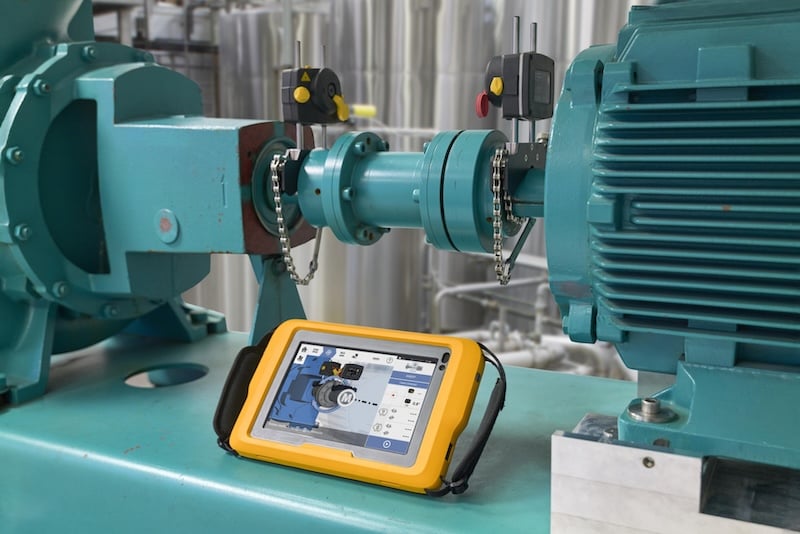
Laser shaft alignment performed on a motor-driven coupling. Image used courtesy of Fluke
What Changes With RotAlign Core and Elite
Fluke’s RotAlign Core and RotAlign Elite are built around a simplified approach to shaft alignment. Both systems use a single-laser, dual-detector architecture, removing the need to align multiple lasers or perform manual pre-alignment steps before measurement. At a basic level, this reduces setup time. More importantly, it removes a layer of variability that often introduces error early in the process.
Measurements are captured across two planes simultaneously, allowing technicians to see alignment corrections in real time as adjustments are made. Instead of correcting one axis and then verifying the other, both are visible at once. That alone reduces the number of correction cycles required to complete a job. The systems are designed around a straightforward goal. Get reliable measurements the first time, and avoid having to repeat them.
Eliminating Rework at the Source
Most alignment inefficiencies come from bad measurements, not super difficult adjustments. RotAlign addresses this directly through a combination of measurement stability and software validation. Features such as the Freeze Frame measurement allow the systems to capture stable data even under less-than-ideal conditions, including vibration or limited rotation. Real-time feedback through Simultaneous Live Move gives technicians immediate visibility into how adjustments affect alignment across both horizontal and vertical planes. This removes much of the guesswork that typically leads to overcorrection or repeated measurements. The result is not just faster alignment.
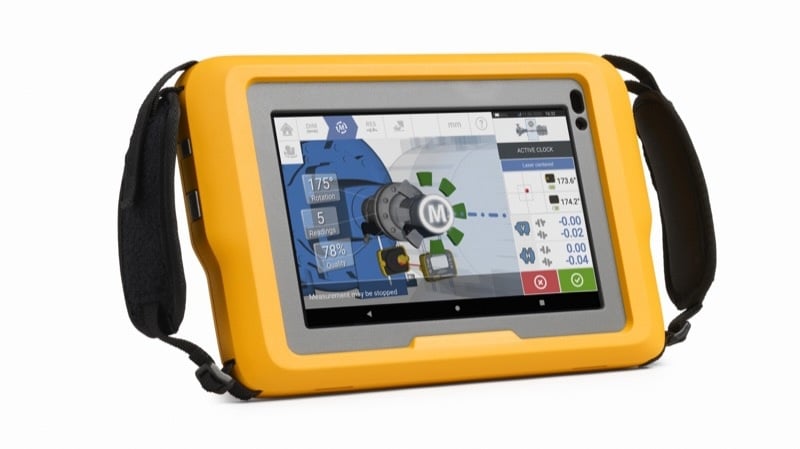
A Fluke RotAlign device used for laser-based shaft alignment in industrial maintenance applications. Image used courtesy of Fluke
RotAlign Core Handles Standard Alignment Workflows
RotAlign Core is positioned as an enhanced solution for standard rotating equipment such as motors, pumps, and fans. Its strength is simplicity. A single-laser, sensor setup reduces the number of steps required to begin alignment.
You’ve got a couple of measurement options depending on how much rotation you can get. Continuous Sweep works when you have room to move, while 8 Point Active Clock covers you when you don’t. Either way, you’re not sacrificing accuracy just because the setup isn’t ideal. Soft Foot detection and out-of-range alerts address many of the issues that are often missed early on. They show up before they turn into bad measurements, which is where most of the wasted time comes from.
RotAlign Elite Takes On Expanding Capability for Complex Systems
RotAlign Elite steps in when the alignment job becomes more complex. Longer shaft spans, spacer couplings, and multi-coupled machines tend to complicate things quickly, especially when rotation or access is limited. The adjustable laser and extended detector range give you enough flexibility to handle those setups without losing precision.
There is more happening behind the scenes than what shows up on the screen. Quality Factor and Standard Deviation are not just reference values. They help confirm whether the measurement is actually stable before you move forward. That is where a lot of alignment work starts to break down. It is usually not the adjustment that causes issues, but trusting data that was not fully settled to begin with.
Core is built to be easy to work with. Elite is built for control. It’s meant for jobs where alignment isn’t just routine work, where a small miss actually shows up later in performance or wear. It’s built for situations where alignment isn’t just routine, where precision directly affects performance and long-term reliability.
Video Replay and Data Validation
One of the more distinctive features in RotAlign Elite is measurement video replay. During alignment, small disturbances, such as sensor contact or vibration, can introduce bad data points without being obvious at the time. In most cases, the only way to catch that is to rerun the entire measurement.
Video Replay changes that. The system records how the measurement behaves throughout the full rotation, so technicians can go back and review what happened to spot outliers after the fact. Instead of starting over, those points can be removed directly using Edit Points. It is a small shift in approach, but it addresses a persistent problem. Not all bad data is obvious during collection.
Taken together, the RotAlign Core and Elite systems focus on one thing: making shaft alignment more reliable in real-world conditions. By simplifying setup with a single-laser design, validating measurements before adjustments are made, and providing real-time feedback during correction, they reduce the need for repeated work while improving confidence in the results. Whether used for routine alignment on standard equipment or more complex multi-coupled systems, the platform supports faster workflows, more consistent accuracy, and better long-term equipment performance.