Facebook
 Google
 GitHub
 Linkedin
Latest Software Updates Aim To Improve Industrial Workflows
Beijer Electronics, Visual Components, and Fluke Corporation have released enhanced HMI software, faster factory simulation tools, and accelerated AI-powered maintenance work.
Beijer Electronics, Visual Components, and Fluke Corporation have released new software updates that follow the trend of making industrial systems more connected, intelligent, and scalable. These updates help with HMI development, factory simulation, and maintenance workflows, aiming to reduce engineering workload and improve visibility, security, and data-driven decision making in real industrial settings.
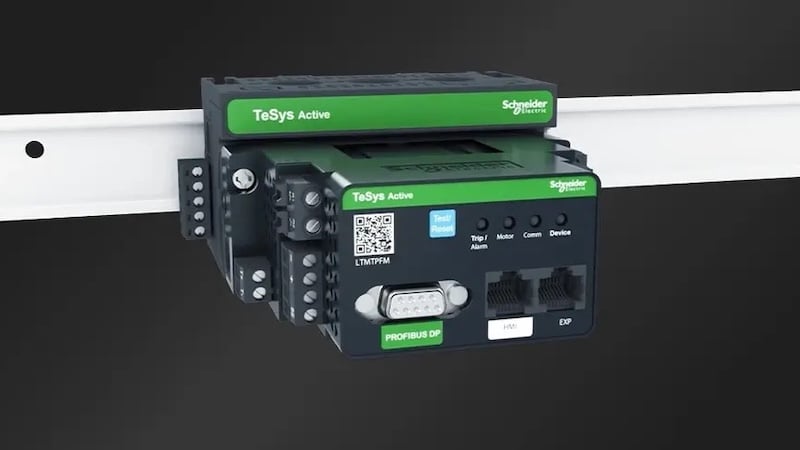
Beijer’s new iX 3.3 HMI interface features structured data and enhanced security for industrial control. Image used courtesy of Beijer Electronics
iX3.3 HMI Software
Beijer’s iX 3.3 HMI software offers a more organized and secure way to develop HMIs, making it easier to manage data. A key update is structured tag management, which lets engineers import OPC UA and Siemens tags in a clear hierarchy. This update makes it easier to navigate and maintain systems with many variables, saving time and making development and troubleshooting clearer.
Another key update is enhanced security, with role permissions, user groups, and stronger authentication. This approach embeds cybersecurity directly into control system design, rather than adding it later.
Additionally, SVG support allows HMI graphics to scale smoothly across different screen sizes without losing quality, which is especially useful in settings with many devices. Improved file transfer also lets engineers retrieve reports, logs, and application data directly from the HMI panel via the command line, making remote maintenance easier.
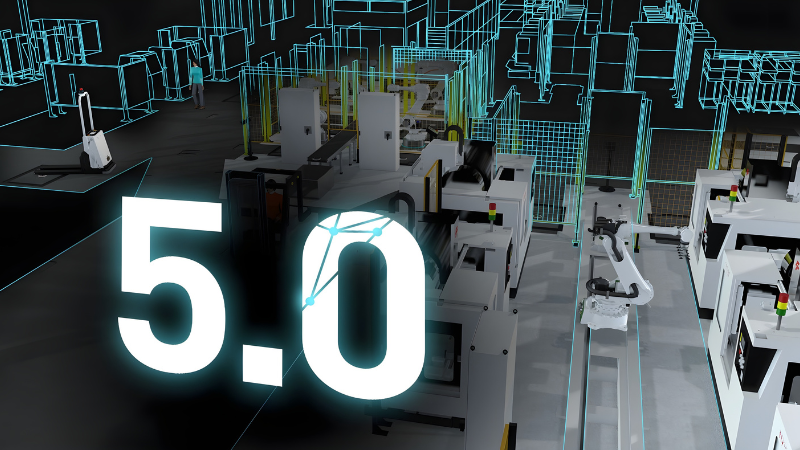
Visual Components’ 3D simulation and digital twin environment is designed to enable faster factory design planning. Image used courtesy of Visual Components
Visual Components 5.0
Visual Components 5.0 moves beyond interface design to support full production planning with a digital twin environment. The improved offline robot programming and 3D simulation make simulations faster and improve collision detection, helping engineers check layouts and workflows more quickly. The platform now connects with more robot brands and PLC systems, making it even more useful for virtual commissioning, where digital models match real operations.
A key new feature is the Python 3 API, which enables greater customization and easier integration with existing engineering processes. With MQTT support, the platform can now share real-time data with equipment like AGVs and AMRs.
Offline robot programming has also improved. Engineers can now create robot paths directly from CAD models, simulate them in a stable environment, and use them with different robot brands. This feature lets programming happen earlier in the design process, reducing the need for physical hardware and speeding up commissioning.
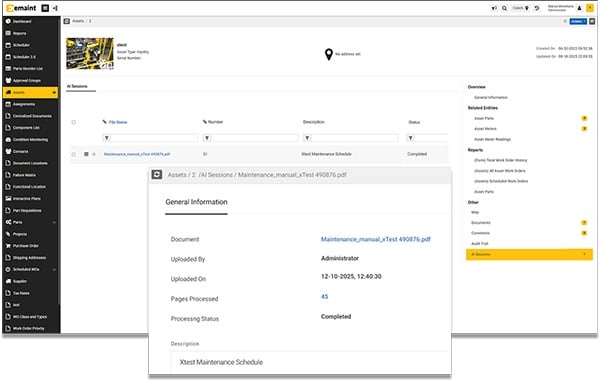
Fluke has added AI features to its eMaint platform, transforming complex data to enable smarter, faster decision-making. Image used courtesy of Fluke Corporation
AI-Powered Maintenance With eMaint
Fluke has added AI to daily maintenance tasks with its eMaint CMMS/EAM platform. Now, technicians can use natural language queries to get instant, summarized insights from work orders, assets, and history, instead of searching manually.
The platform lets users create work orders by speaking, making it faster to report and document urgent issues. It also automatically creates standard operating procedures from manuals and technical documents, which helps in places with skill shortages where consistency and knowledge sharing are important.
With the addition of AI, the eMaint platform now turns complex OEM instructions into simple, on-demand guides, helping less experienced staff do their tasks confidently and accurately.
A Shift Towards Intelligent, Integrated Systems
Industrial automated systems are evolving from standalone units to connected platforms that combine visualization, simulation, and intelligent features. These new updates give system engineers and integrators the chance to design systems that are not only functional but also scalable, secure, and easier to maintain over time.
Related Content