Facebook
 Google
 GitHub
 Linkedin
AI Agents Bring Unified Context to Manufacturing Operations
Augury’s new Industrial AI agents combine machine health, production, and operational data to deliver insights that improve manufacturing performance.
An industrial AI solutions expert, Augury, announced the latest addition to the Industrial AI Workforce: role-based AI agents. These assistive agents are designed to deliver actionable insights to manufacturers via a core Industrial Context Graph built by integrating AVEVA CONNECT, Google’s Gemini models, and Augury’s Machine Health data. The synergy of these technologies is intended to provide a solid foundation for data-backed AI support and human-approved decisions to optimize and evolve production operations.
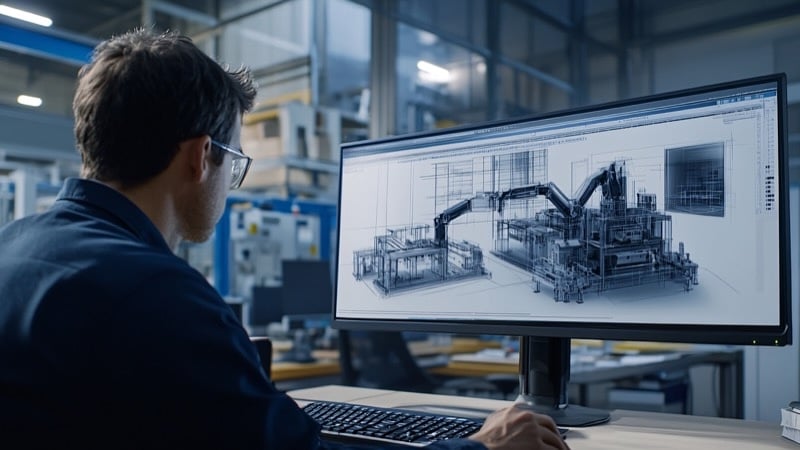
The AI agents are designed to provide assistance and eliminate what has aptly been termed “swivel chair” operations, bringing together diffuse industrial resources and data to hone diagnostics, insight generation, and decision-making. Image used courtesy of Pixabay
Augury’s Industrial AI Workforce Structure
Augury’s Industrial AI Workforce integrates five foundational pillars: continuous learning, operational intelligence, machine health, autonomous action, and the all-important AI agents. The Industrial AI Workforce is primed for continuous learning through experiential learning or pre-training via a large industrial database, which means that the AI has experience and knowledge of “known failures” and what machines should sound like. The system learns and adapts continuously as production components and processes change. This dynamism drives optimal production, allowing production systems to evolve and level up to keep abreast of healthy competition.
In terms of machine health, dedicated sensor technologies such as the Halo R4000 & Ranger Pro might serve as the “eyes and ears” of the Industrial AI Workforce system, sensing changes in temperature and vibration (for example) and feeding this information through enterprise-grade, security-oriented gateways. The Cordant Edge Gateway usually connects to the Augury Cloud through an encrypted LTE/5G cellular link.
Director of Production at ICL Iberia, Avi Boublil, shares his experience of working alongside Augury's Industrial AI Workforce agents. Video used courtesy of Augury
Instead of hitching a ride via the factory’s internal Wi-Fi, the cellular link helps separate machine data, essentially "air-gapping" it from the facility’s sensitive internal systems. Taken together, the sensor technologies that monitor asset health through distinct measures serve as a 24/7 digital workforce.
The Industrial AI Workforce includes a Reliability Agent that oversees major operational risks, mitigates and prevents issues and failures, and independently carries out approved decisions. A Maintenance Agent tracks conditions, creates alerts or flags problems, and autonomously schedules maintenance. Similarly, an Operations Agent identifies issues and pinpoints them to a specific location so teams can act efficiently and resolve the problem. And last but not least, an Industrial Data Agent centralizes reports, system data, and collaborative projects for a holistic view of operations.
The Industrial AI Workforce integrates through AVEVA CONNECT, a centralized, vendor-neutral industrial cloud service that combines data from various engineering, operations, and maintenance software into one unified environment. It is based on Augury's Machine Health solution and is driven by Google Cloud. This architecture integrates real-time machine health information into the workflows of everyday operations, maintenance, and reliability teams by bridging the gap between initial machine diagnostics and more comprehensive production data.
Augury will showcase the Industrial AI Workforce at AVEVA World in Milan, demonstrating how businesses can transition from resource-diffuse, reactive operations to AI-powered, autonomous manufacturing.