Facebook
 Google
 GitHub
 Linkedin
Association for Advancing Automation Updates GigE Vision Standards
GigE Vision 3.0 features remote direct memory access (RDMA) over converged Ethernet version 2 (RoCEv2), enabling zero-copy image transfers that reduce CPU load and boost machine vision system speeds
The Association for Advancing Automation (A3) recently announced that the latest GigE Vision standard has been approved. Version 3.0 contains several fundamental changes from the previous version (2.2), including the addition of remote direct memory access (RDMA) over converged Ethernet version 2 (RoCEv2), integrated RDMA access, and a new streaming protocol. All of these changes are designed to increase data transfer speed and enhance integration across multiple devices.
Approval and Announcement
During the International Vision Standards Meeting (IVSM), held in April, the new standard was introduced to the GigE Vision Technical Committee. The IVSM was hosted as a joint effort between the European Machine Vision Association (EMVA) and the company imavix. During the session, 57 engineers voted on the standard, and it was approved unanimously.
The GigE Vision Technical Committee unanimously approved the 3.0 standard during the International Vision Standards Meeting. Image used courtesy of the Association for Advancing Automation
GigE Vision 3.0
The newest updates to the GigE Vision Standard focus on speed and optimization of task assignment. First, an integrated RDMA system is made possible through the inclusion of RoCEv2, which helps remove the computational load from the operating system. Instead, the devices can write to the memory directly. This frees up the processor to work on other tasks while image data is being collected for future processing.
The importance of this goes beyond simple processor usage. Consider a system where an image is taken and passed through the processor, then stored in memory. When the image is analyzed, it must be called again. At some point, this is a lot of copies of the same image, which can drastically reduce the performance of the whole system. This problem is only compounded as faster, higher-resolution cameras enter the market. RoCEv2 reduces the number of image copies required, making this a much simpler and cleaner way to transfer and analyze data.
Besides this, there was also a new RDMA streaming protocol added to standardize data transfer and improve interoperability between devices. The new standard, the GigE Vision RDMA Streaming Protocol (GVRSP), is designed to manage streaming for 25GigE and beyond, and will require a network interface card (NIC) that supports RoCEv2. Also, the transfer of more data per packet is part of this new standard.
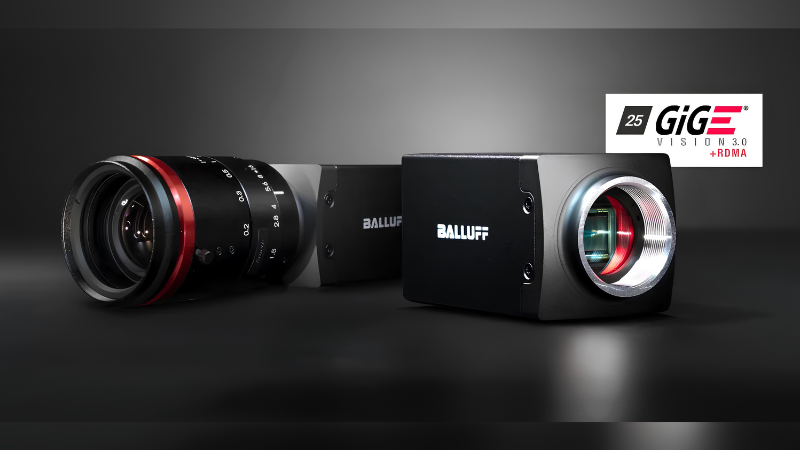
Leading automation companies, including Balluff, are adopting the GigE Vision 3.0 standard to deliver higher throughput and enhanced performance in their latest industrial cameras. Image used courtesy of Balluff
The Future With GigE Vision
Standards that improve high-speed image acquisition will improve virtually any machine vision application that adheres to them. Inspection tasks during quality control will be heavily impacted by the new standards, allowing for increased throughput and decreased quality excursions. Another major impact will be realized where machine vision blends with AI. As AI capability grows by leaps and bounds, these standards will help imaging technology keep up so that it does not become the limiting factor in increased process speed.
To see the details, A3 has made the standards (including 3.0, 2.2, 1.2, and mechanical supplement 1.0) available for download upon completion of an interest form. Also, Version 3 devices will be displayed at Automate 2026, as leading vision companies (Balluff, Basler, Teledyne IIS, and many others) have been working towards this standard and contributed to its creation.