Facebook
 Google
 GitHub
 Linkedin
Siemens Introduces LOGO! 9 Next-Generation Logic Controllers
The LOGO! 9 logic controllers offer up to 800 function blocks, expanded I/O capacity, a color touchscreen display, and improved engineering tools for small-scale automation tasks.
Siemens unveiled the latest version of its compact logic controller designed for small automation tasks, including building systems, small machine control, and apparatus engineering. The release marks the first major update to the LOGO! platform in 11 years. With LOGO! 9, Siemens has improved usability, computing power, and security, while keeping the simple operation the series is known for.
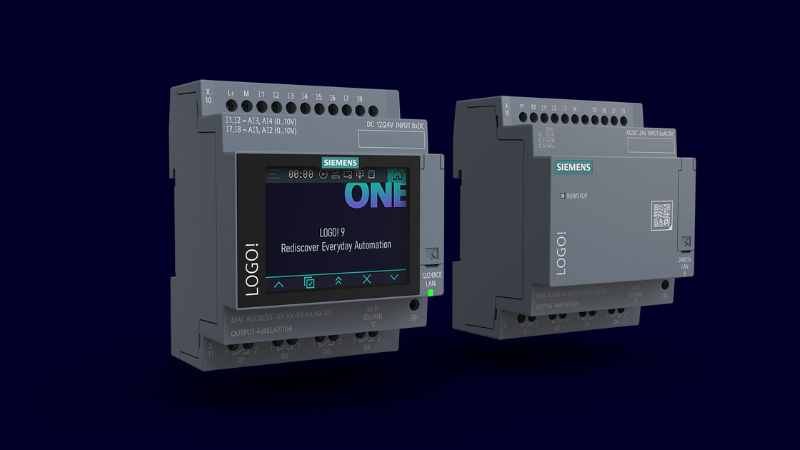
The new LOGO! 9 base PLC module now features a touchscreen display with color. Image used courtesy of Siemens
LOGO! 9 Next-Generation Logic Controller
A key improvement in LOGO! 9 is its higher logic processing capacity. The controller now supports up to 800 function blocks, double the capacity of earlier models. This lets users create more complex control logic in one device. The expanded I/O also boosts system capability, with up to 64 digital inputs, 60 digital outputs, 16 analog inputs, and 16 analog outputs. With these upgrades, many tasks that once needed several controllers can now be managed by a single LOGO! system, making the setup simpler and reducing hardware complexity.
Improved Analog Processing and Calculation Functions
LOGO! 9 also offers better precision for complex measurement and control tasks thanks to its new analog expansion module (AM4). This module lets users pick resolution settings that fit their needs. The controller also supports floating-point math and advanced calculations, which improves sensor data accuracy for uses like environmental monitoring, process control, and building management.
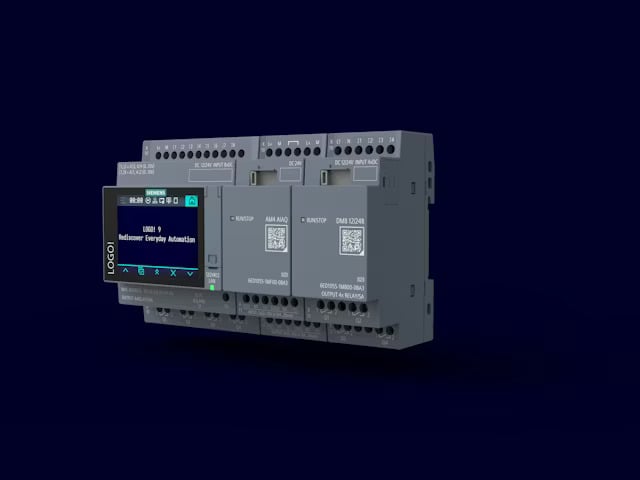
With LOGO! expansion modules, users can scale applications up to 64 digital inputs, 60 digital outputs, 16 analog inputs, and 16 analog outputs. Image used courtesy of Siemens
Touchscreen Operation and Improved Visualization
The new LOGO! 9 from Siemens has a built-in color touchscreen on the base unit with a 320 x 240-pixel display, making it easier to see system status and diagnostic information. For setups that need a larger screen, Siemens offers a 4.3-inch text display with a 480 x 272-pixel resolution and dual Ethernet ports. This allows secure, real-time communication with the LOGO! base controller, making it easier to monitor machine operations.
Cross-Platform Engineering With LOGO! Soft Comfort V9
The new controller is programmed with LOGO! Soft Comfort V9, which brings several improvements to engineering workflows. The software can now be installed easily using a USB stick and remains compatible with earlier LOGO! versions and existing projects.
Siemens has also made the software and the built-in LOGO! Web Editor work with Windows, macOS, and Linux. A new user management system (UMAC) with four roles lets administrators set different access rights for operators, engineers, and other users.
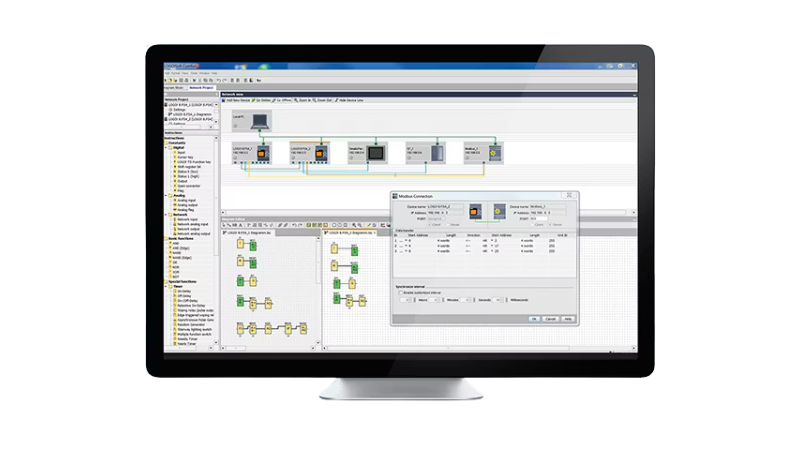
LOGO! Soft Comfort V9 enables plug-and-play programming via USB. Image used courtesy of Siemens
Built-In Security and Lifecycle Support
For security, LOGO! 9 includes Secure Boot and secure communication protocols to help prevent unauthorized access or tampering. For easier maintenance and lifecycle management, firmware can be updated through LOGO! Soft Comfort, and a factory reset option keeps the device’s IP address, making maintenance simpler and saving time on configuration.
The new controller is designed to support environmental and efficiency goals and carries the Siemens EcoTech label. As the need for advanced controller features like user interaction, data processing, and cybersecurity grows, the LOGO! controller family now includes features to meet these demands.
According to Annemarie Große Frie, Head of Automation System at Siemens Digital Industries, controllers that were once limited to basic logic functions must now handle more complex operations. The new LOGO! 9 addresses this shift by combining features usually found in large automation systems with the simplicity and cost structure of a compact logic module. The new controller will be available starting April 1, 2026.