Facebook
 Google
 GitHub
 Linkedin
Autonics TX Series Brings Speed and Precision to PID Control
High-speed sampling and ±0.3% accuracy make Autonics TX controllers ideal for demanding temperature control applications.
Autonics has introduced the TX Series PID temperature controllers, designed to deliver fast, accurate, and flexible temperature regulation across industrial applications. With a 50 ms sampling rate and ±0.3% display accuracy, the controllers respond quickly to system changes while maintaining precise control. Combined with multiple output modes, Modbus communication, and PC-based configuration tools, the TX Series simplifies temperature control without sacrificing performance or adaptability in demanding environments.
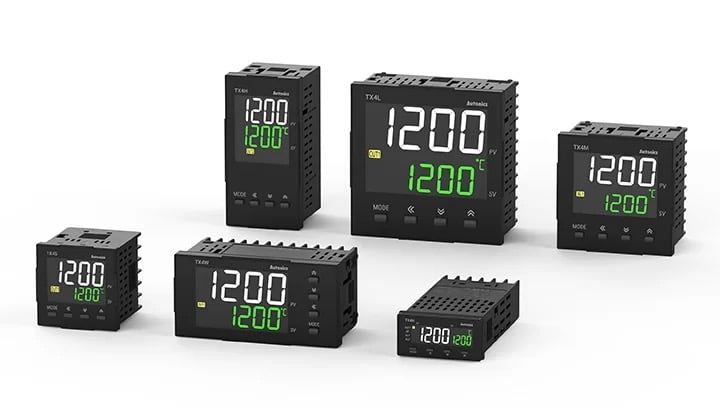
The TX Series PID Temperature Controller in various sizes. Image used courtesy of Autonics
The TX Series PID Temperature Controller
The TX series comes in various sizes to meet virtually any temperature control application, as well as multiple wiring types, including 11-pin plug, screw, and spring clamp. The output can be configured for current output or solid-state relay output. If using the SSR output option, the output can be configured for standard on/off control, cycle control, or phase control. These different types of control allow precise, accurate control of the output signal and the device.
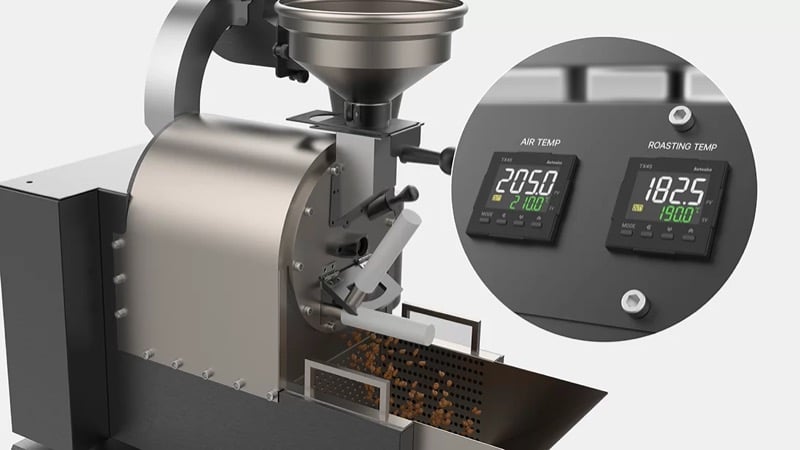
A TX series temperature controller used in a coffee roaster. Image used courtesy of Autonics
High-Speed Sampling
Some systems react very quickly to the heating or cooling device and therefore require a controller that can monitor the system temperature at a high rate. The TX series samples temperature inputs at 50 ms, allowing the controller to quickly determine whether the output should be on or off based on the PID gains and the setpoint value relative to the actual value.
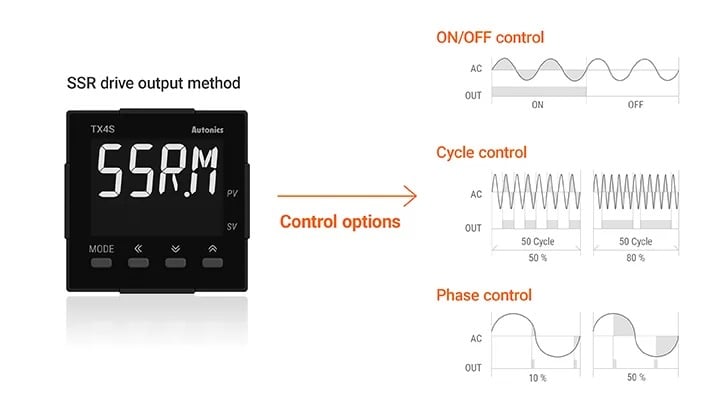
The different types of output control offered by the TX temperature controller. Image used courtesy of Autonics
Communication and Programming
The TX PID temperature controller uses RS485 (Modbus RTU) for communication, and parameter configuration can be completed using a PC via the same RS485 port.
Simple registers can be written to and read, such as run/stop, auto-tune, and alarm reset. The Modbus protocol also allows users to read the input and output states, read the scaled temperature value, change the setpoint value, and set PID gains.
The DAQ Master software, provided by Autonics, offers advanced features such as multi-device support, data analysis, data logging, and parameter management. The pro version of the software allows users to configure Modbus and other industrial protocol settings, a real-time log file, an MQTT publisher/Subscriber, and an OPC UA server. Both the general and pro versions of the DAQ Master software offer a graphical GUI for users to monitor real-time data as well as set parameters without having to interact with the device.
Temperature Control Made Easy
Developing your own PID temperature controller is possible with most modern PLCs, but it does require some understanding of how a PID loop works and will require some troubleshooting. The TX series from Autonics removes the complexity of developing your own temperature controller while still providing enough features to control virtually any temperature system.
In the end, it is sometimes better to use off-the-shelf devices that are designed for specific tasks than to develop a similar system.