Facebook
 Google
 GitHub
 Linkedin
Intrinsic and Google Partner to Advance Physical AI Robotics
Google and Intrinsic are combining AI and robotics expertise to accelerate development of physical AI systems for industrial automation.
Intrinsic has officially joined Google, merging physical AI with Google’s extensive software tools. Founded in 2021 as part of Alphabet’s (Google’s parent company) “Other Bets” projects, Intrinsic has developed AI systems geared toward advancing robotics and automation. Other Bets is an incubator for cutting-edge projects and features companies such as Waymo, Verily, Intrinsic, and many others. With exponential growth in AI, Intrinsic was founded ahead of this curve, amassing expertise in using AI to manipulate and control the physical world.
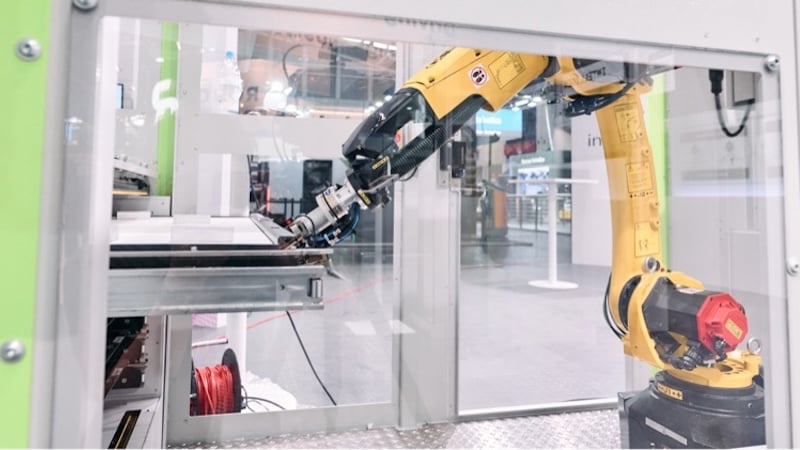
Intrinsic will enhance robotic performance, from optimization of motion to predictive maintenance. Image used courtesy of Intrinsic
Partnership Details
Intrinsic will work with Google, allowing it access to its extensive software and computing capabilities, while remaining its own entity. This means Intrinsic’s platform has enabled developers to create, deploy, and operate AI-enhanced automation systems quickly, thanks in part to its interoperability across manufacturers and platforms.
One such tool is Flowstate, a web-based developer environment that allows users to create AI-enhanced applications using common building blocks that auto-generate code, rather than having to write every line of code by hand. These building blocks contain key parameters for interfacing with different hardware systems, from common roots to machine-vision cameras to sensor arrays. This way, developers can focus on what needs to be done to solve the problem rather than ironing out the integration details.
Even before the partnership with Google, Flowstate and other Intrinsic tools have been used to program robot motion to avoid collisions, minimize unnecessary motions, and provide tight control for handling delicate objects. Past projects have involved developing robots to handle 1000 lb electric vehicle battery assemblies, testing solar panels, developing navigation for autonomous vehicles, and other similar challenges.
This new partnership will also allow tools like Flowstate to integrate with Google’s set of tools. Google Cloud, Gemini, DeepMind, and many others will now be available as new methods to enhance productivity and accelerate application development. With Intrinsic focusing on physical integration, and Google focusing on enhanced AI capabilities, this is a powerful partnership that will likely shape automation for many years to come.
Representatives from both companies expressed excitement about the partnership. Google states that it is looking forward to working in the automation space, including robotics and smart manufacturing centers. Intrinsic’s CEO notes that leveraging Google's AI infrastructure will significantly impact innovation in these fields as well.
The Future for Robotics
This partnership is an example of how hardware and software systems can be integrated with AI to impact real-world performance. Often, AI seems limited to software, making it a neat toy but appearing to have little impact on the physical world. Typically, this means using AI to run simulations or process data, and then having human operators manually operate the automation system to verify that the desired results are achieved. Intrinsic’s partnership with Google enables a more seamless transition between the software space and the hardware reality, which will drastically improve optimization and predictive maintenance models.