Facebook
 Google
 GitHub
 Linkedin
OTTO Expands VDA 5050 Support for Mixed Fleet Control
The company announced that its AMR lineup, including the OTTO 100, 600, 1200, and 1500, is now certified with several VDA 5050-compliant intralogistics software providers. Those include Idealworks, NAiSE, and SYNAOS.
OTTO by Rockwell Automation is expanding its support for the VDA 5050 standard to improve interoperability between autonomous mobile robots (AMRs) and automated guided vehicles (AGVs) in mixed fleet environments. By certifying its AMR lineup with multiple VDA 5050-compliant intralogistics platforms, OTTO enables centralized fleet control, reducing the need for custom integrations and simplifying system communication. The approach helps manufacturers coordinate traffic, optimize throughput, and scale automation more easily, while still allowing flexibility through additional orchestration software and middleware when standardization alone is not enough.
The company announced that its AMR lineup, including the OTTO 100, 600, 1200, and 1500, is now certified with several VDA 5050-compliant intralogistics software providers. Those include Idealworks, NAiSE, and SYNAOS.
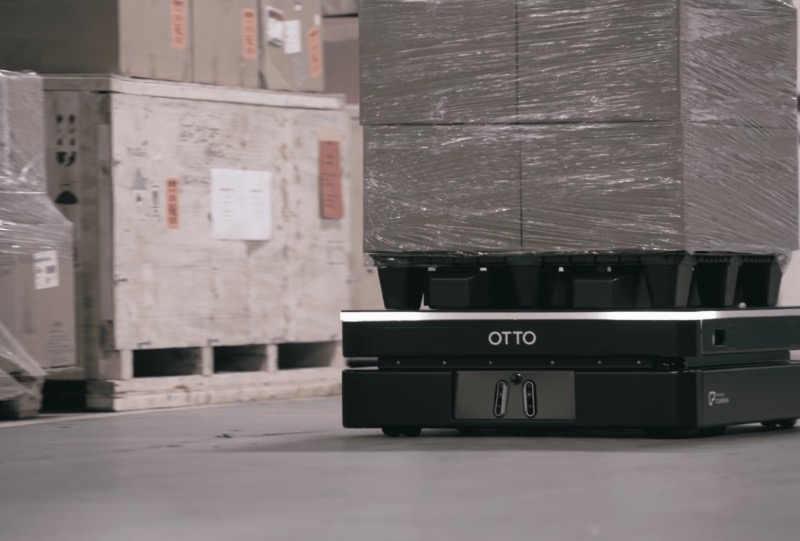
Autonomous mobile robots like OTTO are increasingly deployed alongside traditional AGVs, creating the need for coordinated mixed-fleet operation. Image used courtesy of OTTO
Why VDA 5050 Matters
VDA 5050 is an open communication standard designed to enable different types of autonomous vehicles to operate within a shared control system. Manufacturers can manage traffic, job assignments, and system status from a single platform, rather than running separate software for each fleet. Integration quickly becomes complicated without that kind of standardization. When each vendor uses its own communication approach, companies have to rely on custom interfaces or middleware just to get systems talking to each other.
VDA 5050 is meant to reduce that friction. It gives different systems a way to communicate without custom work every time something new is added. As more vehicles get deployed, that kind of consistency starts to matter more. OTTO was one of the early companies backing the standard. It added support for VDA 5050 in 2023 and made its connector open source, helping more systems work together.
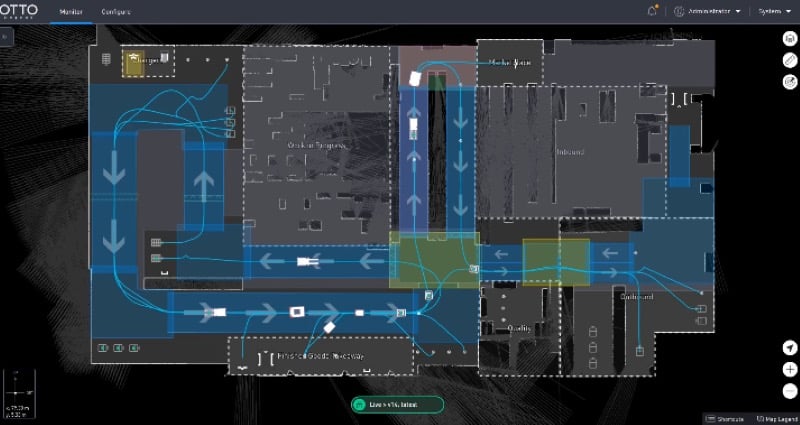
VDA 5050 enables centralized fleet control, allowing different autonomous systems to share routes, coordinate tasks, and operate under a unified management platform. Image used courtesy of OTTO
Mixed Fleets Are Becoming the Norm
The need for interoperability is tied to the evolution of automation. Many facilities no longer rely on a single type of vehicle. They use a mix of AMRs and AGVs instead, depending on the task.
AGVs usually stick to fixed routes. AMRs are used when things need to move more freely. Running both together can help, but only if they’re actually connected. Without that, it gets messy fast. That’s why centralized control starts to matter. When everything runs through the same system, it’s easier to keep traffic moving, avoid backups, and make changes on the fly.
When AMRs and AGVs operate together in a shared transport system, throughput can increase by up to 51 percent compared to AGV-only setups.
Where Standardization Works Best
The VDA 5050 approach works best in structured environments. Facilities with predictable routes, repeatable workflows, and shared traffic zones benefit the most from centralized control. In those settings, coordination can improve floor space usage, reduce idle time, and make operations more consistent. But not every facility fits that model. Some operations are more dynamic. Layouts change. Workflows shift. In those cases, rigid standardization may not be enough on its own.
Flexibility Still Matters
OTTO isn’t sticking to just one method. It supports VDA 5050 and also works with Rockwell’s orchestration software and other middleware. That leaves manufacturers with more options. They can stick with a standard setup when it works. If not, they can build something more custom around it. The shift reflects a broader trend in industrial automation. Companies are moving toward systems that are easier to scale and adapt, rather than locking into a single architecture.
A Step Toward Less Fragmented Automation
The push for interoperability isn’t new, but expectations are changing. Manufacturers want systems that work together without heavy customization. They also want the ability to expand automation without rebuilding everything from scratch.
VDA 5050 doesn’t solve every problem, but it addresses one of the biggest ones. Communication between systems. By expanding its certified integrations, OTTO is leaning into that shift. The result is a setup that gives manufacturers more control over how different types of autonomous vehicles operate together on the same floor.
Related Content