Facebook
 Google
 GitHub
 Linkedin
Autonics Expands Solid-State Relay Line for Flexible Control
New SSRs from Autonics support zero-cross and random turn-on switching, helping engineers optimize performance across industrial applications.
Autonics has expanded its solid-state relay portfolio with new single-phase and three-phase models designed to improve installation flexibility, thermal management, and control performance. The lineup includes options with integrated heatsinks, overheat protection, and both zero-cross and random turn-on switching methods to support a wide range of industrial applications. From heating systems and packaging equipment to motors and manufacturing processes, the new relays offer engineers more options for building reliable, efficient automation systems.
Autonics has released new solid-state relays in its lineup, including a range of updated single-phase and three-phase models. The additions include the SR1, SRC1, SRH1, SRHL1, and SRS1 single-phase series, along with the SR3, SRH3, and SRHL3 three-phase series. Although they share several features to improve reliability and simplify deployment in industrial environments, each family serves a slightly different role.
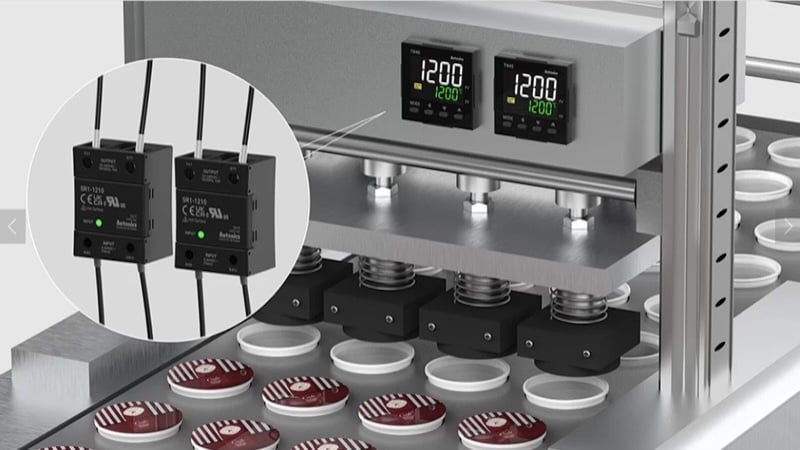
Autonic’s SR1 shown in a packaging application. Image used courtesy of Autonics
Supporting Different Load Conditions
A key feature across the lineup is the availability of both zero-cross turn-on and random turn-on models. Some applications need smooth switching rather than outright speed. That's where zero-cross turn-on is typically used. Switching at the zero-crossing point of the AC waveform helps avoid current spikes and electrical noise that can accompany abrupt switching. Heaters, lamps, and temperature-control systems are common examples.
Random turn-on is aimed at a different kind of job. The relay switches as soon as it receives a command without waiting for the waveform. That quicker response is often preferred in motor-driven equipment, inductive loads, and phase-control applications, where timing has a greater impact on performance. The lineup can accommodate a wider range of industrial equipment without forcing users into a single switching strategy by supporting both methods.
Single-Phase Options for Different Installations
The SR1 series serves as the general-purpose foundation of the single-phase family. It combines a detachable heatsink design with load current ratings ranging from 10 A to 75 A and supports both DC and AC control inputs, depending on the model.
For applications with limited space, the SRC1 series takes a different approach. Its slim 22.5 mm width allows installation in tighter control panels while maintaining support for both zero-cross and random turn-on operation.
The SRH1 series focuses on thermal performance and control flexibility. These models feature integrated heatsinks. Current-input versions also add phase control and cycle control capabilities, allowing more precise power regulation for heating systems and similar applications.
The SRHL1 series adds another layer of protection with built-in overheat prevention. When internal temperatures exceed specified limits, the relay can shut off output, activate alarm indicators, and generate alarm signals to help prevent damage.
Solid-state relays are used in temperature-control systems for packaging and sealing equipment, where stable switching and precise heat control are required. Image courtesy of Autonics
Three-Phase Models for Higher-Power Systems
The three-phase lineup follows a similar structure.
The SR3 series features a detachable heatsink and supports high-power loads, including industrial equipment, large motors, and high-capacity heating systems. Two mounting-hole configurations make installation more flexible across different heatsink designs. The SRH3 series integrates the heatsink directly into the relay assembly while maintaining detachable functionality for easier replacement.
At the top of the range, the SRHL3 series combines integrated thermal management with a two-stage overheat prevention system. Warning outputs activate at elevated temperatures, while higher temperature thresholds trigger protective shutdown functions and alarm outputs.
Built Around Reliability
Autonics emphasizes thermal management, installation flexibility, and operational reliability across both single-phase and three-phase families. Most models provide dielectric strength ratings of 2,500 VAC and support load voltages up to 480 VAC. The broader update reflects a common challenge in industrial automation. Different machines require different mounting styles, power levels, and control methods. Autonics has expanded the lineup to give engineers more options while maintaining a familiar operating framework rather than forcing those needs into a single relay platform.