
 Facebook
 Google
 GitHub
 Linkedin
Achieving High-Performance, Safe, and Flexible Robot Control
Discover how real-time MCUs, motor control SoCs, and AI create precise, synchronized, and safe robotic motion across humanoid and industrial systems.
Modern Robotics
From the early idea of artificial workers to today’s intelligent, autonomous systems, robotics has transformed how machines interact with the world. In 1954, George Devol patented the first robotic arm with six degrees of freedom (Figure 1), which laid the foundation for Unimate, the first industrial robot widely adopted in automotive manufacturing. Developed during the vacuum tube era, nearly a decade before the advent of integrated circuits, this milestone underscored the close relationship between robotics and electronics.
.png "image_tooltip")
Figure 1: The first industrial robotic arm, Unimate, was patented in 1954 by George Devol. (Source: Spectrum)
Similarly, advances in mechanics, control theory, industrial automation, sensors, and artificial intelligence pushed robotics beyond basic automation. Norbert Wiener’s work in cybernetics provided the theoretical framework for feedback and control, while improvements in sensing and embedded processing enabled robots to perceive and adapt to their environments. Collectively, these developments accelerated adoption in post-war manufacturing during the 1970s and established the foundation for today’s autonomous platforms and consumer robotics.
Semiconductors form the foundation of modern robotic systems by delivering the computational and sensing capabilities required for intelligent operation. Microcontrollers and microprocessors fabricated on semiconductor substrates execute control algorithms, process real-time signals, and coordinate communication between subsystems. Sensors such as CMOS image sensors, MEMS accelerometers, gyroscopes, and force sensors depend on semiconductor structures to convert optical, mechanical, or inertial inputs into electrical signals. These signals are then conditioned, digitized, and interpreted by integrated circuits that enable environmental perception. Power semiconductors regulate and switch currents to drive actuators and motors with precision. Together, these devices integrate perception with execution, creating closed feedback loops that are fast, efficient, and scalable across industrial, consumer, and research applications.
Artificial intelligence and machine learning are increasingly applied in robotics to enhance vision, tactile sensing, and multi-joint coordination. Embedded deep learning models enable real-time image classification, object detection, and scene understanding, allowing robots to perceive and interact with complex environments. Machine learning applied to tactile sensor data provides detailed feedback on pressure, texture, and slip, enhancing manipulation and grasping performance. AI-driven control policies optimize coordination across multiple actuators, adapting to dynamic conditions and refining movement trajectories. Arm® Cortex® processors with Helium™ vector extensions accelerate these workloads by providing efficient processing for convolutional neural networks, sensor fusion, and control loops. This integration of AI/ML with advanced processor architectures allows robots to achieve higher levels of autonomy, precision, and responsiveness while maintaining the power efficiency required for embedded applications.
Framework Principles
When considering the core functionality of a robot, a useful model is a cyclic framework that links perception of the environment, decision-making based on those inputs, and execution of corresponding actions. Figure 2 illustrates how the steps of this cycle reflect the fundamental behavior of any robotic system.

Figure 2: The framework for all robotic operations.
For example, an object in the environment may present itself, yielding a target detection signal from an ultrasonic sensor. This information is processed, possibly using a neural network, and then a decision is made to stop and avoid a potential collision. The robot’s drive wheels are then stopped in accordance with this decision, preventing the collision. This entire trip around the framework loop happens hundreds of times per second in complex robots.
Different classes of robots emphasize different aspects of this sense-decide-execute cycle, which in turn drives the selection of components used in their design. Humanoid robots, for instance, place a heavy burden on perception through advanced vision and tactile sensors, as well as on control and execution, where high-performance MCUs, motion controllers, and actuators are required to coordinate complex movements. Industrial collaborative robots prioritize precision control and stringent safety, which leads to the use of redundant sensors, reliable real-time processors, and safety-rated electronics that ensure predictable and fail-safe operation alongside humans. In contrast, home robots tend to focus more on perception and decision-making, relying on cameras, microphones, and environmental sensors paired with embedded processors and neural network accelerators to interpret surroundings and choose contextually appropriate actions. By tailoring sensor suites, computing platforms, and control architectures to the dominant demands of each robotic domain, designers can optimize both performance and efficiency.
Humanoid Robot Solutions
Humanoid robots represent one of the most advanced areas of robotics, designed to replicate the motion and dexterity of the human body. They require a strong emphasis on motion control to achieve smooth, stable, and human-like movement. This begins with motor drives at each joint, which must deliver precise torque and speed control while working in harmony with absolute encoders that provide highly accurate joint position feedback. Because humanoid robots often demand high degrees of freedom (DOF), each joint needs to move independently while maintaining high precision, ensuring accurate positioning and fast response speeds across complex, coordinated movements.
Another key challenge lies in achieving high efficiency and high power density within the compact structure of a humanoid form. Drive and control systems must be integrated into the limited space available in each joint, requiring components that are lightweight yet capable of delivering high power output without sacrificing energy efficiency. At the same time, advanced perception systems are essential for interpreting the environment, enabling the robot to adjust its movements dynamically and interact safely and effectively with people and objects. Together, these elements form the foundation for truly capable and versatile humanoid robots.
To meet these objectives, high-performance microcontrollers for robot joints typically need to focus on the following key technical areas:
- System-Wide Low Power Consumption: Achieving ultra-low power control while maintaining high performance, making them suitable for compact spaces and battery-powered scenarios.
- High-Speed, High-Precision ADC and Hardware Filtering: Employing an analog-digital isolation design to minimize interference, achieving an Effective Number of Bits (ENOB) of over 10.5 for a 12-bit ADC at 3.45 MSPS. This is combined with hardware filtering units (like SDFM) to provide high-quality current feedback for advanced algorithms such as FOC.
- Encoder-Based Speed Compensation: Leveraging high-precision encoder feedback for real-time motor control compensation, enabling ultra-high-precision speed and position control .
- Fast Current Loop: Implementing a microsecond (µs)-level current loop, with some single chips achieving a 1 µs loop time. This delivers the rigidity and rapid dynamic response of the motor control, which typically involves a tightly coupled process of "sampling → filtering → calculation → update".
- Edge AI Capabilities: Integrating AI acceleration units to support small-scale neural network models for more intelligent sensing, prediction, and control.
- Comprehensive Development Ecosystem: Offering support for real-time operating systems (RTOS) like MicroROS and FreeRTOS, complemented by a complete development toolchain and software libraries.
Motion Control
The Geehy G32R series is an outstanding solution for humanoid robot control, as it combines advanced real-time processing, high-performance motor control, and flexible communication capabilities within a single device. Humanoid robots demand precise coordination of many degrees of freedom, and this requires a controller that not only executes algorithms with deterministic timing but also integrates seamlessly with a wide variety of sensors, encoders, and actuators. Geehy’s G32R series was specifically designed for real-time control applications. These microcontrollers strike the optimal balance between performance, peripheral integration, and timing accuracy, making them ideal for tasks that depend on deterministic response and tight control loops.
At the core of the G32R is its Arm® Cortex®-M52 dual-core architecture, operating at up to 250 MHz. This dual-core design allows one core to focus entirely on motor control algorithms while the other manages communications or perception-related tasks, ensuring strict isolation and preventing performance interference.
The G32R also provides comprehensive support for precision position sensing, a critical factor in humanoid robots that must perform smooth, coordinated movements with high degrees of freedom. It includes quadrature encoder pulse (QEP) modules for incremental encoders and flexible interfaces for absolute encoders, ensuring accurate real-time joint feedback. Its high-speed SPI/QSPI interface, capable of up to 240 Mbit/s with DMA support, enables continuous, low-latency data collection from advanced encoders, while its UART channels expand compatibility with asynchronous serial sensors. Together, these features guarantee that the G32R can deliver the high-accuracy position data required for reliable motion planning and execution.
Another major strength of the G32R lies in its communication flexibility. With dual CAN channels and the ability to integrate an EtherCAT slave controller externally through high-speed SPI/QSPI, it offers both cost-efficient and high-performance networking options. This makes it possible to assign EtherCAT to critical high-bandwidth joints such as legs or arms while reserving CAN for smaller actuators or diagnostic buses. The result is a flexible, scalable communication architecture well-suited to humanoid robots with varying control requirements across different subsystems.
Finally, the G32R integrates high-precision analog and digital peripherals to optimize motor control. Its triple high-speed ADCs allow synchronous current sampling at rates up to 3.45 MSPS, providing precise, delay-free current feedback for advanced FOC algorithms. Meanwhile, its 16-channel high-resolution PWM (HRPWM), with 150 ps resolution, ensures the generation of ultra-smooth control waveforms. This minimizes torque ripple and electromagnetic noise while maximizing energy efficiency, critical for achieving lifelike humanoid movements at both low and high speeds.
In summary, the Geehy G32R combines real-time deterministic control, powerful computational acceleration, flexible encoder interfaces, and advanced motor control peripherals to meet the requirements of humanoid robotics. Its architecture not only supports the complexity of multi-DOF systems but also ensures the precision, efficiency, and reliability needed to bring human-like robots to life. The general block diagram of this series, highlighting the wide range of available peripherals, as shown in Figure 3.
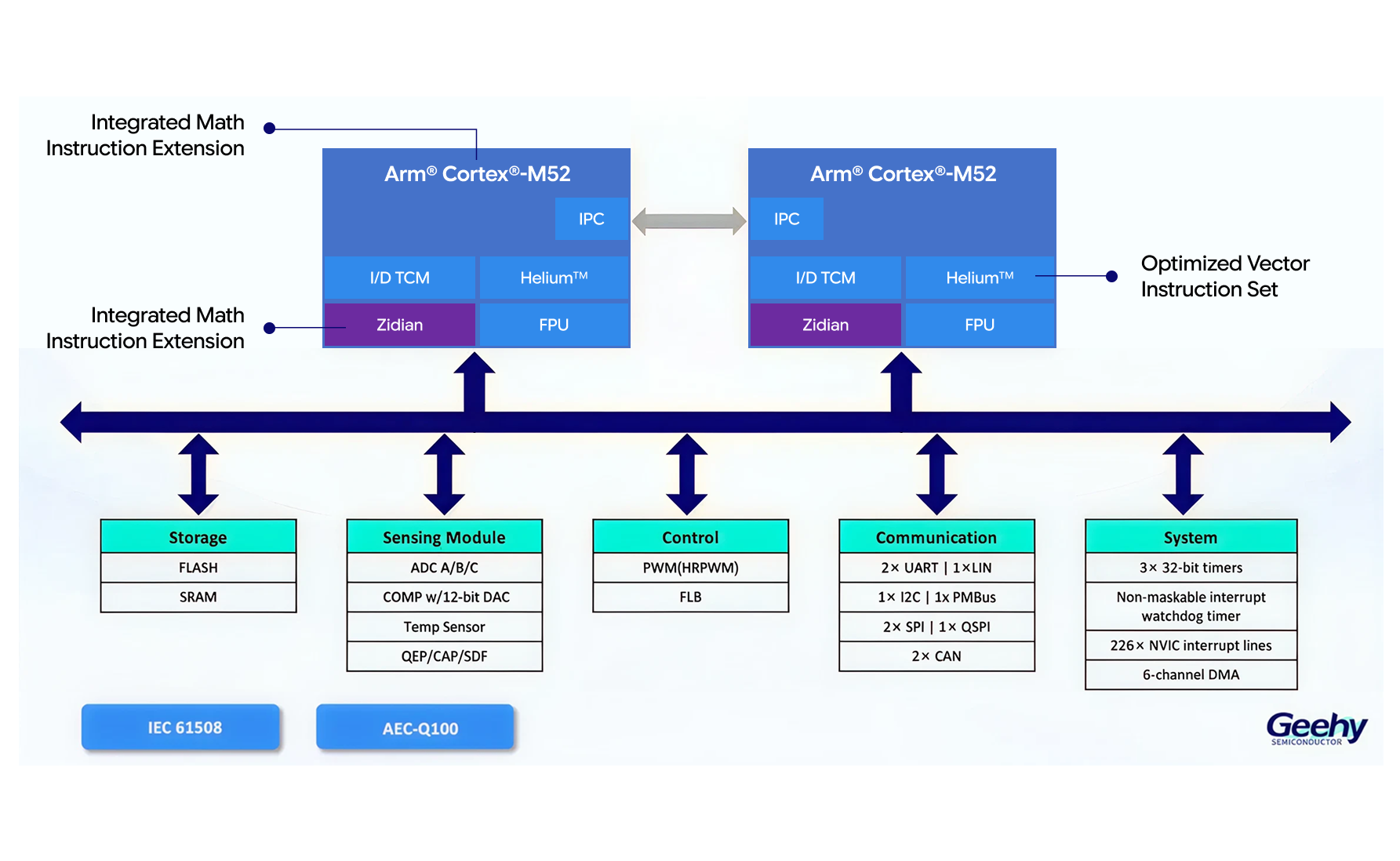
Figure 3: Geehy’s G32R series block diagram.
In addition to the G32R series, Geehy also offers a complementary high-performance MCU for humanoid robot systems: the APM32F427. This device is an industrial-grade MCU that advances performance across four key areas: computation, ADC, Flash controller, and communication interfaces. While the G32R serves as an excellent solution for deterministic real-time motor control, the APM32F427 extends capabilities, supporting humanoid robot subsystems that demand both cost efficiency and high computational capability, such as robotic arms, dexterous hands, and peripheral modules.
At its core, the APM32F427 features an Arm® Cortex®-M4F processor, running at up to 240 MHz, with support for 1MB of Flash and nearly 452KB of SRAM. Thanks to an upgraded Flash Access Controller (FACC), it achieves outstanding algorithm execution efficiency. Its CoreMark score is 777 with a non-zero wait Flash configuration and 796 with a zero-wait Flash, redefining what the Cortex-M4F can achieve in complex industrial scenarios. This level of computational efficiency allows the APM32F427 to handle advanced control algorithms, perception preprocessing, and sensor fusion tasks while maintaining real-time responsiveness.
For humanoid robots, precision sensing is equally important, and the APM32F427 integrates a high-precision ADC with a sampling rate of up to 4 Msps, along with a hardware oversampling feature that improves accuracy. This makes it well-suited for capturing detailed feedback from sensors used in force, torque, or tactile measurements, which are essential for dexterous manipulation and responsive interaction.
Regarding communication interfaces, the APM32F427 offers a rich set of options, including Ethernet, CAN, high-speed USART, SPI, QSPI, SDIO, and USB OTG, facilitating seamless integration into humanoid robot networks and peripheral systems. Figure 4 illustrates a conceptual robotic finger joint with sensors for temperature, proximity, and force. The APM32F427 easily accommodates these bus requirements while providing subsystem computation and integration with a larger CAN ecosystem.
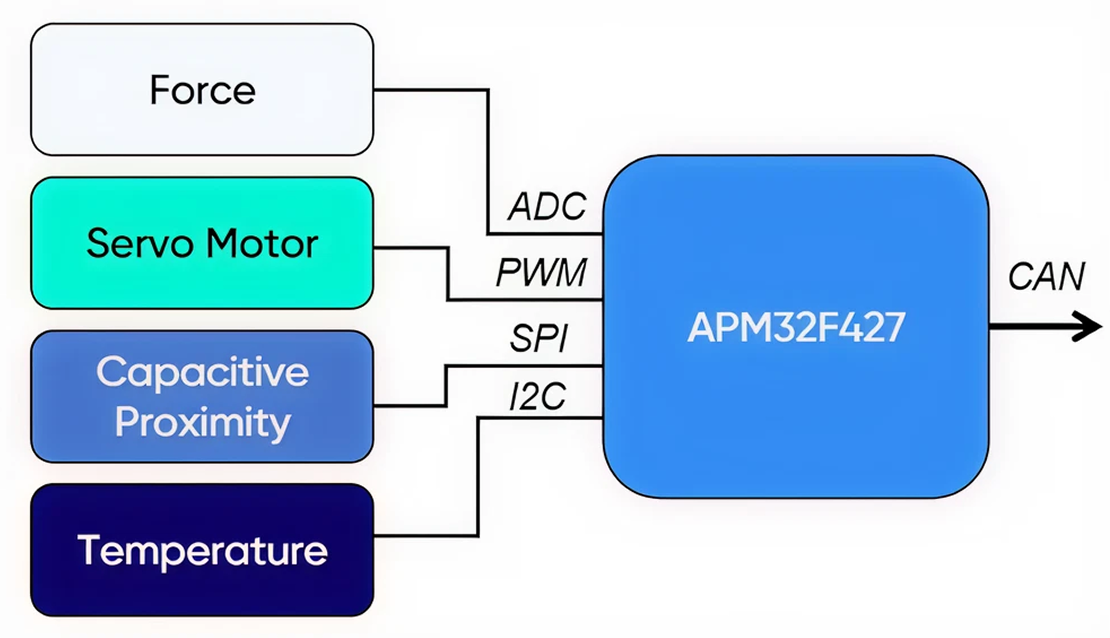
Figure 4: Representative block diagram of a robotic finger joint subsystem.
Its robust industrial-grade reliability, with a wide operating temperature range (-40°C to +105°C) and strong ESD/EMC immunity (HBM 4kV / CDM 1kV), ensures stable operation even in challenging environments.
Taken together, the APM32F427 complements the G32R series by offering a cost-effective, high-performance platform that excels in computation-heavy but cost-sensitive parts of a humanoid robot. While the G32R is well-suited for core motor control and real-time synchronization tasks, the APM32F427 provides an ideal balance for subsystems such as arms, hands, or peripheral sensing modules, ensuring that the overall robot architecture remains high-performing, reliable, and economically viable.
Joint Motor Drive
Designing motor drives for humanoid robot joints requires solving the conflict between space and integration. To understand the complexity of designing motor drives for robot joints, it is helpful to first review the industry's common classification of key design metrics (Table 1):
Table 1: Key Design Specifications for Joint Motors

Also, shown in Figure 5, each joint must house a compact PCBA that integrates power electronics, sensing, communication, and advanced control logic within extremely tight physical constraints. At the same time, the drive must deliver high-precision, high-dynamic real-time control, since the smoothness, accuracy, and speed of humanoid motion depend directly on control loop performance and computational power for algorithms like field-oriented control (FOC). Any compromise in timing or precision leads to unnatural or unstable movements.
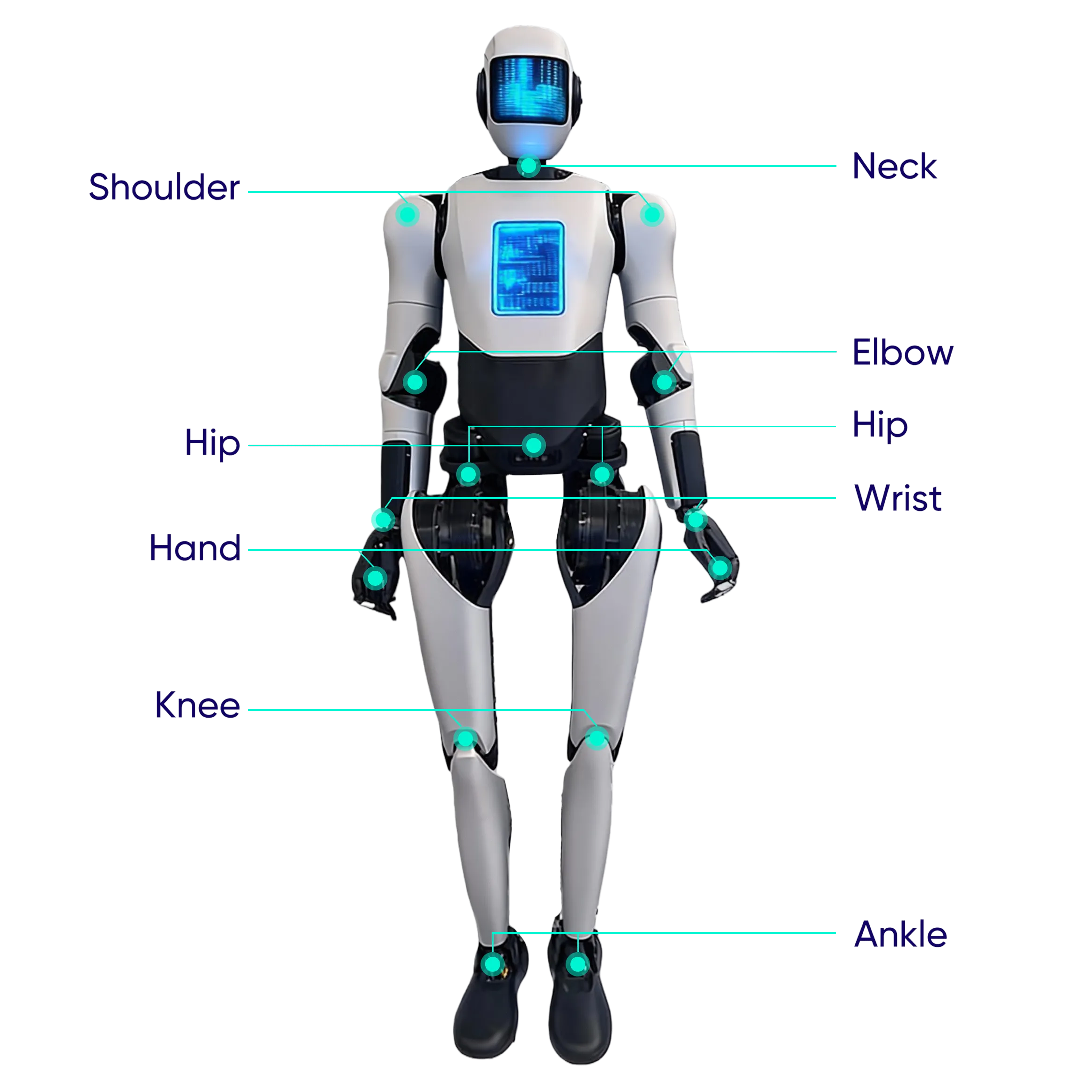
Figure 5: Humanoid robotic joints.
These drives also need real-time, reliable communication across dozens of joints, typically using EtherCAT for high-bandwidth synchronization. Ensuring microsecond-level coordination is critical for whole-body motion. Finally, all of this must be achieved under strict cost control, since humanoid robots require many identical joint actuators. The challenge is delivering maximum precision and communication reliability in minimal space, while keeping costs low enough to make large-scale deployment practical.
Figure 6 depicts Geehy’s APM32M3514 Motor Control SoC. It is purpose-built for compact, integrated joint designs in robots, enabling rotary and linear joints to be controlled within a very small form factor. Its high level of integration allows it to directly drive frameless torque motors while meeting the demanding requirements of bionic joints, including fast dynamic response, high energy efficiency, and compactness. At its core, the device uses a 32-bit Cortex-M0+ processor running at up to 72 MHz, paired with a single-cycle hardware multiplier to handle the complex computational needs of joint motor drives. A built-in M0CP hardware acceleration coprocessor further boosts efficiency by offloading FOC algorithms, reducing CPU workload, and enabling precise, low-power joint motor control.
The APM32M3514 also integrates multi-channel PWM support, a 200V 6N gate driver, and a 3.3V LDO regulator, creating a robust, compact, and highly efficient drive solution. Its flexibility extends across motor types, including BLDC, PMSM, and stepper motors, and encoder types such as Hall, optical, and magnetic. Combined with its mature motor algorithm platform and comprehensive protection mechanisms, the SoC delivers a reliable and versatile foundation for humanoid robot joints.

Figure 6: Integrated Joint Control Solution Block Diagram featuring APM32M3514 and G32R430.
Complementing this, the APM32M3101 Motor Control SoC takes integration even further, with its standout advantage being the inclusion of both a gate driver and LDO within the chip. Traditionally external, these components are integrated into the SoC, which simplifies design, reduces PCBA size, lowers BOM costs, and improves overall system reliability. With a 32-bit Cortex-M0+ core up to 64 MHz, a 40V 3P+3N gate driver, and a 5V/60mA LDO, the APM32M3101 achieves high power density while minimizing system complexity.
The built-in DIV/MULT acceleration ensures efficient sensored and sensorless FOC implementation, while integrated peripherals, such as a 12-bit ADC, SPI, UART with LIN support, OPAMPs, analog comparators, and a temperature sensor, cover all aspects of precision sampling, signal processing, and communication. This makes the APM32M3101 an ideal solution for cost-sensitive yet performance-driven robotic joint drives, where compactness, efficiency, and reliability are all critical.
In humanoid robot joint control, encoder solutions face the same core challenges as motor drives: extreme requirements for compact size and integration, the need for smooth and precise real-time control, reliable high-speed communication, and strict cost management. Absolute encoders are particularly important because they provide precise positioning and power-off position memory, enabling robots to maintain accuracy across complex movements. However, choosing the right encoder solution often means balancing cost against performance. To address this, Geehy offers a tiered portfolio of MCU solutions, ranging from cost-effective general-purpose devices to specialized high-performance encoder controllers.
At the entry level, the APM32F103 (Figure 7) is a mainstream industrial-grade MCU well-suited for cost-sensitive joint applications where the encoder primarily acts as a data mover. Based on a Cortex-M3 core running at 96 MHz, it can efficiently acquire encoder data and transmit it to the main controller via integrated communication interfaces such as USB, SPI, DMA, and CAN. This makes it ideal for applications like service or educational robots, where kinematic computation is centralized and joint modules only need to report their positions.

Figure 7: Magnetic Absolute Encoder Reference Design Based on Geehy APM32F103 and Its Performance Verification.
For higher performance, the APM32F402 offers a Cortex-M4F core running up to 120 MHz with an integrated FPU, better ADCs, and enhanced peripherals, enabling it to perform local data optimization and more dynamic joint-level feedback. This makes it a good fit for industrial and collaborative robots where real-time response is more critical.
For advanced applications, Geehy provides a dedicated encoder MCU, the G32R430 (Figure 8), designed specifically for creating all-magnetic, absolute encoders in robotic rotary or linear joints.
_1.png "image_tooltip")
Figure 8: G32R430 Encoder Reference Design Board - Physical View.
In such precision motion control, magnetic sensors provide angle feedback via sine and cosine signals, as detailed in Figure 9. Converting these analog signals into precise angles typically requires the arctangent function (atan2). However, traditional software algorithms (such as CMSIS-DSP) face significant challenges in handling this calculation: they rely on complex floating-point division and polynomial approximation. This approach not only consumes excessive CPU cycles but can also introduce latency and quantization errors, thereby compromising the responsiveness of high-speed control loops.

Figure 9: Sine and Cosine Analog Output Signals from a Magnetic Position Sensor. Channel A corresponds to cos(θ) and Channel B corresponds to sin(θ), where θ represents the actual rotation angle of the magnet.
Unlike traditional software approaches (such as CMSIS-DSP) that rely on computationally expensive polynomial approximations and floating-point division—often resulting in latency and quantization errors—the G32R430's hardware TMU streamlines the calculation pipeline. It accepts 16-bit ADC samples directly and returns a precise 32-bit electrical angle with a latency of less than 1 μs and precision of < 0.0001°. This hardware acceleration offloads the CPU, improving the overall position loop response speed by 40% compared to software-based solutions, while the use of ITCM and DTCM ensures zero-wait state execution.
Furthermore, its high-precision, high-speed internal oscillator (HSI), with an accuracy of ±1.5% over the -40 to 105°C range, and a high-precision temperature sensor provide the hardware foundation for temperature compensation. The low-power design, characterized by standby power consumption of less than 1.5 µA and STOP mode consumption under 10 µA, also makes it an ideal choice for integration into space- and power-constrained joint modules, it delivers the precision and stability needed for high-dynamic, closed-loop motion systems. Rich communication options, including USARTs up to 20 Msps, SPI up to 50 Mbit/s, and I2C, guarantee low-latency, reliable data exchange with motor drives and main controllers.
Together, these solutions allow developers to scale encoder implementations by cost, performance, and system complexity. From general-purpose MCUs that keep BOM costs low, to high-performance SoCs that deliver precise, real-time feedback for dynamic humanoid joints, Geehy provides the flexibility to balance integration, accuracy, communication, and cost in building scalable multi-joint robot systems.
Perception System
Perception is a cornerstone of robotic intelligence, as it allows machines to understand and interact with their surroundings. Achieving reliable perception requires two critical elements: high-precision data acquisition and efficient data processing capabilities. Sensors must capture detailed information from the environment—whether distance, shape, sound, or movement—with minimal noise and high repeatability. At the same time, the raw data must be quickly processed and interpreted to support real-time decision-making and control.
In robotic applications, ultrasonic sensing is particularly valuable for distance measurement and obstacle avoidance. However, designing a robust ultrasonic perception system poses multiple challenges. The sensor driver must generate high-quality ultrasonic pulses, amplify and filter weak echo signals, and maintain stability under varying temperatures and environmental conditions. Additionally, the processing circuitry must reliably distinguish between real targets and noise or interference, ensuring both short-range precision and long-range reliability. These requirements demand a dedicated chip solution optimized for both analog signal integrity and efficient embedded processing.
Geehy addresses these challenges with its GURC0x ultrasonic sensor driver family, whose architecture is shown in Figure 10, designed for high-performance distance measurement and object detection. The GURC01, a representative device in this series, integrates the core functions required for ultrasonic perception into a compact, reliable package. It drives ultrasonic transducers to generate precisely timed pulses and then receives and processes the returning echoes to calculate accurate distance information.

Figure 10: Geehy’s GURC0x Internal Echo Signal Processing block diagram.
Compact robotic platforms benefit from the GURC01, which combines transmit, receive, and signal-conditioning circuits on a single chip to minimize external components and simplify system integration. Its analog front-end ensures low-noise, high-sensitivity echo detection, enabling reliable recognition of both near-field and long-range obstacles. Paired with Geehy’s microcontrollers, the GURC01 provides a streamlined pipeline from sensor excitation to data acquisition and interpretation, supporting real-time robotic perception loops.
This solution is already proven in automotive ultrasonic parking assist systems (USPA, PAS) and industrial measurement applications, where accuracy and robustness are paramount. Applied to robotics, these same strengths translate into precise obstacle detection, reliable collision avoidance, and stable perception performance across diverse environments. Whether in humanoid robots requiring safe human-robot interaction, industrial AGVs navigating dynamic factory floors, or household robots mapping cluttered rooms, Geehy’s GURC0x sensor driver family delivers the sensing foundation necessary for safe and intelligent operation.
Industrial Robot Solutions
Industrial robots are the backbone of modern manufacturing and logistics, delivering precision, speed, and reliability across diverse applications. Two of the most prominent categories are six-axis robotic arms, which provide highly flexible and accurate motion for tasks such as welding, assembly, and material handling, and logistics automated guided vehicles (AGVs), which enable efficient, autonomous movement of goods across warehouses and factory floors. While their form factors and use cases differ, both rely on the same core requirements: deterministic real-time control, robust perception, safe human-robot interaction, and reliable communication. Meeting these demands requires microcontrollers and SoCs that can rapidly process sensor data, execute advanced motor control algorithms, and maintain reliable connectivity in dynamic environments. Geehy’s portfolio of industrial-grade MCUs and dedicated motor/encoder control solutions addresses these challenges directly, enabling manufacturers to build high-performance robotic arms and AGVs that are both flexible and dependable.
Six-Axis Robotic Arm
Industrial robotic arms represent one of the most demanding applications of real-time control technology. These systems must execute precise, coordinated multi-axis movements while simultaneously handling auxiliary tasks such as gripper actuation, safety monitoring, and operator feedback. The controller must schedule and process multiple events in parallel, from sensor feedback and protection mechanisms to communication and kinematics calculations, all with deterministic timing. Any delay or jitter can compromise synchronization and degrade performance. In addition, six-axis robotic arms require smooth, sub-millimeter trajectory accuracy. This precision depends not only on each joint’s local servo loop, but also on the main controller’s ability to issue synchronized commands across all servo drives through a real-time industrial Ethernet protocol such as EtherCAT (Figure 11).
.png "image_tooltip")
Figure 11: Hardware control architecture of the 6-axis robotic system.
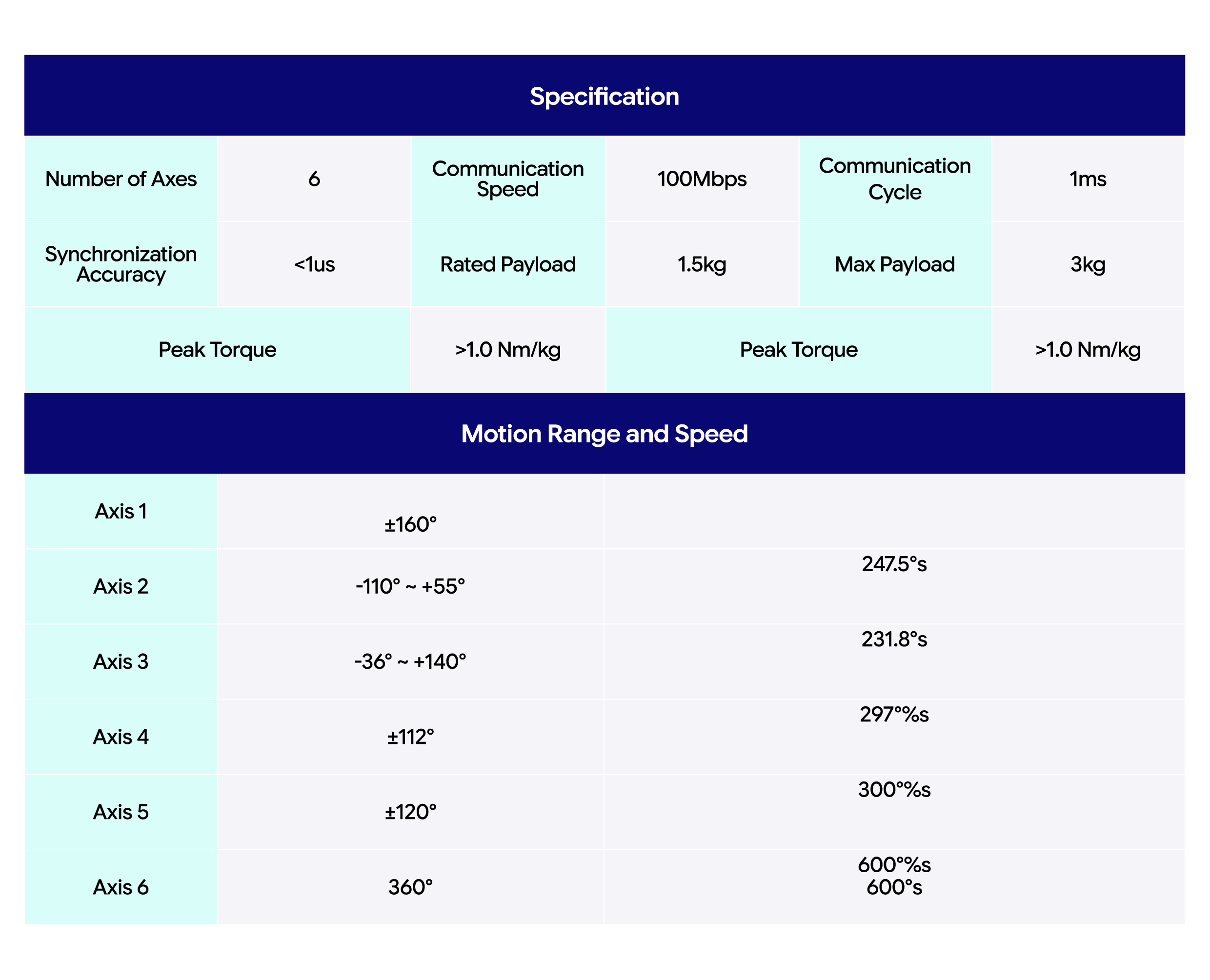
As shown in Table 2, a 1 ms communication cycle requires the controller to send commands, receive feedback, and execute corrections with extremely low latency.Achieving this level of determinism places stringent demands on both the processing power and communication efficiency of the system’s MCU.
Table 2: Key Performance Specifications and Axis Motion Ranges
A typical six-axis robotic arm control system integrates multiple subsystems into a tightly coupled architecture:
- Six servo controllers, one per joint, to perform fine-grained motor control and position feedback.
- Auxiliary peripherals, such as pneumatic valves for grippers and suction cups, plus I/O channels to drive indicators, alarms, and emergency stop detection.
- EtherCAT-based communication, with the controller as the EtherCAT master and the servo drives plus remote I/O modules as EtherCAT slaves. With a 1 ms cycle time, this distributed setup relieves the main controller of low-level motor control tasks, enabling it to focus on higher-order functions such as inverse kinematics, task scheduling, and safety monitoring.
This architecture guarantees the tight synchronization and responsiveness needed for high-precision trajectory planning and coordinated motion execution in industrial environments.
Geehy’s G32R501 real-time microcontroller is purpose-built for these challenges, offering the performance, determinism, and safety features required by industrial robotic arms.
The G32R501 integrates four SDFMs and supports a PWM-synchronized 3-channel fast ADC, which is key to implementing a 1 µs-level fast current loop. Its “Zidian™” acceleration unit, combined with Tightly-Coupled Memory (TCM), enables the rapid calculation of control algorithms (Figure 12). The unique dual-core architecture allows for the parallel execution of tasks such as current loop PI control and current transformation. Simultaneously, it offloads industrial bus communication tasks, ensuring the real-time performance and determinism of the control system, making it ideal for trajectory planning, trigonometric functions, and kinematics equations, while minimizing CPU load and execution time.
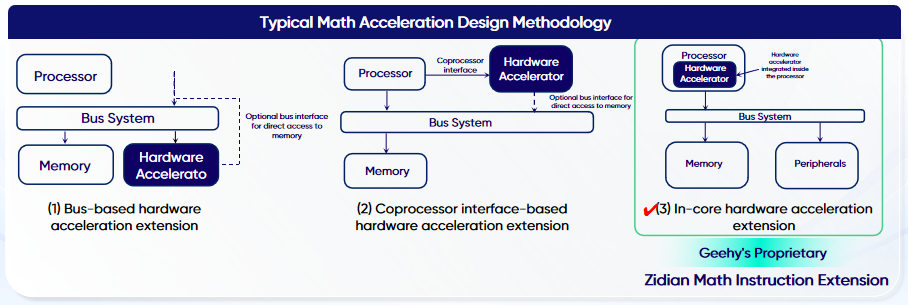
Figure 12: Zidian Math hardware-level acceleration engine performs mathematical operations directly within the instruction set to boost computational efficiency.
Benchmark comparisons in Figure 13 demonstrate that Geehy’s G32R matches or surpasses competitors in execution cycles, highlighting its high performance for robotic control.
.png "image_tooltip")
Figure 13: Geehy’s G32R series performance compared to five competitors. (Source: "Real-time Benchmarks Showcasing C2000™ Control MCU's Optimized Signal Chain" by Ashwini Athalye [2022])
With the ability to act as the EtherCAT master, the G32R501 manages synchronized command issuance and feedback processing within a 1 ms cycle, guaranteeing sub-millimeter trajectory accuracy. By leveraging the distributed architecture of “master planning + driver execution,” the G32R501 handles the heavy kinematics and multitasking, while each servo drive executes local closed-loop control. This balance ensures smooth, stable, and accurate six-axis motion.
For designs that require higher levels of integration, Geehy’s G32R430 encoder MCU can be paired with the G32R501 to build custom servo or encoder modules. This “dedicated processing + master control” combination optimizes system performance, reduces cost, and provides a scalable path for advanced robotic arm architectures.
Alongside real-time performance, safety remains a mission-critical requirement in industrial robotics. The G32R501 integrates a Non-Maskable Interrupt Watchdog Timer (NMIWDRS) for fail-safe resets, hardware CRC for data integrity, clock failure detection, encrypted boot, and dual-zone security protection to safeguard both hardware and software. These features ensure safe operation alongside human workers in collaborative environments.
Logistics AGV
Automated Guided Vehicles (AGVs) are the backbone of modern logistics automation. Highlighted in Figure 14, they are tasked with transporting goods safely and efficiently in factories, warehouses, and distribution centers. Their design must balance high reliability with robust motor performance while operating in environments filled with electrical noise and varying thermal conditions. Two of the most pressing challenges are:
-
Strict Thermal Management: Motors and control electronics generate considerable heat during continuous operation. Without proper control, excess temperature can degrade performance, shorten component lifespan, or even cause failures.
- Electromagnetic Interference (EMI) Constraints: AGVs operate in electrically noisy environments where interference can disrupt sensor readings, motor control signals, or wireless communication. Robust EMI handling is essential for smooth, uninterrupted operation.

Figure 14: Common logistics AGV applications.
To address these requirements, Geehy recommends the APM32M3514 Motor Control MCU, part of the APM32 family, designed specifically for precision motion control applications. AGV motors demand precise drive signals to achieve smooth and efficient motion. The APM32M3514 integrates advanced control timers with dead-time insertion, center-aligned PWM output, and multiple channels to support three-phase motor drives. These features ensure optimal power delivery, minimize torque ripple, and enhance efficiency, which is critical for extending AGV battery life.
Reliable position and speed feedback is central to safe AGV operation. The APM32 series includes Quadrature Encoder Input (QEI) and Hall sensor interfaces, enabling closed-loop control strategies such as FOC (Field-Oriented Control), BLDC drive, and servo motor applications. This allows AGVs to maintain precise navigation, smooth acceleration, and reliable braking in dynamic environments.
By combining high-precision PWM control with integrated sensor interfaces, the APM32M3514 provides AGV developers with a robust foundation for thermal-efficient, EMI-resilient motor control. These capabilities not only improve motion stability but also support scalability across different AGV designs, from small warehouse shuttles to heavy-load carriers.
Household Robot Solutions
Household robots, particularly robot vacuum cleaners, are among the most widely adopted consumer robotic devices. To deliver the convenience and reliability users expect, these systems must overcome two central challenges. First, they need real-time obstacle avoidance. Robot vacuums continuously gather data from sensors such as infrared, ultrasonic, or LiDAR, and the controller must process this information immediately to adjust movement, avoid collisions, and navigate smoothly around furniture, walls, pets, and people. Second, they must address battery efficiency. Because vacuums operate untethered for extended periods, the MCU must deliver strong computational performance while consuming minimal power to maximize operating time and minimize charging frequency.
Geehy’s APM32F407, part of the APM32 industrial-grade MCU family (Figure 15), provides an effective solution to these challenges. Built on a high-performance Cortex-M4F core running at up to 168 MHz, the APM32F407 integrates a Floating-Point Unit and DSP instruction support, making it well-suited for math-intensive, real-time calculations required in navigation and obstacle detection. Its advanced architecture combines processing, control, and networking functions, ensuring the system can handle both computationally heavy workloads and responsive, sensor-driven decision-making.

Figure 15: Geehy APM32 series of microcontrollers.
Equally important, the APM32F407 is optimized for low-power operation, allowing robot vacuums to extend battery life without compromising performance. A wide selection of 16-bit and 32-bit timers provides precise scheduling and motion control, while the MCU’s extensive peripheral support simplifies integration with motor drivers, wireless communication modules, and sensor systems.
By balancing high-speed real-time processing with efficient power management, Geehy’s APM32F407 enables the development of household robots that are more intelligent, energy-efficient, and responsive, offering consumers a smoother, longer-lasting, and more reliable cleaning experience.
Geehy’s Design Ecosystem
A strong support system is critical for efficient engineering design. Engineers need to test product performance, build MVPs, and expand results into functional systems. Shown in Figure 16, Geehy supports this process with a comprehensive ecosystem that accelerates development and minimizes risk. A broad portfolio of ICs provides flexibility in selecting the right device, while development kits and test boards enable rapid prototyping and hardware validation. Software libraries, reference code, and development tools simplify integration and accelerate application-level testing. Professional support teams and application engineers provide direct guidance, while whitepapers and reference designs share best practices. This combination enables developers to move from concept to deployment efficiently and maintain confidence in system performance and reliability.
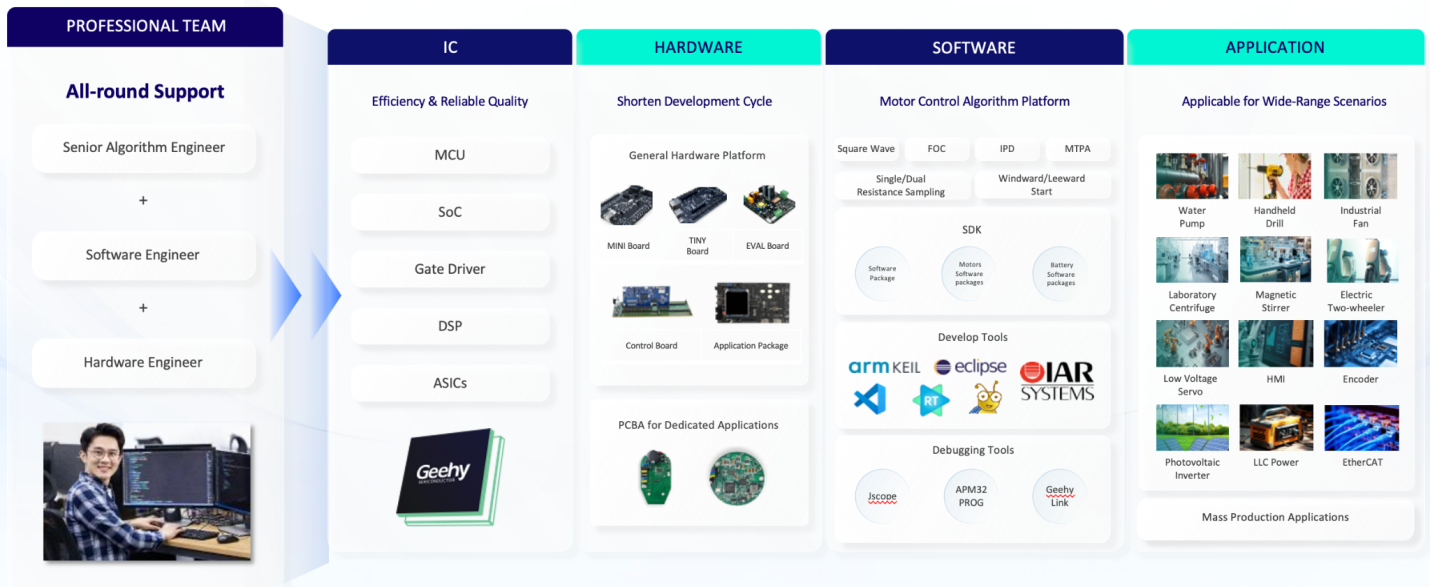
Figure 16: Geehy’s comprehensive engineering ecosystem.
Conclusion
Modern robotics relies on a tightly integrated ecosystem of sensors, microcontrollers, actuators, and AI/ML-enabled processing to achieve precise perception, decision-making, and execution. Semiconductors provide the foundation for real-time control, while AI and machine learning enhance vision, tactile sensing, and coordinated motion, enabling autonomous and efficient robot operation.
Humanoid robots and multi-axis manipulators illustrate the complexity of modern robotic systems, demanding millimeter-level accuracy, synchronized multi-joint control, and high-speed computation. Geehy’s APM32 microcontrollers deliver the performance, peripheral integration, and timing precision necessary for these applications. Collaborative robots benefit from APM32 motor control devices, which address thermal and EMI challenges with floating-point units, DSP instruction support, high-frequency operation, and feature-rich timers. Home robots require real-time controllability and extended battery life, making the APM32 general-purpose variant ideal, with operating frequencies up to 168 MHz and integrated floating-point units. Across demanding applications, Geehy’s products and design ecosystem provide the performance and reliability necessary to bring advanced robotic systems to life.
About Geehy Semiconductor
Geehy Semiconductor Co., Ltd. is an integrated circuit design company focused on the R&D and design of industrial-grade/automotive-grade microcontrollers, high-performance analog and mixed-signal ICs, and Systems-on-Chip (SoCs). The Geehy team possesses 20 years of experience in integrated circuit design and embedded system development, with six R&D centers worldwide. With the mission to "drive industrial innovation with chip technology and continuously create value for customers," Geehy places technological innovation at the core of its development. The company primarily provides reliable chip products and solutions for various platforms and scenarios in industries such as industrial, automotive electronics, energy, and consumer electronics, meeting customers' diverse needs in innovative applications like high integration, precise control, secure identification, and efficiency improvement.
To learn more, visit Geehy's Microcontrollers and Microprocessors product page.


