Facebook
 Google
 GitHub
 Linkedin
Renishaw Expands Motion Insight With Multi-DoF Encoders
Multi-axis measurement and absolute encoding help Renishaw’s RXMA30 deliver precise, real-time motion insight.
Renishaw is advancing motion measurement with a multi-DoF encoder system that captures movement across multiple axes simultaneously. By combining the RXMA30 1.5D scale with Resolute absolute encoder readheads, the system provides direct multi-axis measurement without homing requirements. Designed for high-performance applications, it enables real-time error detection and compensation, giving machine builders deeper insight into motion behavior and improving accuracy, repeatability, and overall system performance.
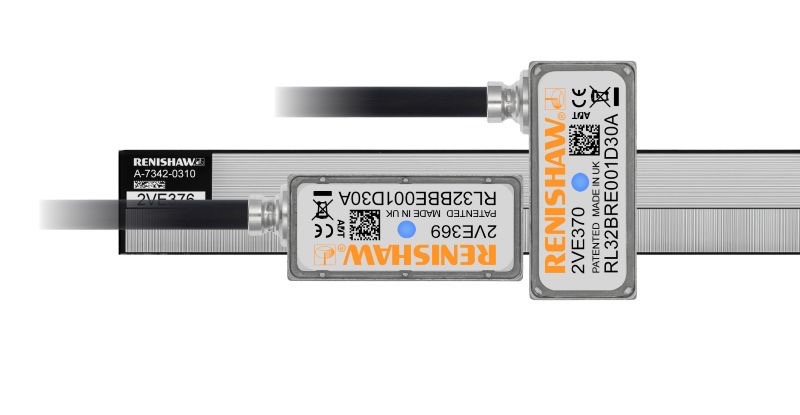
The RXMA30 scale, paired with Resolute readheads, enables direct multi-axis position measurement in high-performance motion systems. Image used courtesy of Renishaw
Moving Beyond Single-Axis Measurement
Most encoder systems are built around linear position. That works until it doesn’t. In real machines, motion isn’t perfectly straight. There are small shifts, rotations, and deviations that accumulate over time and begin to affect accuracy. The multi-DoF approach addresses this directly by measuring more than just position along a single axis. It allows designers to see how the system behaves under load and in motion. That includes straightness errors, small translational offsets, and rotational effects that would otherwise go unmeasured. This matters because those errors don’t go away on their own. If you can measure them, you can compensate for them.
What the RXMA30 1.5D Scale Changes
The RXMA30 scale uses two orthogonal patterns, allowing it to measure motion in both X and Y axes directly. There’s no need to derive one axis from another or rely on extra signal processing. Measuring each axis this way avoids the kind of errors that accumulate when signals are inferred rather than measured. It also improves thermal behavior. Expansion along one axis doesn’t affect the other because each axis is measured independently. That helps maintain accuracy as temperatures change.
Absolute Measurement Without the Usual Tradeoffs
The system uses absolute encoder technology, so there’s no homing. That’s useful on axes where startup movement is limited. In something like a semiconductor stage, it means you don’t have to stop and find a reference position. The system already knows where it is.
Measuring Error So It Can Be Corrected
One of the more practical advantages of a multi-DoF system is the ability to measure error sources in real time. Things like guideway straightness, slight misalignment, and rotational deviation are often treated as unavoidable. The difference here is that they can be tracked during operation and compensated for as they occur.
That shifts the system from measurement to correction. Instead of living with errors, they can be handled as they happen. That shows up in process capability and yield.
Built for Dynamic Motion Systems
This is aimed at systems where motion is fast and tightly controlled. Semiconductor XY stages are a good example, but the same thing shows up anywhere precision and speed both matter. The system is built to keep up without getting in the way. Fast readheads, stable scale materials, and consistent signal output all help it hold performance as speeds increase.
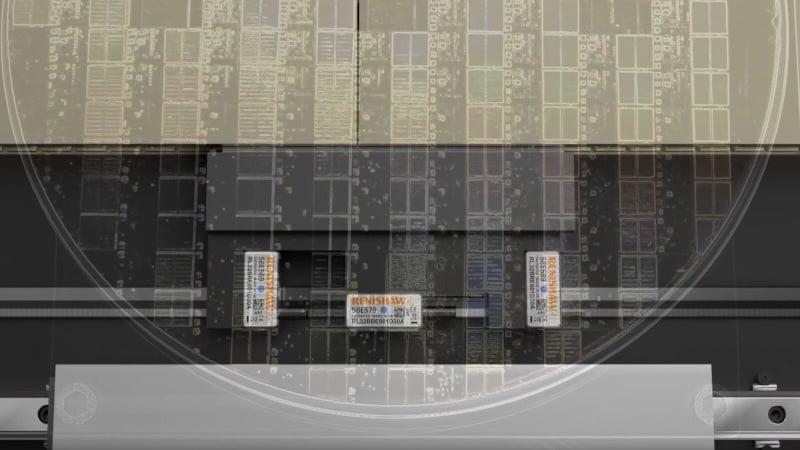
Multi-DoF encoder systems measure motion across multiple axes in high-precision applications. Image used courtesy of Renishaw
Integration Without Added Complexity
Even with the added measurement capability, it’s still easy to integrate. Each axis has its own track, so signal processing stays simple, and it works with common serial interfaces. Readheads can be placed where they make sense for the application, which helps with layout. Cable routing can be adjusted, too, depending on how tight the space is. It adds capability without forcing a full redesign of the control loop.
Where This Fits
Measuring position alone isn’t enough as motion systems continue to push for tighter tolerances and higher throughput. Understanding how motion deviates in multiple directions becomes just as important. Renishaw’s multi-DoF encoder system reflects that shift.
By combining direct multi-axis measurement with absolute positioning, it gives machine builders a more complete view of system behavior and a way to act on it. That’s the difference. It’s not just about knowing where something is. It’s about knowing how it got there and what needs to be corrected along the way.