Facebook
 Google
 GitHub
 Linkedin
Vention Gets a GRIIP on Physical AI for Factory Automation
Combining NVIDIA foundation models with MachineMotion AI, Vention’s GRIIP brings adaptable, training-free robotics to manufacturing
Vention has introduced GRIIP (Generalized Robotic Industrial Intelligence Pipeline), a new end-to-end physical AI pipeline designed to help companies deploy autonomous robot cells in their daily manufacturing environments. The system is intended to move beyond task-specific automation by delivering a generalized platform that is able to be scaled across many industrial applications without custom programming.
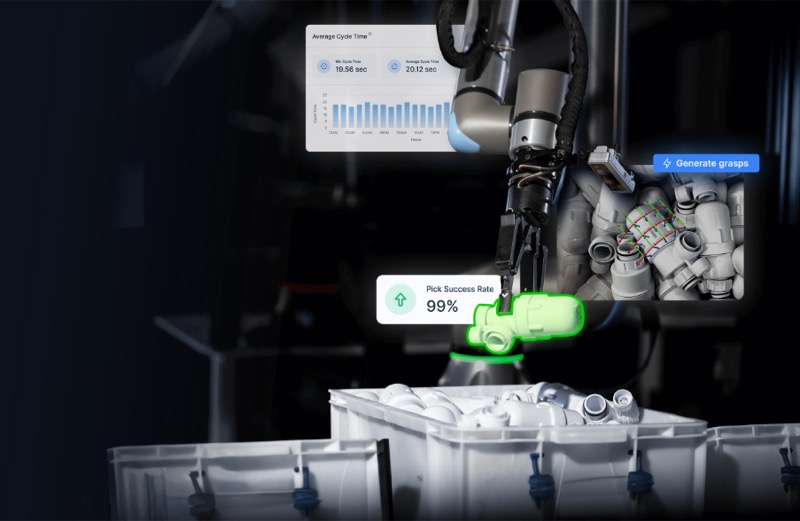
Vention has released its generalized robotic industrial intelligence pipeline (GRIIP) for unpredictable manufacturing environments. Image used courtesy of Vention
Vention’s GRIIP integrates perception, reasoning, and motion into a unified pipeline. It combines Vention’s proprietary models with NVIDIA Foundation models, including NVIDIA FoundationStereo for stereo matching and NVIDIA FoundationPose for 6DOF pose estimation. Running on Vention’s MachineMotion AI controller powered by NVIDIA Jetson, the system handles scene digitalization, object segmentation, pose estimation, grasp selection, and collision-free motion planning within a single architecture.
Production-Ready Performance
GRIIP has been demonstrated in continuous 24/7 lights-out operation over a three-month period, while maintaining a consistent pick performance without any degradation within the system. The system also maintained a throughput of up to 5 parts per minute during this evaluation period, with no reported decline in cycle time.
Pose estimation accuracy is specified at sub-millimeter levels, supporting precise manipulation throughout the pick-and-place process. Unlike earlier physical AI approaches that required retraining or manual adjustments as conditions changed, GRIIP is designed to maintain performance across variations in part geometry, surface texture, transparency, lighting, and workspace conditions. The system operates out of the box without training data or custom datasets. It's as easy as uploading CAD files to begin picking in approximately 15 minutes, and full robot cell deployment is capable in as little as two days. GRIIP also supports over-the-air AI updates through MachineMotion AI via WiFi or built-in LTE connectivity
End-to-End Pipeline
The GRIIP AI pipeline starts by automatically digitalizing and calibrating the robot workspace by creating a usable model of the environment. It then applies perception and segmentation to detect and isolate objects in cluttered scenes, before calculating full 6 degrees-of-freedom pose estimates to determine each part’s exact position and orientation. That data then feeds into the grasp stage, where the system can evaluate and even rank multiple candidates’ grasp points that are based on the object's geometry, orientation, and accessibility.
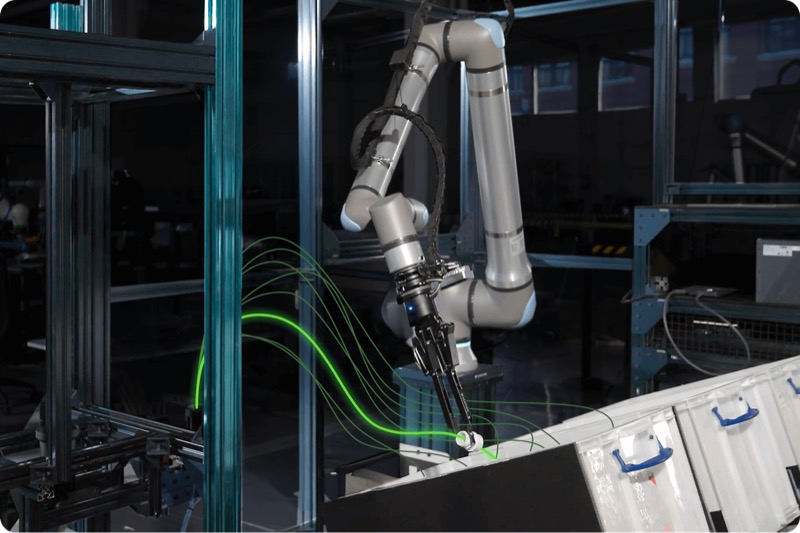
The GRIIP physical AI adapts paths to ensure collision-free tool paths based on the part's current orientation. Image used courtesy of Vention
Once a grasp is selected, the motion planning layer can then generate a collision-free trajectory for the current circumstance, recalculating paths as conditions shift. The architecture is designed to incorporate updated foundation models over time, enabling on-the-fly performance improvements through software updates rather than hardware changes or manual reconfiguration.
Applications Across the Factory Floor
GRIIP deploys the same AI pipeline across typical manufacturing automation tasks, such as bin picking; it handles randomly oriented parts in deep bins, including mixed SKUs and cluttered scenes. For conveyor pick-and-place, the system tracks and manipulates moving parts without recalibration.
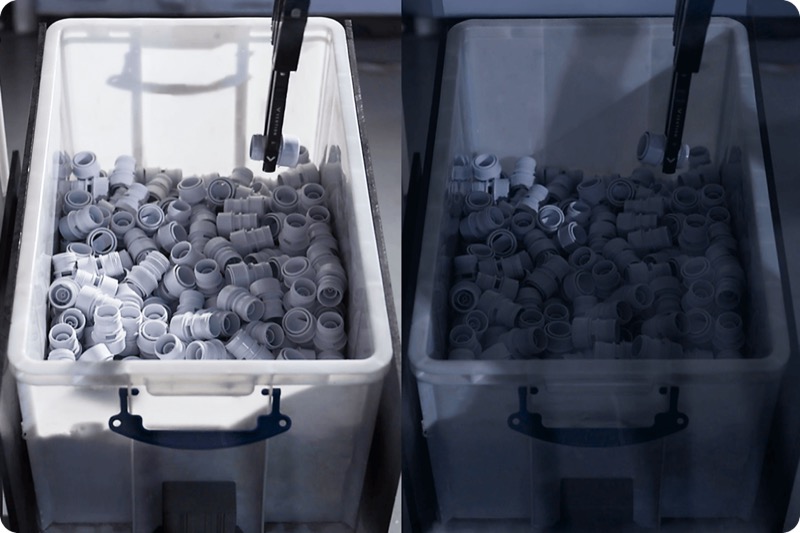
GRIIP can adapt to even extreme changes in lighting, which can cause issues for vision systems. Image used courtesy of Vention
In kitting applications, GRIIP can assemble multiple part types into trays while adapting to changing configurations. Depalletizing operations can benefit from automated unloading of mixed pallet stacks and varying orientations. The platform also supports machine tending, loading, and unloading parts for CNC machines and presses while maintaining consistent cycle times. GRIIP can even be used in surface finishing tasks such as sanding, as the system can adapt tool paths to actual part pose and geometry.
GRIIP is built to run the same AI pipeline across multiple factory tasks without rewriting code for each one, shifting automation from application-by-application engineering to a reusable platform approach. Vention is expanding enterprise demonstrations now, with broader production rollouts planned for 2026 as manufacturers evaluate the system for deployment in live environments.