Facebook
 Google
 GitHub
 Linkedin
Getting a GRIIP on Physical AI: Vention’s Rapid Operator AI
Physical AI is a recurring theme in today’s industrial automation. Control.com recently met with Vention’s CEO to gain insights about the company’s newest offering, Rapid Operator AI.
NVIDIA’s GTC conference unveiled a number of new AI-based innovations across all of industrial automation. Vention, a machine design and engineering firm based in Montreal, announced the launch of Rapid Operator AI, a bin-picking application that promises a faster setup time, more reliable operation, and a simplified package that bundles all the required hardware into a single unit.
Although the week was very busy, our engineering team had the chance to speak with the CEO of Vention, Etienne Lacroix, to learn a bit more about the impact of ‘Physical AI’ in our industry, particularly since this term has been recently applied to many new products and services, and may still be unfamiliar to many engineers.
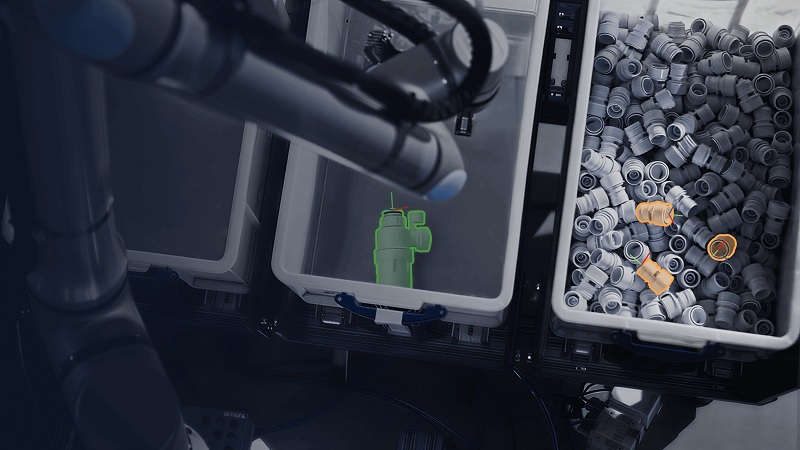
Bin picking can be a difficult task for traditional automation. Image used courtesy of Vention
Rapid Operator AI
Last week’s GTC announcement is a breath of fresh air for an application that has been notoriously difficult for traditional machine vision and automation. Unstructured bin picking is fairly easy for human operators. You see an item in a bin and immediately recognize features: is it upright or upside down? Is one part partially lying on top of another part? Should you grip it so as to avoid fragile or soft features? These questions are fairly simple for humans…but not so for robots.
Deep bin picking in a non-structured environment requires a nearly infinite capacity to identify the situation and reason through a proper solution. As AI solutions continue to improve, so do the specific applications of the software.
Rapid Operator AI is a proprietary application that includes the robot, software, gripper, and vision all in one package. The software relies on Vention’s recently announced GRIIP AI and provides 99% effective grip detection, along with plotting paths free of collisions with the bin walls.
The AI algorithms provide superior performance in challenging situations, such as with transparent materials, in low-light environments, in deep containers that cast shadows, and in more difficult collision-avoidance scenarios.
Physical AI: How Does It Affect Automation?
As with any innovative technology, we always try to dig a little deeper. With the advent of AI, we have become accustomed to asking serious questions — exactly HOW is the AI technology improving life for engineers?
We posed a few questions to Vention CEO Etienne Lacroix to learn a bit more about the future of AI tech and its impacts across the industry.
Our first question is about ‘Physical AI’: is this a different software category from other generic AI that has been integrated into most applications over the last few years?
“Physical AI, often referred to as embodied AI, represents a shift from purely digital intelligence to AI systems that can perceive, decide, and act in the physical world through robotics. Unlike traditional AI used in software or analytics, Physical AI integrates computer vision, real-time decision-making, and robotic motion planning into a single autonomous system.
This evolution changes how robots are programmed: instead of following rigid, pre-defined instructions, they now operate based on mission-level objectives. As a result, robot behavior becomes generative — each trajectory is dynamically computed and adapted in real time depending on the environment and task conditions.”
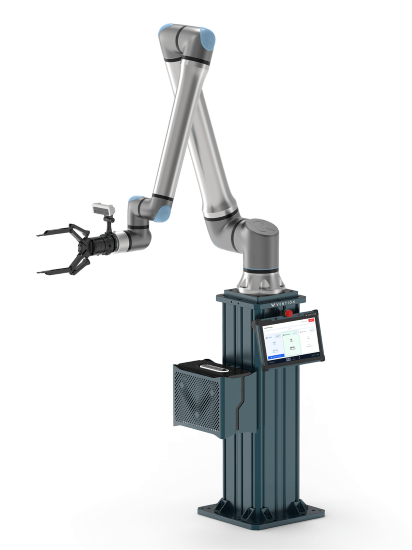
Rapid Operator AI is an all-in-one solution with both hardware and software. Image used courtesy of Vention
What are some of the major challenges that have eluded AI engines for the past few years but are now finally able to be approached?
“Any computer vision technology developed prior to 2023 can now be considered obsolete. Recent progress in stereo vision, image segmentation, pose estimation, and collision-free path planning enables robots to operate in highly cluttered and visually challenging environments.
These systems can now handle low-contrast parts, poor lighting conditions, and complex geometries that were previously difficult or impossible to process reliably. A key inflection point came between 2024 and 2025, when pre-trained models reached a level of maturity that allows strong generalization across a wide range of tasks and part types.”
What challenges still remain — are there bin-picking scenarios/situations that continue to be a challenge for AI to handle from a practical standpoint?
“From a technical standpoint, most bin-picking scenarios can now be considered largely solved in terms of feasibility. The next frontier is performance optimization — particularly improving cycle time through faster grasp execution and reduced inference latency.
Enhancing robotic dexterity remains a priority, especially for handling complex or tightly packed parts. The introduction of bi-manual robotic systems, where two arms operate in coordination, will reduce the need for intermediate re-gripping steps and further accelerate throughput. As these improvements mature, we can expect rapid deployment of fully autonomous bin-picking solutions in real-world industrial environments, beyond controlled R&D settings.”
The Future of Bin Picking
The advent of physical AI has allowed more robotic applications than ever before. The barrier of robots being applicable only to repetitive, consistent processes is beginning to erode. It is being replaced by companies that can supply complete solutions, enabling end users to achieve nearly 100% success across so many of those dull and difficult tasks that have been the target of automation.