Facebook
 Google
 GitHub
 Linkedin
Bihl+Wiedemann Releases Configurable ASi-5 Safety I/O Module
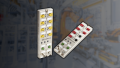
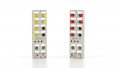
The new safety I/O module, the BWU4277, replaces complexity with flexibility. The device features up to 14 safe inputs and two safe outputs, targeting a wide range of safety applications.
Bihl+Wiedemann’s new configurable ASi-5 safety I/O module transfers power and data to field devices while reducing system complexity. It can interface with virtually any sensor in a flexible manner. With up to 14 safe inputs, configurable through software, and two safe outputs, this safety I/O block reduces the number of I/O modules and other devices needed to transfer sensor signals to the control system.
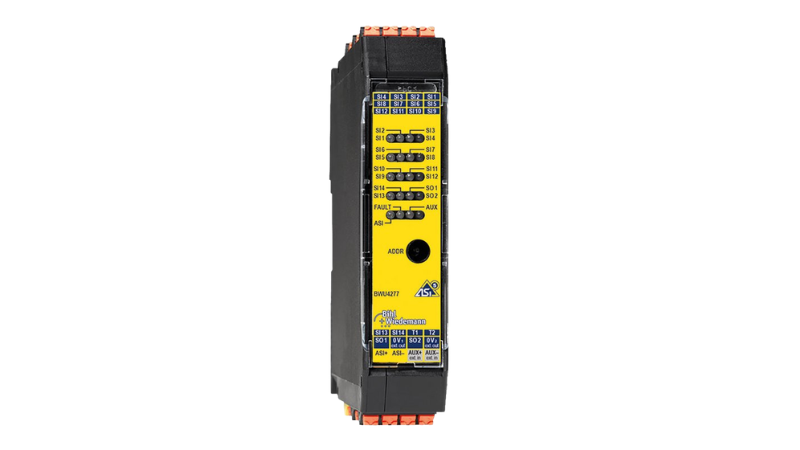
Bihl+Wiedemann’s ASi-5 safety I/O module, the BWU4277. Image used courtesy of Bihl+Wiedemann
Reducing Variant Diversity
Bihl+Wiedemann has designed its ASi-5 safety I/O module to “reduce variant diversity.” At first glance, this may sound like eradicating a mutating disease, and while that is not the case, having too many “variants” can lead to safety incidents.
Different devices are needed to interface with the variety of sensors required for safe industrial equipment. Sensor types, by their nature, are diverse: pull cords, light curtains, emergency stop buttons, and many other types of safety equipment are necessary. This is desirable, as it allows systems designers to match a safety mechanism to the application for the quickest, most reliable activation.
Variant diversity is the measure of how many additional hardware types are required to interface these sensors. Consider the array of sensors available for a piece of industrial hardware, all supplied from different vendors. Often, these sensors have their own device or gateway to transmit data to the control system. The more variants, the more complex, the more fragile, and the less reliable the safety system.
The ASi-5 Safety I/O Module
The key feature of the ASi-5 is its sensor flexibility. The module’s 14 safe input channels can be connected to door locks, interlocks, light curtains, and numerous other devices. Whether sensors have floating contacts or output signal switching devices (OSSD), they integrate easily with this new I/O block. The module can also handle standard or antivalent switching modes, meaning unpowered or active switches to be used on the same device.
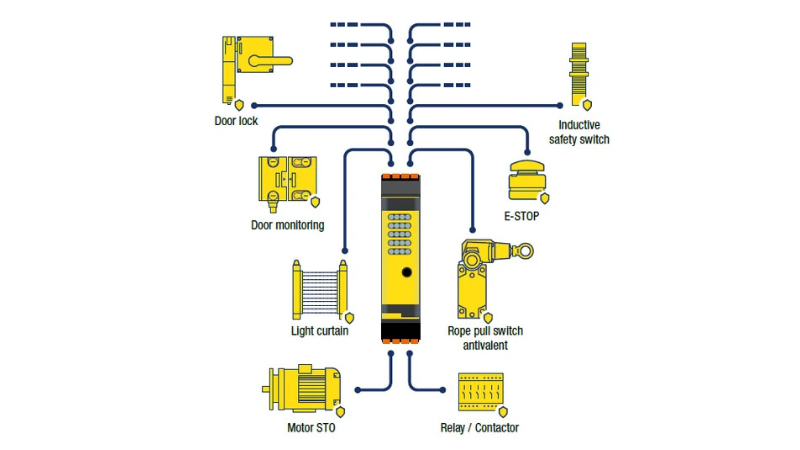
The ASi-5 safety I/O module can be used in conjunction with numerous sensors and safety mechanisms. Image used courtesy of Bihl+Wiedemann
These modules also include safety diagnostics for each safe signal. Usually, a device must be polled by the controller to detect system faults. This can make it difficult to determine when a fault occurred. The ASi-5 uses cyclical diagnostics, embedding diagnostic data in each data exchange so that fault data is found quickly. It also provided a mechanism to display diagnostic data at all times.
Flexible Functional Safety
So many industrial safety systems are fragile. They feature a hodgepodge of sensors, third-party modules, and cabling that is sometimes vendor-specific. At best, this system performs, maybe with a nuisance alarm or two, but is largely stable. It becomes an extra burden during troubleshooting procedures and has a higher-than-desired failure rate.
The configurable ASi-5 allows the system designer to remove some of the “variants” and route them directly through this I/O module, simplifying the system and significantly increasing reliability. Whether a designer is building a new automation system or retrofitting an old, bottom-up-designed system, the ASi-5 series modules offer a simple, clean approach.