Facebook
 Google
 GitHub
 Linkedin
Wago Expands I/O System, Releases 750 Series Safety Logic Modules
Wago adds functional safety modules to its existing I/O System 750, giving designers the power to include safe I/O without the need for a safety PLC.
Machine safety requires the use of specialized I/O that is connected to a safety controller. This topology is typically used for medium to large-scale systems that require numerous safe I/O points. The safe inputs will typically have features such as broken wire detection, short circuit monitoring, and cross circuit monitoring. Safe outputs will have safety features such as dual output redundancy and short circuit protection. These features allow designers to build equipment that can have a zero energy state, enabling operators and technicians to work safely inside the equipment.
Recently, Wago has released safe I/O blocks as part of the 750 series of modules, controllers, and fieldbus couplers.
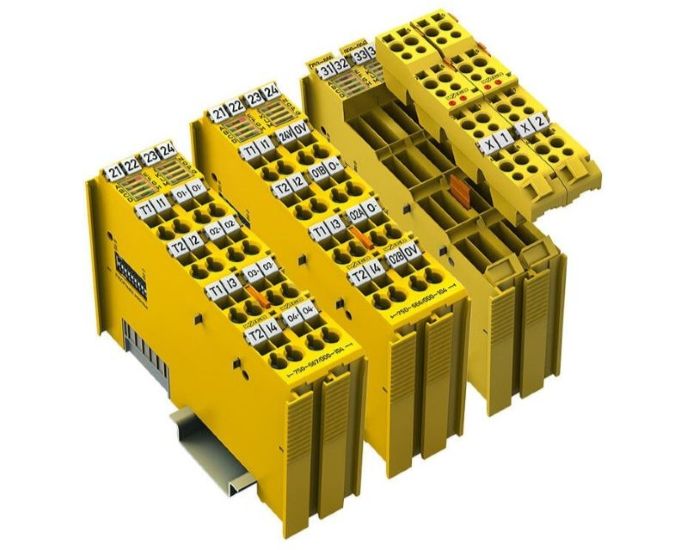
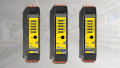
The new 750 series safe I/O modules include four safe inputs and two or four safe outputs (10 A/24 VDC or 2 A/24 VDC). Image used courtesy of Wago
Safety Logic Modules
The new 750 series safety logic modules integrate with Wago’s PFC Basic Controller 100, PFC100, PFC200, or PFC300 to build safety systems that can monitor inputs and set outputs, all with safety-rated components. The input modules come in either 10 A or 2 A output versions and can be ordered with either two inputs and two outputs or four outputs.
To ensure cross-circuit wiring is not present, the 750 series uses a separate 24 V source. This ensures that each channel is wired to the correct power supply. Each output can be configured to operate in either bipolar or unipolar mode, which is useful if you need to wire your outputs with a common supply or by switching the load.
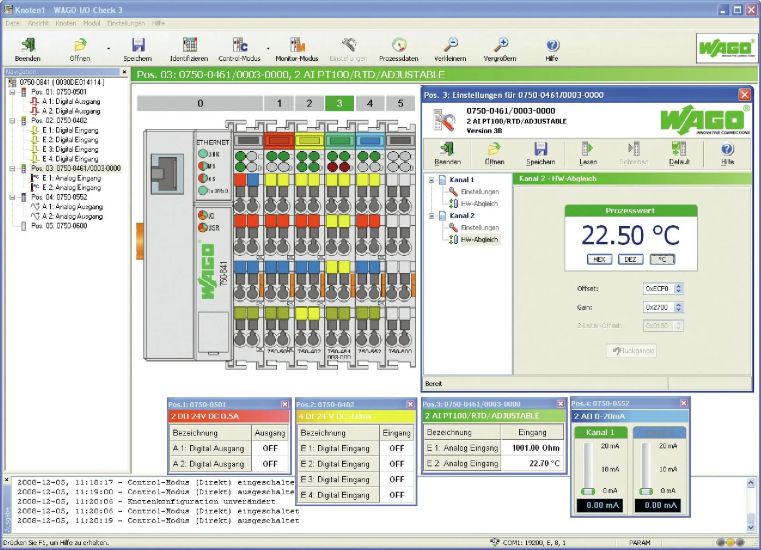
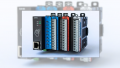
The 750 series safety logic modules can be programmed with Wago’s I/O-Check software (pictured above) and Wago’s Safety Editor software. Image used courtesy of Wago
Safety Programming
The 750 series safety logic modules are programmed and configured using Wago’s I/O-Check software and Wago’s Safety Editor Software. Each module contains internal logic that can be used to build SIL3/PLe-rated safety programs. The advantage of the 750 series is that a safety PLC is not required. The Safety Editor software allows for all the programming, and the I/O-Check software allows for parametrization along with access to the integrated logic.
Safe Topology
Typical safety I/O systems consist of I/O modules and a safety controller. The new 750 series is a catalog of I/O modules that can be connected to Wago’s Basic Controller, along with non-safe modules. This topology can save on required components and real estate in the control panel.
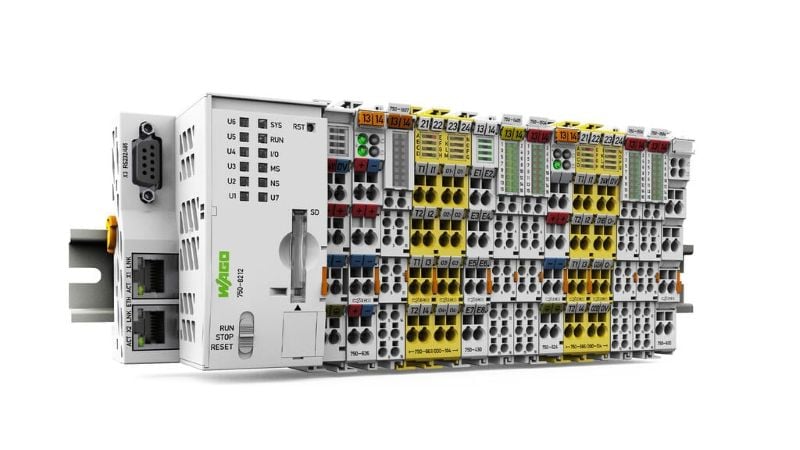
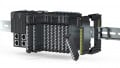
Wago controller with safe and non-safe devices. Image used courtesy of Wago
Safety Systems in Machines
Large factories that contain automated equipment will have many different kinds of safety systems in place. Most commonly, these are systems that monitor and lock operator doors. These doors allow access to the inside of the automated equipment. When an operator opens the door, all of the automated equipment needs to stop moving. A safety control system will monitor the door position and issue a stop to all robots and servos and dump any compressed air within the system. Using an I/O module like the 750 series from Wago allows designers to use one control system with one I/O rack to provide both safe and non-safe automation control.