Facebook
 Google
 GitHub
 Linkedin
FANUC and Google Advance Physical AI for Manufacturing
A new partnership between FANUC and Google aims to accelerate Physical AI adoption in robotics through ROS integration and advanced AI capabilities.
Fanuc and Google have announced a partnership focused on accelerating the adoption of Physical AI in manufacturing, combining Fanuc’s industrial robotics expertise with Google’s artificial intelligence capabilities. The collaboration aims to create more adaptable robotic systems capable of perceiving their environments, making autonomous decisions, and responding dynamically to changing production requirements. Leveraging the Robot Operating System (ROS) ecosystem and advances in machine learning, computer vision, and large language models, the partnership seeks to reduce deployment complexity while enabling more flexible automation. As manufacturers face increasing demands for agility and customization, the initiative reflects a broader industry shift toward intelligent, data-driven robotics that can bridge the gap between digital AI and real-world industrial operations.
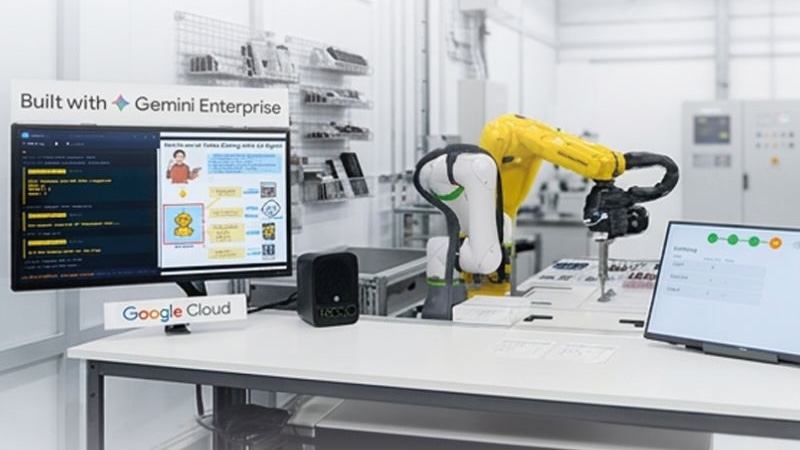
Fanuc and Google are teaming up to combine their respective expertise in industrial automation and AI and embed Physical AI into modern manufacturing systems. Image used courtesy of Fanuc
The Expanding Realm of Physical AI
The realm of Physical AI is expanding as humanity refines its knowledge of AI and its application to mechanical systems. Whereas past innovations involved the pre-programming of bots to undertake fixed or set tasks with little room for flexibility or adaptability, modern robotic systems leverage the neural-like plasticity of particular branches of AI, such as machine learning (ML) and deep learning (DL), to allow robots to assimilate data from their environment, perceive it, and react according to the needs, quality, and safety requirements of a particular industrial process.
Essentially, Physical AI is the product of the combined effort of researchers and engineering experts who are attempting to create intelligent, human-like machines that can respond dynamically to their environment. This kind of intelligence boosts operational efficiency.
LLMs are becoming a prominent feature in automated robotics systems. LLMs can enhance cognitive reasoning in physical machines (such as mobile and humanoid robots) by translating natural-language instructions into code for robot control and logic. The convergence of enhanced computer vision, multimodal models, and zero-shot learning enables industrial businesses to deploy robots quickly, reducing training and programming time.
Dynamic and Adaptive Robotic Solutions
Fanuc’s robot operating system (ROS) drivers support the ROS framework, an open-source software platform combining the components, interfaces, and tools for building advanced robotics applications.
ROS is a middleware abstraction layer that uses a single communication protocol to convert advanced AI decisions into standardized motor control commands. This framework enables developers to readily transfer "digital brains" from simulated environments to real-world environments. This is made possible by using a common language that allows industrial hardware and sensors to communicate, eliminating the need for custom code for each component. This interoperability serves as the foundation for embodied AI, facilitating autonomous decision-making and enabling robotic systems to respond to evolving processes in industrial environments.
An overview of the three key technologies that serve as the foundation for Physical AI. Video used courtesy of Fanuc
Robotics software company Intrinsic acquired the for-profit branch of the Open Source Robotics Foundation, Open Source Robotics Corporation, which evolves and maintains the ROS platform. Intrinsic is actively developing the ROS platform to promote the widespread adoption of ROS-based systems. By integrating through Intrinsic, Google seeks to span the void between digital AI and physical robotics.
Fanuc and Google’s partnership will bring together their respective technologies and expertise in industrial-grade robotics and AI to promote the integration of Physical AI in manufacturing across North America.
Featured image used courtesy of Adobe Stock
Related Content