Facebook
 Google
 GitHub
 Linkedin
Datalogic Showcases AI Tools for Smarter Factory Automation
New AI-driven solutions from Datalogic enhance safety, machine vision, laser marking, and barcode reading for more flexible manufacturing.
Datalogic showcased a portfolio of AI-powered automation technologies at Automate 2026, highlighting solutions for machine safety, laser marking, vision inspection, and product traceability. Featured products included the SLS-10 safety laser scanner, AREX400 AF fiber laser marker, Matrix 220 XAI barcode reader, and MX-G2000 vision controller. Together, the technologies are designed to simplify system integration, improve inspection accuracy, and help manufacturers build safer, more adaptable production environments.
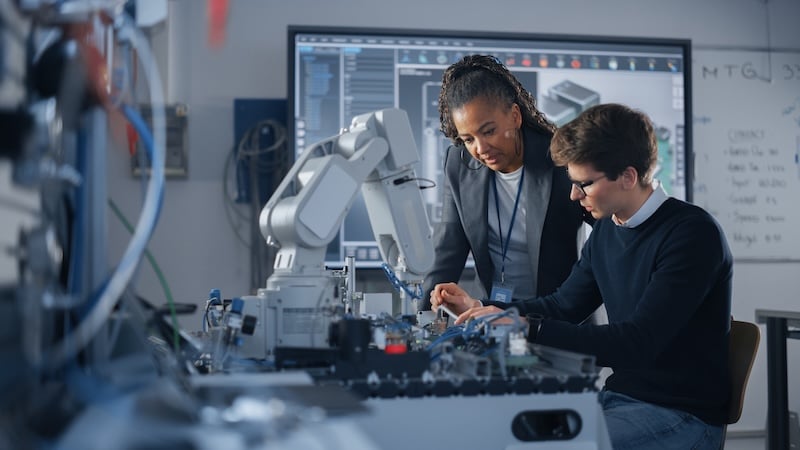
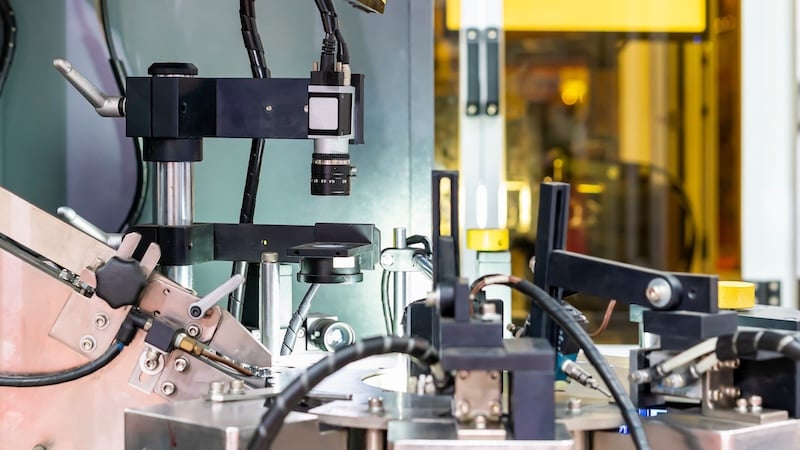
Machine vision and sensing systems are becoming central to intelligent manufacturing, helping production lines improve inspection, traceability, and process control. Image used courtesy of Adobe Stock
Expanding Safety Coverage with the SLS-10
One of the main products in the lineup is the SLS-10 safety laser scanner. It is designed for areas where people work near moving machinery, robotic cells, palletizers, conveyors, and automated material handling systems.
The standout characteristic is definitely range. Datalogic says the SLS-10 is the first safety laser scanner with a detection range up to 10 meters. It also offers a 275-degree scanning angle, providing sufficient coverage to protect larger areas with fewer devices. That matters in real installations. Safety systems can become expensive and complicated when multiple scanners are required to cover a single cell or traffic zone. A longer range scanner can reduce hardware count, simplify installation, and even shorten commissioning time.
The SLS-10 is also aimed at mobile automation. Its angular resolution and fast response times support safer navigation for AGVs and automated forklifts. Dust immunity and configuration tools round out the product for industrial environments where scanners cannot rely on clean, perfect conditions.
Making Laser Marking More Flexible
Datalogic also highlighted the AREX400 AF fiber laser marking system for the U.S. market. The main feature here is automatic focus adjustment controlled through software. Traditional fixed-focus laser marking systems may require mechanical repositioning when part height changes. That adds equipment, slows format changes, and creates another point of adjustment on the line.
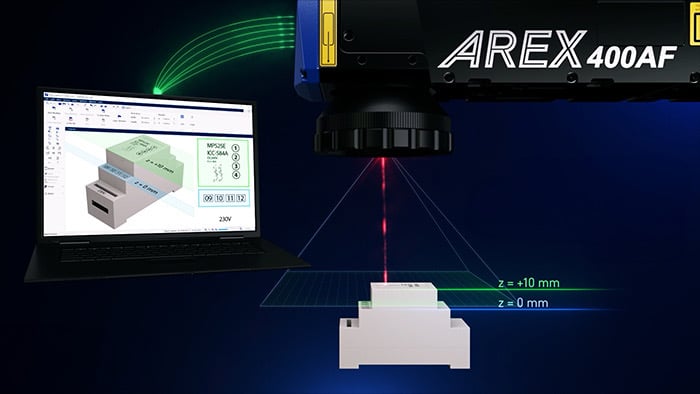
The AREX400 AF uses software-controlled focus adjustment to mark parts at different heights without manual repositioning or added mechanical hardware. Image used courtesy of Datalogic
The AREX400 AF handles that differently. It can adjust focus across different part heights during the same production cycle, allowing manufacturers to mark products without manual intervention or external positioning hardware. Its focus range extends from ±20 mm to ±60 mm, giving the system room to handle product variation without stopping the line. Format changes can be made using software commands rather than physical adjustments.
The system is also built for automation environments. It uses a compact 3.5 kg scan head, robotic-grade cabling, and IP64 protection, making it a better fit for robotic integration and continuous motion applications.
AI in Sensing and Traceability
Beyond the two main launches, Datalogic also showed how AI is being applied across sensing, barcode reading, machine vision, and packaging line inspection.
The Matrix 220 XAI barcode reader is built for challenging code-reading conditions. Direct part-marked codes, reflective surfaces, damaged markings, and low-contrast labels can all create problems for traditional readers. AI-enhanced decoding is intended to improve read rates under those conditions, reducing line stoppages and enhancing confidence in traceability.
Datalogic also presented the MX-G2000 vision controller, which combines traditional machine vision with deep learning AI. The controller can locate, measure, and inspect components simultaneously. That can reduce the need for multiple inspection stations and make integration easier for manufacturers seeking to consolidate quality-control steps.
Datalogic also demonstrated sensors, safety devices, cameras, and barcode readers working together throughout a full production cycle in packaging environments. That is where the company’s approach becomes clearer. The goal is not one isolated device. It is a more integrated automation layer that can handle inspection, safety, and traceability in a single system.
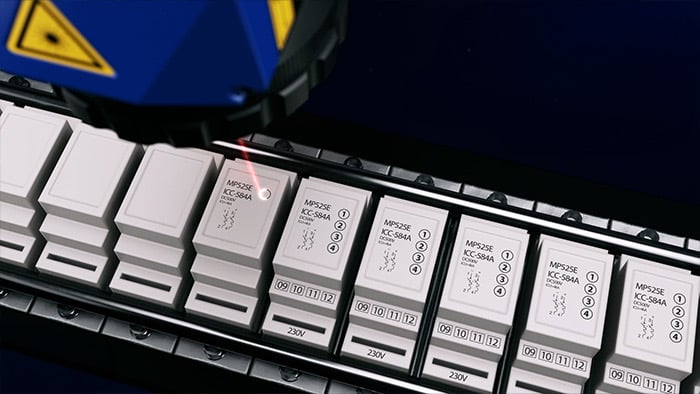
Datalogic’s AREX400 AF is designed for automated marking environments where consistent, high-contrast codes must be applied across changing production conditions. Image used courtesy of Datalogic
Automation Built Around Adaptability
The most useful part of Datalogic’s lineup is how directly it addresses flexibility. The SLS-10 is built to cover larger safety zones with fewer devices. The AREX400 AF reduces the need for mechanical adjustment in laser marking. The Matrix 220 XAI and MX-G2000 use AI to handle difficult inspection and identification tasks that can slow down production. Datalogic understands product formats change. Materials vary. Codes get damaged. Robots and AGVs move through shared spaces.
Together, these technologies reflect Datalogic's focus on making industrial automation more intelligent, adaptable, and easier to deploy as manufacturing demands continue to evolve.