Facebook
 Google
 GitHub
 Linkedin
Next-Generation Microswitches: Integrating Resistors for Smart Fault Detection
Conventional microswitches are limited to two states—ON and OFF—making it difficult to identify wiring faults during normal operation. External resistors can add a third state but fail to detect issues between the switch and resistor, increasing component count and assembly time.
Next-Generation Microswitches: Integrating Resistors for Smart Fault Detection
.png)
Introduction
Microswitches are found everywhere—from refrigerator doors and vending machines to industrial robots and smart meters. For decades, these devices have reliably toggled between two states: ON (closed) and OFF (open). While adequate for simple presence or limit detection, two-state switches leave systems blind to wiring problems. A broken wire looks identical to an OFF state, and a shorted wire is indistinguishable from ON. To monitor wiring faults, designers often add external resistors to create voltage dividers, but those resistors cannot detect breaks between the switch and the resistor, and they increase component count and assembly complexity.
OMRON’s resistor-integrated microswitches address these shortcomings by embedding chip resistors directly into the switch body. A resistor-integrated switch outputs one of four distinct voltages—Vcc, V1, V2 or 0 V—corresponding to open circuit, ON, OFF and short circuit conditions. By measuring this voltage with a single analog input, a microcontroller can unambiguously distinguish normal operation from wiring faults, enabling self-diagnosis and remote maintenance. The built-in resistors also eliminate the need for externally mounted resistors, reducing PCB area and installation time.
How Four-State Detection Works
Inside the switch, chip resistors are connected across the moving contacts. When the switch closes, current flows through one resistor (R2), producing a voltage (V1). When the switch opens, current flows through two resistors in series (R1 + R2), producing a higher voltage (V2). If the wiring is shorted, the resistors are bypassed, pulling the voltage low. If the wiring is broken (open circuit), no current flows and the voltage floats high toward Vcc. By defining thresholds between these levels, the system can detect four distinct states without additional hardware.
This four-state detection has several advantages. First, it improves safety and reliability. Wiring faults are detected immediately, allowing systems to shut down safely or trigger maintenance actions before failure. Second, it reduces component count and space. Eliminating external resistors shrinks the bill of materials and frees board area, simplifying assembly. Third, it enables predictive maintenance and remote diagnostics; by monitoring voltage levels, systems can log events, send tamper alerts and forecast component replacement needs.
D2AW-R: A Drop-In Upgrade
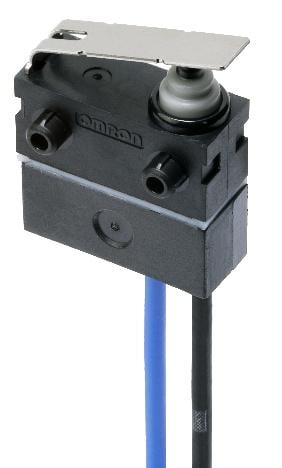
The D2AW-R series is designed as a direct replacement for existing D2AW microswitches. It shares the same outline and stroke options, so designers can upgrade to four-state detection without changing housings. Two chip resistors are mounted inside, and the maximum power rating per resistor is 0.5 W. The sliding contact mechanism ensures smooth actuation and long life. Multiple terminal options are available including PCB terminals, press-fit terminals and versions with molded lead wires to accommodate various assembly methods. The devices are sealed to IP67 (excluding terminals), making them suitable for harsh environments with water spray or dust.
Applications for the D2AW-R series include security devices such as smart meter covers, safes, anti-theft device covers and automatic locking systems. Because the resistors are inside the switch, tampering attempts like wire cutting or shorting are detected immediately. In factory automation, D2AW-R switches provide failure diagnosis by detecting wire disconnection and switch failures.
D2EW-R: Ultra-Subminiature and Versatile
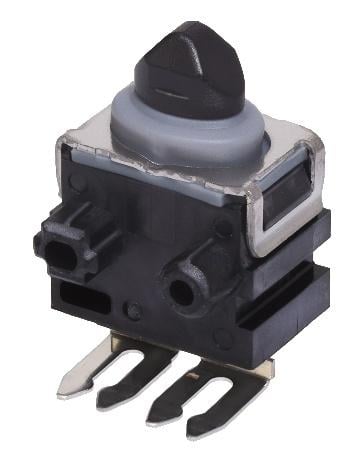
For applications where space is at a premium, OMRON offers the D2EW-R series. Measuring just 8.3 × 7.0 × 5.3 mm, the D2EW-R retains four-state detection while supporting multi-angle plunger operation without a lever. The series uses the same sliding contact architecture as the D2EW family and has IP67 sealing and high resistance to vibration and shock. Because the resistors are built in, the system can differentiate between normal switch-open or switch-closed status and an open circuit or short circuit at the terminals. This capability extends diagnostic monitoring in industrial automation and enhances security in vending machines and smart meters.
The D2EW-R’s space-saving design is complemented by flexible mounting options. Polarized mounting posts or M3-screw mounts simplify installation, while press-fit terminals, solder terminals and molded lead wires provide assembly flexibility. The devices operate from 5 V to 18 V over a temperature range of −40 °C to 85 °C. This makes them suitable for battery-powered devices and low-voltage control circuits. The switches target security applications requiring anti-tamper functionality—smart meters, safety boxes, surveillance cameras and automated locking systems—as well as factory automation equipment such as industrial robots, autonomous mobile robots and AGVs.
Implementing Four-State Switches
Integrating a resistor-integrated microswitch into a system is straightforward. The switch output connects to a microcontroller’s analog input. Software sets thresholds to detect four voltage ranges: high (open circuit), V2 (OFF), V1 (ON) and low (short circuit). Designers should allow margin for resistor tolerances and temperature variation. Many microcontrollers offer analog comparators that can classify the voltage without continuous polling, saving processing power.
For tamper loops with multiple doors, several resistor-integrated switches can be connected in series, each contributing a known resistance. The controller measures the total resistance; if any door is open, the loop becomes an open circuit. If the wiring is shorted, the total resistance drops, triggering an alarm. Assigning different resistor values to different switches can create unique signatures for each door. Because the resistors are inside the switches, individuals cannot bypass detection by inserting matching resistors.
Conclusion
By embedding resistors inside microswitches, OMRON has transformed a simple electromechanical component into a smart diagnostic device. A resistor-integrated microswitch can detect four states—ON, OFF, short circuit and open circuit—without external components. This capability improves safety, reduces assembly complexity and enables predictive maintenance. With broad applicability in security devices, factory automation, vending machines, ATMs and robotics, these switches represent a significant step forward in making systems more reliable and resilient.
Webinar Summary:
Conventional microswitches are limited to two states—ON and OFF—making it difficult to identify wiring faults during normal operation. External resistors can add a third state but fail to detect issues between the switch and resistor, increasing component count and assembly time. OMRON addresses these limitations by embedding chip resistors directly into its switches, allowing them to distinguish between "normal" and "abnormal" operations using four voltage outputs. This innovation detects open and short circuits, reducing equipment downtime, and simplifies installation by detecting wiring faults within the sealed switch body.
This webinar introduces the integrated resistor technology, transforming simple switches into diagnostic devices. It covers the D2AW-R and D2EW-R families, highlighting mechanical compatibility, resistor configurations, and environmental ratings. The D2HW-R and D2AW-R series match existing outlines, enabling systems to output four distinct voltages for ON, OFF, short circuit, and disconnection states. The D2EW-R series features an ultra subminiature design, supporting multi-angle operation without a lever, with built-in resistors for fault detection in smart meters, safety boxes, and industrial robots. Attendees will learn to implement four-state detection using a single analog input, set voltage thresholds for reliable detection, and explore economic benefits like reduced components, assembly time, and downtime. By the end, participants will understand how integrated resistors can transform microswitches into smart sensors.
Key Highlights:
- Overview of D2AW-R and D2EW-R families.
-
Economic benefits: reduced components, assembly time, and downtime.
-
Guidance on implementing four-state detection.
Webinar Title: Next Generation Microswitches: Integrating Resistors for Smart Fault Detection
Date: Tuesday, March 24th 2026
Time: 11:00am CST / 12:00am EST / 9:00am PST
Presenter: Roland Hiso, Product Manager, OMRON Electronic Components

Biography: Roland Hiso is a Product Manager at OMRON Electronic components, where he manages the company’s Switch and Connector product lines. He brings nine years of experience at OMRON, having previously overseen sensor products and developed a broad understanding of industrial and electronic component markets. Roland holds a degree in Computer and Electrical Engineering Technology from DeVry University and focuses on aligning product strategy with customer and application needs.

Connect with OMRON Electronic Components on social media:
LinkedIn: https://www.linkedin.com/company/omron-electronic-components-americas
YouTube: https://www.youtube.com/c/OmronElectronicComponentsAmericas
Twitter: https://twitter.com/OmronComponents
Instagram: @omron_dms