Facebook
 Google
 GitHub
 Linkedin
Imago Launches Modular AI Vision Sensor With On-Device Processing
The new PV4 is a compact vision sensor that integrates classic image processing with AI inference. It features 2 TOPS NPU and a modular sensor head, targeting inspection tasks that undergo frequent changes.
Imago Technologies has introduced the Vision Sensor PV4, a modular AI-based vision system designed for demanding industrial inspection tasks. The PV4 combines traditional rule-based image processing with AI inference directly on the device, reducing the need for external computing platforms. It is flexible enough to adapt as production requirements change.
Positioned between standard smart vision sensors and larger AI industrial PCs, the PV4 is aimed at applications where inspection needs often shift.
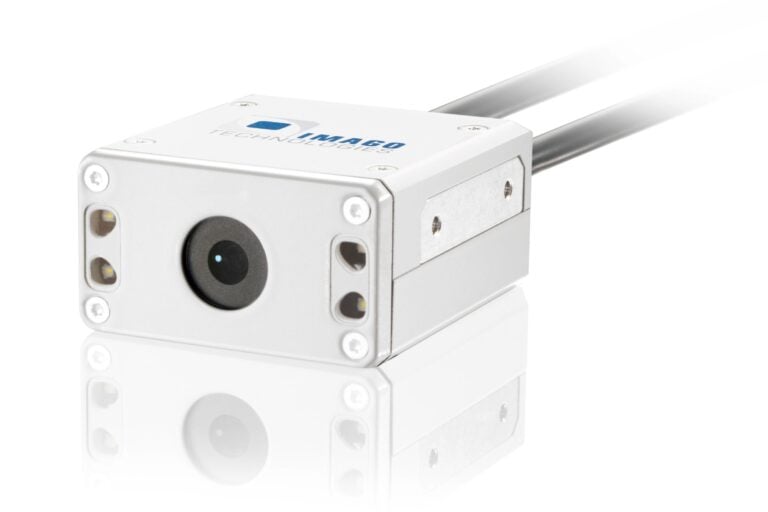
Imago’s new PV4 AI-based vision sensor for industrial inspection needs. Image used courtesy of Imago Technologies
On-Device AI and Classical Vision Processing
The Vision Sensor PV4 runs on a hexa-core Arm Cortex-A55 processor and has a built-in neural processing unit (NPU) that delivers 2 TOPS of AI performance. This setup lets the device handle traditional image processing tasks such as blob analysis, code reading, and optical character recognition, as well as deep learning inference, all directly on the device without needing external systems.
Because it does not require a separate AI computing platform, the PV4 reduces latency, simplifies system design, and offers compact real-time inspection solutions that fit into space-limited machines. It runs on a Linux-based platform and is fully programmable, so users can build custom applications in Python or C++ without being restricted to proprietary software.
Modular Hardware for Changing Requirements
A main feature of the new PV4 vision sensor is its flexible, modular hardware, which allows users to swap out sensor modules without redesigning the entire system. It comes in resolutions such as 2064 x 1552 pixels and 2472 x 2064 pixels, with both color and chromatic options, depending on the model.
The PV4 is available in two mechanical versions: a 205 g cubic housing and a 125 g matchbox housing with four synchronized high-intensity LEDs. An optional liquid lens adds autofocus, making it easier to handle fast changes in working distance or object size.
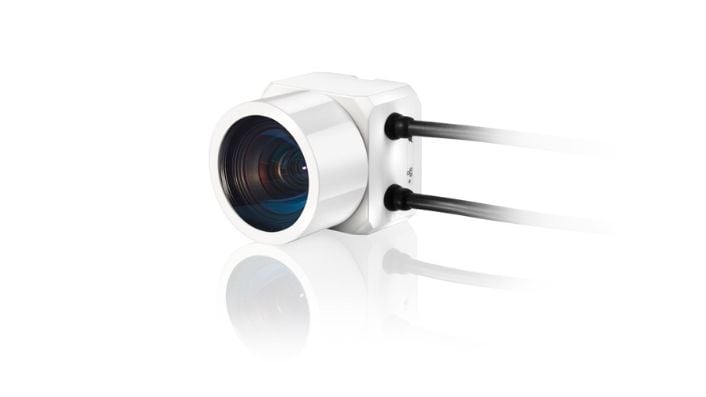
Imago's Vision Sensor PV4 cubic model. Image used courtesy of Imago Technologies
The new sensor supports a range of industrial interfaces, including 2.5 Gbit/s Ethernet, GigE Vision, OPC UA, trigger interfaces, and opto-isolated digital I/Os with two inputs and four outputs. For extra flexibility, it also offers optional expansion modules, such as a universal illumination module (UIM) and an I/O expansion box.
Application Areas in Dynamic Production Environments
The PV4 is built for inspection tasks in settings where production and packaging change frequently, making it hard to plan tasks in advance. In packaging and logistics, it can read barcodes and text even on damaged or covered labels, and its AI-based classification helps with sorting and routing. In the food and beverage industry, the PV4 checks fill levels and labels, even on reflective surfaces or containers of different shapes.
It also works well in pharmaceutical settings, handling small fonts and batch differences, with AI-based segmentation improving recognition. In printing, the sensor checks print quality, color differences, and positioning accuracy using both traditional inspection logic and AI.
Bridging the Gap in Industrial AI Vision
As production environments become more dynamic, systems that combine on-device AI with modular hardware are likely to become more popular. Imago’s Vision Sensor PV4 offers a compact, ready-to-use edge vision system for machine builders, OEMs, and system integrators who want modularity and adaptability in a programmable vision system.