Facebook
 Google
 GitHub
 Linkedin
Tech Hubs Unite, Igniting Innovation in Automation Solutions
The University of Tulsa announced the opening of its Institute for Robotics & Autonomy, and other tech hubs are seeking to advance robotics-based operations.
This article explores the current state and growth of the global robotics market and the innovative robotics and automation technology-focused hubs, seeking to develop commercialization pathways for new, lab-born technologies, enhance product and system testing, improve supply chain resilience, and expand employment opportunities in the United States.
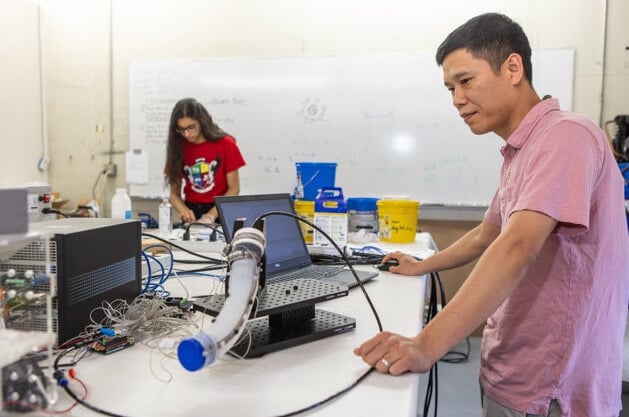
Students developing and testing new technology in UTulsa’s soft robotics laboratory. Image used courtesy of UTulsa
The Global Robotics Market
Benchmark International valued the Global Robotics Market at $46 billion in 2023 and projected a rise to $169.8 billion on transitioning from 2024 to 2032 (based on a compound annual growth rate of 15.1%). The drive to digitize industrial settings and processes, augment human worker capabilities with robotics, and automate wherever possible is facilitated by innovation, competition, and the desire to improve operational efficiencies, reduce costs, and keep abreast of consumer demand.
Advancements in machine learning, a branch of artificial intelligence, allow robots to learn more efficiently from their environment to navigate, sense, collect data, and execute certain tasks. Robots serving multiple industries have developed miniaturized electronic components and improved sensor technology for advanced perception, cutting material costs and improving the accuracy of tasks.
Robots and cobots used in the industrial sector play key roles in several application areas, including welding, product assembly, material handling, finishing, and more.
UTulsa Institute for Robotics and Autonomy
The University of Tulsa’s newly founded Institute for Robotics & Autonomy (IRA) is intended to amp up collaborative cross-industry research in robot communication, prototyping, design, interaction, and safe operation alongside humans.
The Institute is dedicated to tackling industrial and societal issues by bringing software and robotics systems from the lab bench to real-world applications. Utilizing the university's cybersecurity competence, the institute strongly emphasizes shared creativity and experiential learning, where educators and pupils collaborate on innovative initiatives. U.S. Senator Markwayne Mullin, who assisted in obtaining money for the institution, said he is eager to see what innovations the institute would make.
Research areas include the development of robotics for assisted living for senior individuals and collaborations with community partners such as the U.S. Army, as well as researching interactions between robotic dogs (such as Spot from Boston Dynamics) and the environment and humans.
Equitable and Trustworthy Autonomy
Academic research professionals and student collaborators of the IRA are also engaging with the Tulsa Hub for Equitable and Trustworthy Autonomy (THETA). In July of this year, the consortium (run by Tulsa Innovation Labs) was nominated to receive an award of $51 million in investment by the U.S. Economic Development Administration. THETA is intended to help push forward the curation, testing, and production of Trustworthy and Equitable Autonomous Systems (TEAS).
The funding would boost the advancements of six key projects, including:
- establishing an AI center for excellence
- enhancing the frameworks of commercialization strategies across universities and the businesses they support
- setting up governance structures for project completion
- establishing a cyber and data management testing facility to tackle adoption issues
- providing seminars and an exhibition center to help TEAS manufacturers expand their capabilities
- Enhancing commercialization frameworks among universities and affiliated startups

Visit Control Automation’s educational ebook repository to learn and expand your knowledge. Image used courtesy of Control Automation
Other Innovative Tech Hubs
Under the direction of the Rhode Island Commerce Corporation, the Ocean Tech Hub of Southeastern New England develops AI-powered marine robotics and sensor technologies. The hub concentrates on speedy development, testing, and commercialization using its coastal resources, such as commercial ports and various marine locations.
The initiatives include "digital twins" of coastal bays, enhanced digital and water-based testing facilities, collaboration spaces for submarine robotics, and employment programs to foster innovation and job expansion. The center is advancing automation and robotics as a selected funding recipient, similar to the UTulsa’a IRA.
The Headwaters Hub seeks to develop autonomous solutions in critical fields essential to the national security and economic success of the United States. By creating testbeds suited to rough terrain, precision farming, and road conditions, it seeks to overcome adoption obstacles while promoting invention and regional resilience. The EDA recommended an investment of $41 million in support.
Developing the photonics sector through employment training programs that prioritize possibilities for native and rural learners is one of the major goals. Another is the improvement of infrastructure for the design and testing of micro-integrated photonic systems. Tribal and two-year institutions spearhead efforts to guarantee fair access and all-encompassing workforce assistance.
In light of championing innovation and education, Control Automation has recently launched its educational ebook page for budding or fully-fledged control systems professionals to test the limits of their knowledge and skills.
Related Content