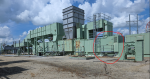
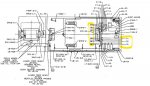
GE Frame 6b Generator connection location

We are performing a generator inspection on this 1980s vintage Frame 6b and are struggling to locate a good spot to determ and ground the generator. We don't have a good layout diagram. It's a short distance from the exciter and generator breaker to the generator but it's all sealed up. The covers we lifted so far do not have any connections. Has anybody out there seen one of these dinosaurs apart? Where is the best location to determ and apply grounds?
 
@borellimd,

If there is a GAC (Generator Accessory Compartment) on the collector end of the generator and the generator breaker is located in the GAC the generator output terminals are usually located under the floor in the GAC, and often the line side generator output terminals were located on the roof of the GAC. There were usually large CTs (Current Transformers) located under the GAC floor, around he generator output terminal cable or bus bars. There were usually drawers in the GAC for the PTs (Potential Transformers) above the generator terminal cables or bus bars. There were also usually removable covers on the base of the generator assembly to access lightning arrestors under the belly of the generator; sometimes they were under the floor of the GAC. That's where I've generally seen the testing ground cables attached, because the lightning arrestors shouldn't be in the circuit when testing is being done (at least in the dinosaur days).
 
@borrellimd

As @WTF? there should be a GNAC (Generator neutral accessory compartment) & GLAC (Generator Line accessory compartment this is linked by bus bar to the 52G Generator circuit breaker ).

Is that an Alstom or other OEM Generator?

If it is an Alstom or Elin I will search on the documentation that i got if i can find drawings/schematics

Regards,
James
 
GNACs and GLACs were developed post GAC.

This machine is supposedly a "dinosaur" and probably wouldn't have a GAC. But, then we don't know a lot about this dinosaur/machine.

GE didn't often use non-GE generators with Frame 6B machines; but licensees/packagers of GE machines sometimes did. So, as @ControlsGuy25 says that could be one reason why it's difficult to find the generator output terminals (line and neutral). Some GACs had removable panels which exposed bus bars which were connected to the generator terminals, but my experience was that for most Frame 5s and Frame 6Bs of 1980's and early 1990's vintage machines the generator terminals, CTs and lightning arrestors were under the floor of the GAC.
 
GNACs and GLACs were developed post GAC.

This machine is supposedly a "dinosaur" and probably wouldn't have a GAC. But, then we don't know a lot about this dinosaur/machine.

GE didn't often use non-GE generators with Frame 6B machines; but licensees/packagers of GE machines sometimes did. So, as @ControlsGuy25 says that could be one reason why it's difficult to find the generator output terminals (line and neutral). Some GACs had removable panels which exposed bus bars which were connected to the generator terminals, but my experience was that for most Frame 5s and Frame 6Bs of 1980's and early 1990's vintage machines the generator terminals, CTs and lightning arrestors were under the floor of the GAC.
You right I was ready to correct my posts

If it is a Alstom generator then you should look for MV platform drawings as it was called by Alstom
 
We are performing a generator inspection on this 1980s vintage Frame 6b and are struggling to locate a good spot to determ and ground the generator. We don't have a good layout diagram. It's a short distance from the exciter and generator breaker to the generator but it's all sealed up. The covers we lifted so far do not have any connections. Has anybody out there seen one of these dinosaurs apart? Where is the best location to determ and apply grounds?
The Manufacturer for the unit?

As Controls Guy and WTF have mentioned there are different configurations for the MV Cubicle dependent on manufacturer.

Some units have doors at the top of the NDE of the generator accessible from the outside, normally scaffold required to access. This is where you will find CT's VT's star point etc.. However the MV cubicle on these may have a fuse switch where you can attach earths normally opposite to the GCB location.

Others run it all out to the MV cubicle which is normally larger and easier to access. doors with panels behind to access the Generator Bus. You can attach earths here.

Best case is to study the MV cubicle in combination with the Generator/HV ducting drawings to establish earthing points.

Many times it ends up flexible working earths you attach.

What manufacturer is the unit I may be able to send you drawings.
 
Thanks for all the input!

This is a GE Frame 6b.

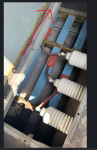
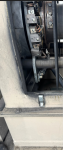
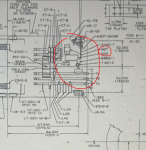
After reaching out here and other groups and contacts, we obtained ‘similar’ layout drawings and we lifted enough covers to locate the HV cables, bushings, and neutral grounding area.

The covers are on the floor at the end of the generator for the output and we were able to lift the DC cables off the collector brush rigging. We are grounding each end at those locations. This satisfied the crew doing the work.

I’ll attach the diagrams in case anybody needs to know in the future:

6b-asaurus rex, generator compartment:
1757336931569.png

1757336946042.png

1757336972158.png


A drawing of a machine  AI-generated content may be incorrect.


1757336993541.png
 
@borellimd,

Everything has an evolution, the 6B is no different. Back in the 60's, 70's, 80's and early 90's MANY GE-design heavy duty gas turbines packaged, sold, installed and commissioned by GE were for peaking power plants--MANY of which were unmanned. These machines were designed to be installed on a single concrete foundation, with foundation-embedded conduits for passing the cables that interconnected the various compartments. It made interconnecting them electrically and mechanically (lube oil and lube oil return lines, cooling water, etc.) "easier" and commissioning them "easier" (as long as the plug-connected cables were connected correctly!). It reduced the number of stand-alone modules and junctions boxes greatly. They were, however, not the easiest to maintain or repair--but the footprint was small and compact and could be easily constructed.

As GE sought to use similar modules for many different machines the number of "off-base" modules (think gas valve compartments and cooling water modules and control compartments (PEECCs) and water injection skids, etc.) increased and so did the construction, installation and commissioning times.

You may consider these machines to be dinosaurs, and yes, they are old and aging, but just because you aren't familiar with them and they have some rusty spots doesn't mean they aren't valuable power generation assets. (We lose hair in some places as we age, and gain it in other places (noses, ears); and the age spots on out skin start to appear and multiply and increase in size.)

You have--and are using--your contacts and networks and this forum to help you maintain and operate these machines and their auxiliaries. Good on you! The F-class machines (or whatever you're used to working on) were NOT the best machines in the early days of their existence (and SIZE doesn't make them any better than a 6B or a 7E/EA or even a 5P!). A LOT of money was spent using Antonov cargo planes shipping turbine rotors around the world to keep the F-class machines running even though they weren't being applied in the way they were designed to be applied. (They were built to be Base Loaded machines, not load-following machines started as quickly as possible and stopped twice per day in many instances. Essentially they were (are) being used as peaking machines when that's NOT what they were designed for--and it cost a LOT of money and effort to "convert" them to keep these high-maintenance machines running and producing power in the way they were being applied.

One of the beauties of GE machines is that they are scaled up (or down) but the basics of the machines stay the same. Just the way everything was arranged has evolved over time. Don't be afraid to open floor panels to find something because if it's not immediately visible, or overhead, then chances are good that it's behind vertical panels or under floors. The generator output has to get to the generator breaker, and the excitation has to get from the exciter to the brush rigging. What's really a shame is that many of the drawings for these older machines seem to have gotten lost on the sites where the machines are located--and the people that know where they might be have retired or passed. One of the frustrating things about these older machines was that the generator-related equipment drawings weren't put in the Operations and Maintenance Manuals. They were given over in "bankers' boxes" to someone and many times that someone didn't know what they being given or how to store them. As you have found, there ARE drawings--it's just that many of the generator-related (physical arrangements and even schematics) drawings weren't included in the O&M Manuals like they should have been--and they got lost or ratholed away somewhere never to be seen again.

Anyway, congratulations--and thanks for the feedback and photos!
 
Thanks for the follow up and info!

I ‘lovingly’ refer to them (and myself) as dinosaurs, 60s, 70s, and 80s vintage beasts that we are... We have spent many cold winter nights together, fishing through diagrams, chicken scratches on the wall, and tracing down cables and faults. I sometimes wake in the middle of the night with cold sweats from nightmares past. Looking forward to the next sleepless run…

These particular units are important. Strategically placed at the end of the line and were used to pick up the ‘slack,’ which happens less and less as the power line infrastructure is updated. Although, the increase in demand has cancelled some of that out, but 4-5 days a year is about it. We are trying our best to fight for proper maintenance, that’s the reason we needed to figure out how to determ and ground. As you commented, the experienced crew has since ‘moved on.’ With enough time and money they will continue long after me.

I happen to like the compartmental design that GE employs. Especially after working with some other manufacturers, I find the GE units easier to navigate. It’s nice to go from one plant to another and have a clue to where things are, or what the logic might look like. You will definitely pay extra for the meatball. With GE I’ve found that you might get a better product but you won’t pay more for it. As a former GE employee, I think I can say that. My personal experience, certainly up for debate, is that they (GE turbines in general) seem to be more reliable, given their own quirks. There are definitely plenty of people and groups with experience (and parts) locally.

I’ve been stationed at a couple of different 2x1 7FA/D11 for over 25 years including commissioning but have had the pleasure of helping at other plants including a few simple cycle 7FAs and these 6Bs (which are part of our immediate responsibility) as well as other ‘peakers’ and other brands. I also assist at a few coal plants (talk about dinosaurs- 50s and 60s vintage still with life to give) and started my career in power at a wood burning power plant in NH, a tea kettle on a wood stove compared to the large frame jets.

Forums like this, other user groups, networking and connections are invaluable. Sometimes if only for a sanity check, sometimes good for a laugh. I contribute words and parts at times when I can but appreciate the help for sure. I always try to close the loop on a post. I’ve looked for help on issues only to find my old post and the resolution helps me (and my failing memory) I hope it helps others.

Thanks for your contribution!
 
Top