MARK VIe

A

Thread Starter

AK

Dear friends on control.com

I Want to know why CD core is not required in MARK VIe. What is the difference between mark VI and VIe

 
GE were forced to upgrade the MK V because Microsoft no longer support MS-DOS.

I guess it doesn’t need it. There is sufficient horsepower in the new modules to process both the IO and comms. Each RST processor also has an ethernet connection so there comms redundancy by default. Why have 4 or 5 cores when 3 will do?

Hardware wise for the MKVI all the IO cards (and CPU and VCMI) resided in a VME chassis (sans VPRO) and were connected to the terminal boards via a multipin (proper name escapes me) copper cable.

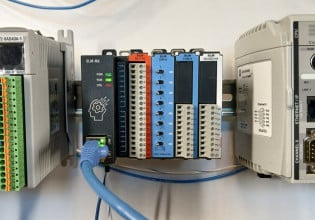
MKVIE (i think it should have been called MKVIIE) has no VME based rack. All connections between the CPU and the IO are via ethernet. Each component is pretty much an individual stand alone part with an ethernet cable and power supply connected to it.

There are a number of network switches in the panel for the CPU and IO modules to connect to. To keep the TMR scheme there are dedicated switches for networks R, S, T. The VPRO module/chassis has been replaced by a PPRO terminal board. The VCMI card, thankfully, has been eliminated completely.

There is not much difference in the field wiring, other than the MKVIE field modules having a higher density (phoenix contact style) terminal design. Some MKVI IO cards have been re-used with MKVIE. The difference is the hardwire cable has been replaced with an IO PACK. The IO PACK terminates the ethernet cable. Our Frame 6B site was retro fitted from MKIV to MKVI.

Panel wise there is very little difference between the two. MKVIE might need a little bit less space, but only 10-20%. Our MKVIE 9E units were a new installation and came in 2 bays. Our retrofitted MKVI 6B units were a single bay to conform to the original MK4. Internal factory panel wiring of both(typical of USA wired panels) is terrible and was not up to local regulations. European wiring is so much better. I really don’t know why USA wiring is so awful. From a hardware fault finding perspective I find the MKVIE panel is a little bit quicker and easier than MKVI. As each component has just a power and network cable faults are simpler to identify. The absence of a VCMI is a blessing.

From the IO terminals to the field devices there is no difference. I assume in time GE will start to place the IO modules in the field and just run a network cable back to the PEECE. I guess there's merit in this provided the IO modules can survive the environments.

Software wise MKVI used Toolbox and MKVIE uses ToolboxST. They both do the same things with a different face. Both are cumbersome and take 5 times as long navigate around in and find what you want. Think a hybrid of powerpoint, autocad and visio. (How I miss that Woodward GAP. It was a blessing to be able to print an A4 page and read the logic in front of you).

If you have done MKVI you can pickup MKVIE on the job. I did a GE course for MKVI a few years ago which was questionable, but for the MKVIE I had a very good working relationship and learned a lot from the GE tech.

Actual sequence logic style shows it's heritage all the way back thru MKVI/V/IV. ( An old timer told me it goes back to each relay in MK II).

Capability wise there is not much difference functional difference between the 2. Both have a good way to manage control constants. Down loading is similar, both have similar ways to download application code and IO config to the IO boards. MKVIE has an auto config options which is supposed to make things abit easier, but we've been told we need a toolbox upgrade ( again ! ). Trender and trip log are a bit more user friendly in the E, but getting down to it both have the same ability. Both have the same Alarm & Event Logger, and both our site have the same Cimplicity 6 point something.

HMI setup and architecture is the same but file management is a bit different. MKVI had individual M6B/ECB files for each unit. This has now gone to a single TCW file with "components". hmmm ....make your back ups. File structure aka, e:\site\cimproj, f drive, etc are the same. The hmb file has disappeared as the E uses OPC (there is a similar workstation import feature which i forget what its called) although the SDB is still used with MKVIE because the EX2100 is based on the MKVI platform.

Whilst it was a generational change for hardware and software, functionality/capability is not that much improved. So I gather that’s why it was named MkVIE rather than MKVII. I assume GE developed MKVIE to take advantage of modern manufacturing techniques and minimise cost/maximise profit (good for them), and the advantage for the customer (it's still early days for our site) but comparatively the MKVIE appears to have a high reliability hardware than MkVI.

Wish list wise it's not a long list. There seems to be a heavy reliance on network comms which combined with the tcw makes me a bit nervous. I believe in the kiss principle and every unit should by individualized. Redesign the toolbox interface, and ditch the ladder logic and start programming in SFC.
 
One other advantage for Mark VIe is that in addition to simplex and TMR architecture, there is now dual redundant processor architecture available which GE uses for HRSG and balance of plant control on combined cycle applications. The gas and steam turbine controls remain TMR.

Also, maybe I'm an "older" timer, but the sequence logic goes back to at least Mark I Speedtronic, and maybe even some fuel regulator controls.
 
> GE were forced to upgrade the MK V because Microsoft no longer support MS-DOS.
>
> I guess it doesn’t need it. There is sufficient horsepower in the new modules
> to process both the IO and comms.

Wow.

Both of those statements are, well, incorrect.

The real reason to move from the Mark V to the Mark VI was simply the availability of new hardware that dramatically improved the control system, both the turbine control panel and the operator interface.

The ARCnet-style LAN used by the Mark V was also a limiting factor going forward with the Mark V product line. Limiting in the sense that it forced having a separate network topology and protocol from an Ethernet-based network in use with Mark VI and Mark VIe.

The differences and similarities between Mark VI and Mark VIe have been covered in previous control.com threads. If the original poster has specific questions about differences or similarities we can address those here.
 
>Both of those statements are, well,
>incorrect

Ok, I concede one is incorrect. Do you know which one ?

I thought this board could do with some dry humor which may not be apparent to all.

I was curious who would bite first ... looks like we have a winner.
 
The humor is so dry, it's wilted and blown away, never to be seen.

>I guess it doesn't need it.

Now there's a good reason. "I guess...."

And an even more laughable explanation.

Now there's some humor!

 
Well, the Microsoft thing isn't right; it isn't even wrong, as the Mark V PCs ran DR-DOS, not MS-DOS. :)

And for the <CD> question, well, the architecture is simply different. In the Mark VI, the I/O processing took place in VME cards, aggregated through the VCMI to the controller. In the Mark VIe, that has all moved to the I/O packs (each of which is a standardized QNX based embedded device coupled to an I/O specific daughter board).

The main reason the Mark VIe isn't a Mark VII was that it was fundamentally the same control system as far as turbine control goes. Lots of improvements, of course, but the same philosophy--and terminal boards. Upgrading a Mark VI to Mark VIe is relatively easy, as nothing from the terminal boards on has to be replaced, and the application software can be upgraded from Toolbox to ToolboxST.

Where the Mark VIe is much better is in remote I/O capability and BOP/DCS control. There are a fair number of large plants where the entire DCS is Mark VIe, not just the turbine controls, and much of the enhancements to the platform are designed to support BOP/DCS.

With remote I/O, if you don't design your plant with it in mind you don't get the cabling benefits; GE has been redesigning its new plants to do so. Whole skids can be delivered to site pre-wired, with just power and Ethernet connections required on site.

The Mark VIe also has many more I/O options than the VI, as adding a new type of I/O involves just plugging a new I/O pack into a switch. I'd go through the list, but I'm already sounding like a marketing guy, which I try very hard to avoid.
 
S

Saudi_contract

> Well, the Microsoft thing isn't right; it isn't even wrong, as the Mark V PCs
> ran DR-DOS, not MS-DOS. :)

Is this correct. The <I> still needs a base layer of MS-DOS, with IDOS loaded on top ? Is DR-DOS and IDOS the same thing. Typing VER at the cmd prompt on the <I> tells us MS-DOS 6.22
 
the major difference between mark6 and mark6e is the fact that now the mark6e TMR is able to manage a 10ms frame rate mainly for aeroderivative turbines (LM and PGT). before Mark6e they had to use simplex to manage this rate.
 
Top