Facebook
 Google
 GitHub
 Linkedin
Predictive Maintenance Made Possible Through the Arduino UNO Q Board
By analyzing equipment behavior at the edge, the Arduino UNO Q provides a low-cost entry point into predictive maintenance to detect failures before downtime occurs.
Predictive maintenance has become the gold standard for simultaneously reducing costs and downtime on production lines. However, it can seem intimidating to add to a process based on upfront costs and the need for additional sensing and computing capabilities.
The Arduino UNO Q can be used for the data collection and analysis used for predictive maintenance at the edge of the system. Lower starting cost and ease of scalability are two primary advantages of using a microcontroller for predictive maintenance over a fully integrated control system.

The Arduino UNO Q serves as a compact, low-cost solution for data collection in industrial predictive maintenance. Image courtesy of Arduino
Reactive, Preventive, and Predictive Maintenance
There are three major maintenance categories: reactive, preventive, and predictive.
Reactive maintenance occurs when a component breaks and a machine is forced into unplanned downtime for repair, such as a car breaking down on the side of the road.
Preventive maintenance is scheduled tasks that can reduce the number of breakdowns, such as regular oil and tire changes. These reduce downtime as compared to reactive maintenance, but often sacrifice good, used components. Sometimes, the engine oil is not that dirty, or a belt “ages out,” even though it still has useful life.
Predictive maintenance combines historic and sensor data to determine when a component will fail. Before it does, the maintenance can be scheduled. This further reduces downtime and saves on costs, as good, used components are not discarded. The challenge is that the effectiveness of predictive maintenance is limited by the quality of the data and the data analysis performed.
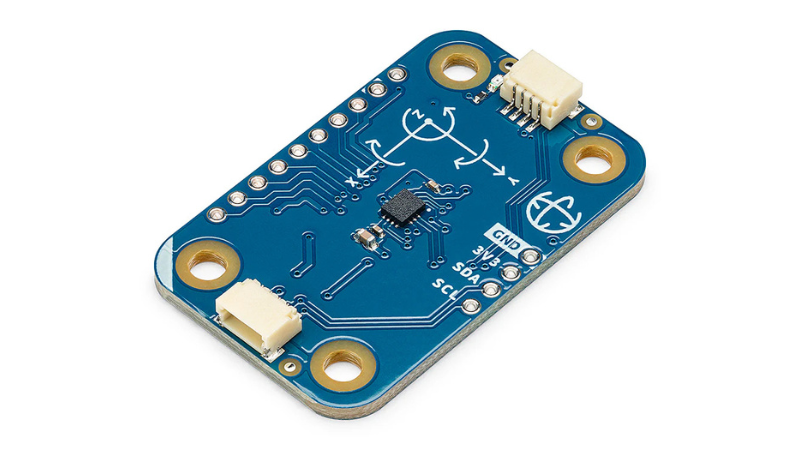
Arduino Modulino movement sensors mount directly onto mechanical equipment to measure vibration across three axes for real-time tracking. Image courtesy of Arduino
Arduino UNO Q to the Rescue
One of the most telltale signs of impending mechanical failure is new vibrations. Whether a cooling fan has collected enough debris to be out of balance, or a set of pump bearings is oil-starved and eroding, new signals will show up long before failure. By the time the machine is making an audible sound, it is too late, and it will require unplanned downtime.
The Arduino UNO Q can detect these changes, especially through the use of Arduino Modulino movement sensors. These sensors detect vibrations along three axes and can be easily mounted on mechanical equipment.
Sensing vibrations helps, but more data means more occupied bandwidth on the network. The UNO Q can perform some of the signal analysis, only passing on problematic signals to the cloud, instead of sending all data through. From here, anomalies can be used to trigger alarms, buzzers, or affect an overall risk score, alerting operators to problems in advance. Fine tuning reduces the number of false alarms.
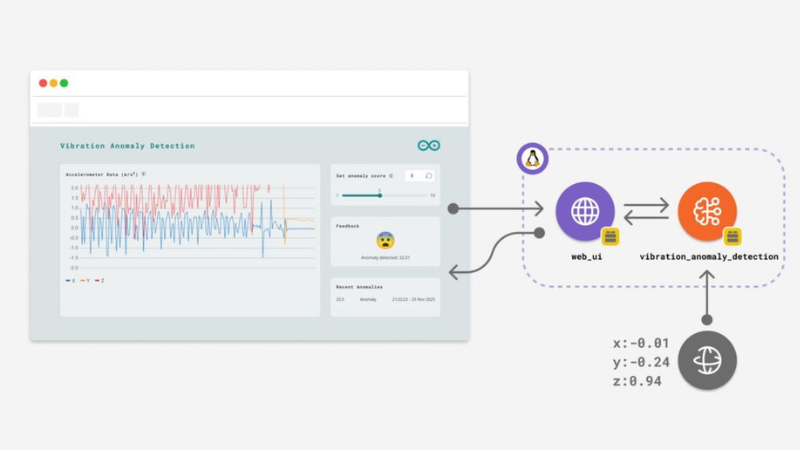
Local vibration detection enables the UNO Q to analyze equipment movement on-site and filter out normal operating background noise. Image courtesy of Arduino
The Microcontroller Advantage
All of this data collection and signal analysis could be performed on a more complicated, comprehensive control system. However, using a microcontroller, like the Arduino UNO Q, means a lower starting cost and more tailored edge systems.
The Arduino UNO Q enables engineers to scale up their predictive maintenance program a piece at a time. It can run independently alongside existing industrial control systems, without interfering with them at all.
Example Case
Consider a liquid transfer pump with a high duty cycle that is central to the plant’s operation. In the past, the pump failed and was replaced. A preventative maintenance program was introduced. Now, the pump is routinely taken out of service on a scheduled basis, and the bearings, gaskets, and wear surfaces are replaced.
The Arduino UNO Q is the final step: predictive maintenance. It measures vibrations and detects trends and anomalies that may indicate a gasket or bearing is failing. Repairs are only done on a necessary but scheduled basis.