Facebook
 Google
 GitHub
 Linkedin
Delta Motion Gets RMC Controllers Into Shape With Trapezoid Command
The company has added a Trapezoid Waveform Command to its RMC motion controllers, providing configurable cyclic position, pressure, and force profiles for testing applications.
Delta Motion has added a new Trapezoid Waveform Command to its RMC Motion Controllers for generating repetitive motion profiles used in test and automation systems. The command supports position as well as pressure or force control and is available across the RMC75, RMC150, and RMC200 controller families.
The new command expands the waveform capabilities already available in the RMC platform, which include sinusoidal and curve-based profiles. Rather than programming a series of individual motion segments in a PLC, engineers can generate continuous cyclic waveforms directly in the motion controller. Parameters including amplitude, offset, frequency, rise time, high time, and fall time can be configured for the application and adjusted while the waveform is running.
Delta Motion’s RMC controllers will now feature a Trapezoid Waveform Command, which gives users more capabilities for testing and automation. Video courtesy of DeltaMotionControl
Building Different Waveforms From a Single Command
Although Delta calls it the Trapezoid Waveform Command, the function is not limited to trapezoidal profiles. By adjusting the rise, high, fall, and low portions of each cycle, engineers can generate several common waveform shapes from the same command and tailor the motion or force profile to the requirements of the test.
- Square Wave: Provides rapid transitions between two levels, making it useful for cyclic loading or tests that alternate between defined states.
- Isosceles Triangle Wave: Uses equal rise and fall periods without sustained high or low portions, producing a continuous linear ramp in either direction.
- Isosceles Trapezoid Wave: Adds high and low dwell periods to the linear rise and fall, allowing a commanded position or force to be held for a defined period before transitioning.
- Sawtooth Wave: Uses unequal rise and fall times to provide a gradual ramp in one direction followed by a faster return, or the reverse.
With a triangular waveform, the form continuously ramps between its minimum and maximum values, which means there is no time spent holding either condition. That can be a limitation in tests where a specimen must reach a specified load or position and remain there before the next transition. A trapezoidal profile adds adjustable high and low dwell periods, allowing the test to control both the transition rate and the amount of time spent at each extreme.
As for the new features of the Trapezoid Waveform Command, the waveform does not have to remain fixed once a test begins. Engineers can adjust parameters such as amplitude, offset, phase, and waveform shape while the command is running, without stopping and rebuilding the motion sequence. For example, a square wave duty cycle can be changed over a specified period or number of cycles, while a triangle waveform can gradually transition into a sawtooth profile during operation.
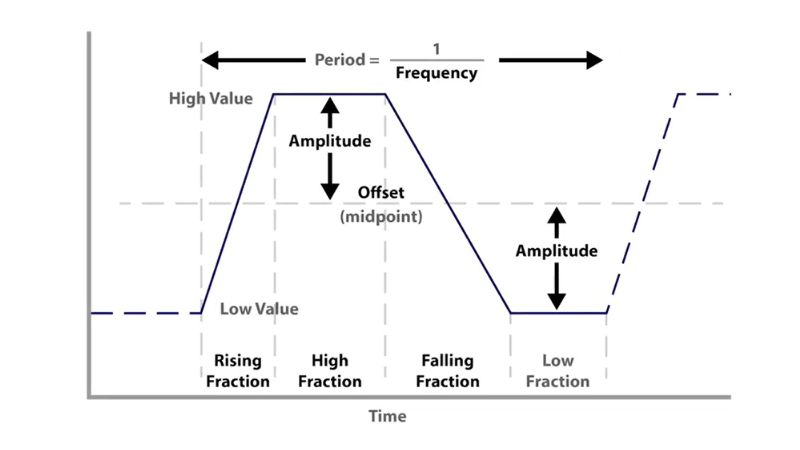
The Trapezoid Waveform Command defines the rising, high, falling, and low portions of a cycle, along with amplitude, offset, and frequency. Image courtesy of Delta Motion
Trapezoid Control for Testing Applications
Having the ability to modify waveform parameters during operation is particularly useful in test systems where conditions may need to change throughout a test sequence. Amplitude, offset, phase, and waveform shape can be adjusted without stopping motion, allowing test conditions to be changed without rebuilding the underlying motion program.
For force-controlled applications, adaptive amplitude control becomes useful when test conditions do not remain constant. In a fatigue test, for example, a specimen may become softer or stiffer after thousands of load cycles. The controller can adjust the waveform amplitude as those conditions change while maintaining the requested peak force. In material testing, an engineer could repeatedly load a rubber sample, composite, or metal component to measure how it responds as the applied force changes over time. For component durability testing, the waveform could reproduce the repeated forces experienced by a suspension component, hinge, or mechanical assembly during normal operation. In each case, the test profile can be adjusted to more closely represent the loads and movements the component is expected to experience in service.
Waveform generation takes place directly in the RMC controller rather than relying on PLC scan cycles or network updates. The controller handles the repetitive motion internally, removing the need for the PLC to generate each segment of the waveform. This also keeps waveform timing within the motion controller, which can be important in testing applications where the same motion or force profile may need to be repeated over a large number of cycles.
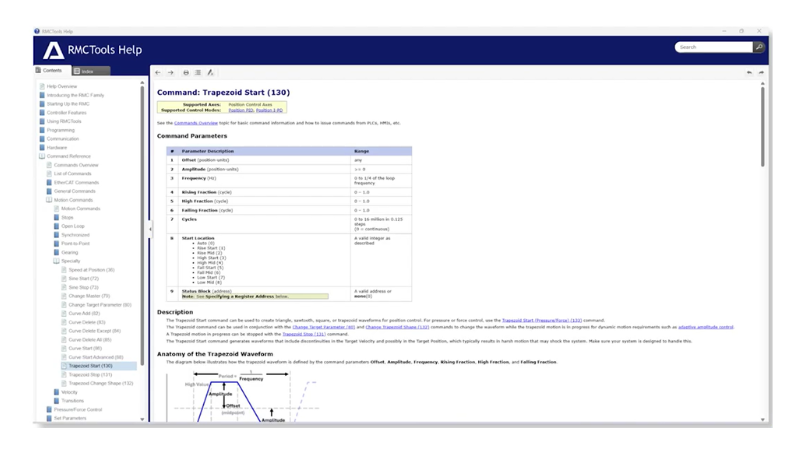
Users can complete controller setup, tuning, and programming across RMC controllers with Delta's RMCTools software. Image courtesy of Delta Motion
Across the RMC Controller Family
The Trapezoid Waveform Command will be available across Delta Motion's RMC75, RMC150, and RMC200 Motion Controllers. The controller used depends largely on the size and number of axes in the test system. An RMC75, for example, can handle one- or two-axis applications such as a standalone hydraulic test actuator. The RMC150 supports up to eight axes for test machines that need to coordinate several actuators, while the RMC200 extends the same control approach to larger systems with up to 50 axes. This allows the new waveform command to be used across anything from a relatively simple component test stand to larger multi-axis testing equipment.
Controller setup, tuning, and programming are handled through Delta's RMCTools software. By adding the Trapezoid Waveform Command across the RMC family, Delta gives engineers another controller-level option for building repetitive position and force profiles without developing a separate waveform generator in the PLC.