Facebook
 Google
 GitHub
 Linkedin
Oriental Motor Adds Z-Axis Motion to OVR and SCARA Robots
Add controlled vertical motion to OVR and SCARA robots with Oriental Motor's EL Series electric lifting columns, available in four lift heights.
Oriental Motor has introduced the EL Series of electric lifting columns, giving its OVR and SCARA robots an additional axis of controlled vertical motion. Available in four lift heights from 50 to 300 mm, the columns provide rigid support while helping robots reach multiple workstations or transfer components between stages. The ball-spline construction is designed to improve precision and vibration damping, making the system suitable for material handling, packaging, assembly, and semiconductor equipment applications.
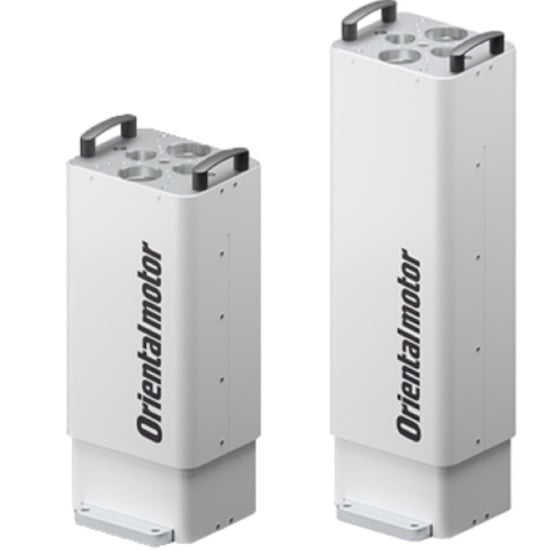
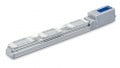
Oriental Motor EL Series Electric Lifting Columns. Image used courtesy of Oriental Motors
Lifting Columns
Lifting column robots, such as the EL series, have one major purpose. They give machine designers a way to take an existing robot z-axis capability. A robot mounted on the top of the column can now be lifted in a tightly controlled manner, allowing it another axis of motion.
One of the primary advantages of this system is that a lifting column provides significantly stiffer support for a heavy robot when compared to other lifting schemes. For example, track-mounted lifters or vertical guides may not support a heavier robot as well, meaning the z-axis precision is much less repeatable. This is a major problem for robots that reach far from the center, where the center of gravity moves away from the center of the robot.
Outside of materials handling, machines that are performing assembly or machining operations in this situation experience Tool Center Point (TCP) wobble. If the TCP moves around from workpiece to workpiece in response to robot motion, that is a major quality control issue.
By lifting from the bottom of the robot, a lifting column also maximizes the work area available for the robot. If a robot requires tracks and guides, this cuts into that workspace, limiting options for space and motion.
Features of the EL Series Column Electric Lifting Robots
The EL series column electric lifting robots are available in four lift heights: 50 mm, 100 mm, 200 mm and 300 mm. Furthermore, the EL series can handle torque of up to 80 N*m, or objects up to 30 kg, making them suitable for lifting objects and extending them onto nearby workstations or storage locations. The rigid, ball-spline construction provides support and vibration damping, also increasing the accuracy of the movements.
Oriental Motors has designed these robots to pair with their line of OVR or SCARA robots. They simply bolt on top of the lifting column, which gives each robot z-axis capability.
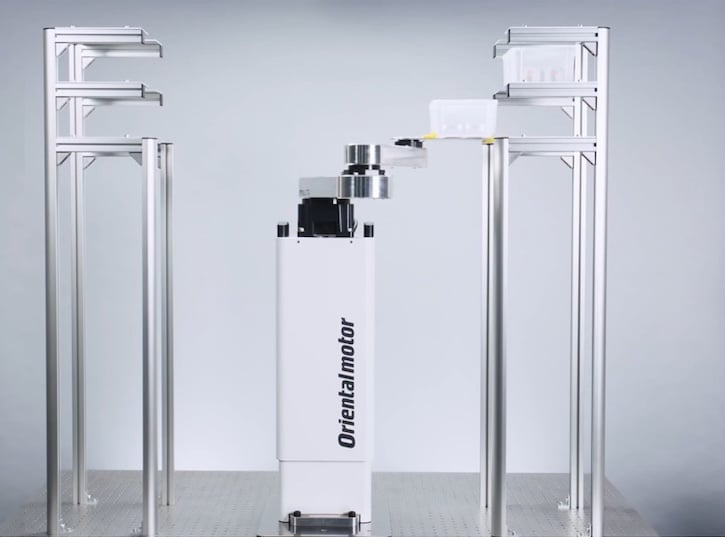
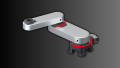
The pairing of the OVR rotating robot (top) and the EL column lift (center) as it rotates between work stations at different heights. Image used courtesy of Oriental Motor
Potential Applications
One potential market for this system is in semiconductor equipment manufacturing. In wafer handling applications, semiconductor wafers are routinely transferred between work stations and the Front Opening Unified Pods (FOUP). For example, a wafer in a lithographic scanner may need to move between spin coaters, ovens, and exposure stations inside the scanner, and this combination of lifting and turning is the ideal tool for performing these operations.