Facebook
 Google
 GitHub
 Linkedin
Banner Adds IO-Link To Three-Axis Vibration and Temperature Sensors
In addition to IO-Link connectivity, Banner’s QM30VT3 sensors feature an ultra-low noise third axis for flexible installation and onboard machine learning for improved early fault detection.
Manufacturers continue to seek practical ways to reduce unplanned downtime without increasing system complexity. Banner Engineering’s new QM30VT3 three-axis vibration and temperature sensor now includes IO-Link connectivity, expanding integration flexibility while maintaining the sensing and diagnostic capabilities required for predictive maintenance applications.
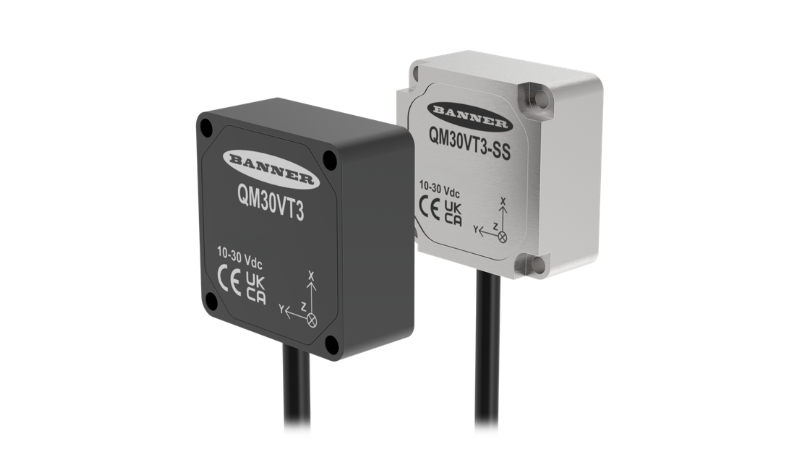
Banner has added IO-Link connectivity to its QM30VT3 3-axis vibration and temperature sensors. Image used courtesy of Banner Engineering
QM30VT3 Sensors With IO-Link
With the addition of IO-Link, the QM30VT3 sensors provide process data as floating-point or integer-based values in both imperial and metric units. User-defined profiles allow cyclic data to be configured with only the most relevant overall values. This simplifies PLC programming and reduces control logic overhead. The sensor can also operate as a smart vibration switch using its configurable discrete output after commissioning via IO-Link, enabling deployment in systems without an IO-Link master.
All QM30VT3 models feature true three-axis vibration detection across the X, Y, and Z axes, delivering a complete representation of machine health regardless of mounting orientation. Ultra-low noise performance on all three axes improves measurement reliability and allows flexible installation when space constraints limit positioning options.
Many three-axis MEMS sensors exhibit higher noise density on their third axis, reducing sensitivity and potentially masking early-stage faults. The QM30VT3 supports accurate detection of imbalance, misalignment, looseness, and bearing wear in motors, pumps, fans, conveyors, and gearboxes by maintaining consistent low-noise performance across all axes.
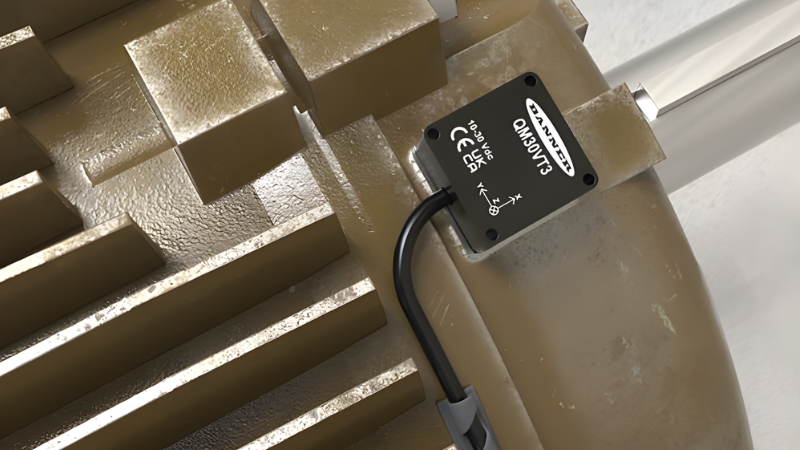
Banner’s QM30VT3 sensor mounted directly to a motor housing for continuous vibration monitoring. Image used courtesy of Banner Engineering
Expanded Frequency Bandwidth for Earlier Fault Detection
The QM30VT3 operates across a wide frequency range of 6 Hz to 5.3 kHz, enabling monitoring of both slow- and high-speed assets. Expanding the upper bandwidth beyond traditional 4 kHz limits allows the capture of high-frequency impact signals associated with early bearing and gear defects.
The sensor’s adjustable frequency maximum (FMax) setting enables users to tailor resolution to specific machine speeds. Higher FMax values capture broader frequency ranges suitable for high-speed equipment, while lower FMax values extend sampling duration and increase resolution for slow-moving machinery. The sensor’s high-frequency enveloping (HFE) further improves detection of bearing and lubrication issues by filtering out dominant low-frequency process noise and isolating weak high-frequency fault signatures.
A high 26.8 kHz sampling rate supports detailed analysis of short-duration transient events, improving visibility into developing faults before they escalate into failures.
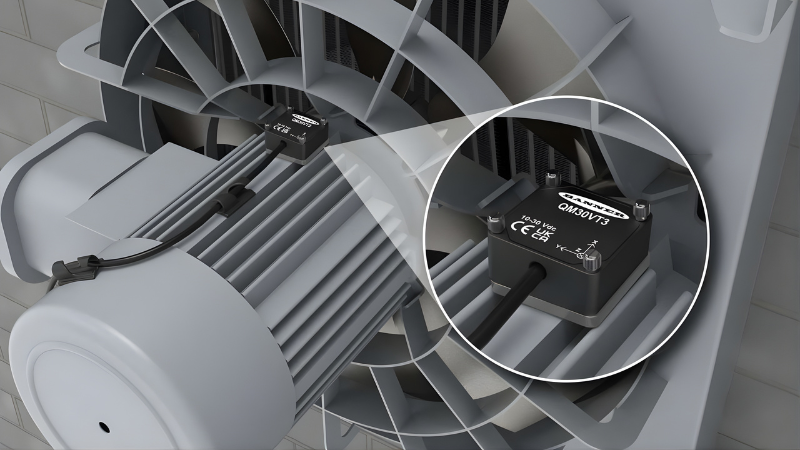
VIBE-IQ analyzes root-mean-square-velocity trends to automatically establish baselines and generate early warning thresholds. Image used courtesy of Banner Engineering
Onboard Machine Learning Simplifies Predictive Maintenance
The QM30VT3 integrates VIBE-IQ, an onboard machine learning algorithm that continuously analyzes vibration data across all three axes. The system automatically establishes baseline patterns and generates warning and alarm thresholds without requiring external analytics software or vibration expertise.
VIBE-IQ reduces the sensor’s reliance on external controllers and simplifies deployment in both new and retrofit applications by processing data within the sensor itself. The result is earlier fault detection with fewer false alarms, supporting the shift from reactive to predictive maintenance.
Flexible Deployment Options
The QM30V3 is available in both line-powered and wireless battery-powered configurations. Wireless models integrate vibration sensing, radio communication, and battery power in a single housing or allow separation of sensor and radio when mounting constraints require flexibility. MultiHop radio compatibility enables transmission of vibration data across facilities to centralized gateways. Line-powered configurations support continuous monitoring applications and direct integration into industrial controllers. Battery-powered models provide more than 24 months of operational life, depending on reporting intervals.
The QM30VT3 is designed for long-term operation in industrial environments with its compact aluminum enclosure. Typical applications include monitoring of motors, gearboxes, conveyors, and rotating equipment where early detection of imbalance, misalignment, and bearing wear can prevent costly downtime. The QM30VT3 expands access to high-resolution machine health monitoring across a broad range of automation environments by combining wide frequency coverage, ultra-low noise 3-axis sensing, onboard analytics, and flexible connectivity.