Facebook
 Google
 GitHub
 Linkedin
Orbex Advances Mobile Robotics With Optimized Compact Wheel Drives
Orbex Group has introduced its latest mobility-enhancing technology for autonomous mobile robots and automated guided vehicles in industrial environments: compact wheel drives.
Orbex Group has released a line of compact wheel drives for autonomous mobile robots (AMRs) and automated guided vehicles (AGVs). The CWD-1000 and CWD-500 models have a 15:1 gear ratio and integrated encoder, motor, and wheel combination units. Orbex is a global manufacturer of high-performance motors and slip rings — the compact wheel drives are the latest addition to the company’s offerings.
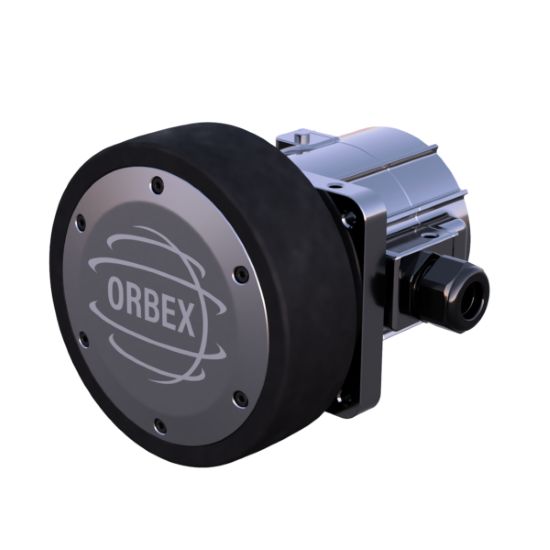
Orbex’s wheel drives feature a compact build, IP54 protection, and optional customizations. Image used courtesy of Orbex
Autonomous Mobility by Design
AMRs and AGVs employ a variety of structural designs to aid mobility and achieve optimum navigational capacity to suit different environments. Some mobile robots employ four-wheel drive and/or separate motors for independent movement of each wheel. Of course, the main difference between AMRs and AGVs is that the latter moves via a fixed path, and the former navigates independently using simultaneous localization and mapping (SLAM) technology, integrated sensors, and feedback systems in the external environment.
For AMRs using SLAM technology, sensor signal processing and pose graph optimization are employed to build a map of the robot’s surrounding environment and assess locality in relation to objects within that environment. Light detection and ranging (LiDAR) SLAM uses lasers to determine AMR location relative to its environment. To concurrently map the environment and locate the robot, LiDAR sensors emit laser beams, measure the distances to barriers, and combine the information using algorithms. Its benefits include accurate navigation in difficult or shifting surroundings, no need for a GPS, and dependable operation under any lighting situation.
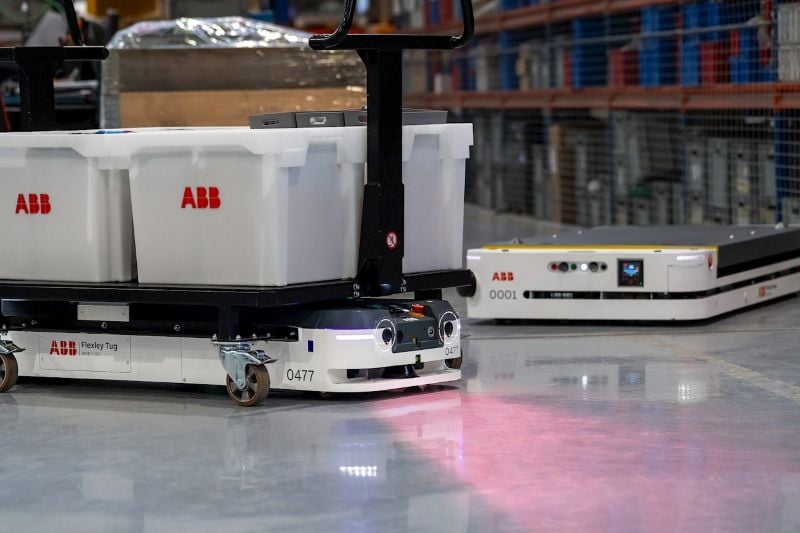
AMRs and AGVs have differing mobility capacities depending on wheel design and motor flexibility. Image used courtesy of ABB
Mobile Robot Wheels
Returning to motors and wheels, AMRs and AGVs can employ wheels at the center of the vehicle or have them fitted to the outer edges of the vehicle, which can mean added stability when carrying particular objects of a specific shape, size, and load.
AMRs can use four primary types of motors and wheels: Ackermann steering, omnidirectional, differential drive, and Mecanum wheels. A differential drive consisting of two separately operated motors and a rear caster can turn precisely in small lanes but is not as stable on rough terrain. With numerous rollers per wheel, omnidirectional wheels allow for movement in all directions without requiring rotation, providing remarkable agility in confined industrial areas.
Ackermann steering, which is similar to vehicle steering, gives larger AMRs stability and agility on level ground, while Mecanum wheels, with their unique omnidirectional construction, having slanted rollers, provide smooth diagonal and lateral mobility, making them perfect for customizable layouts. To improve automation and productivity in industrial workflows, engineers must choose these settings carefully, taking into account the needs of the application while harmonizing speed, load equilibrium, and accurate placement.
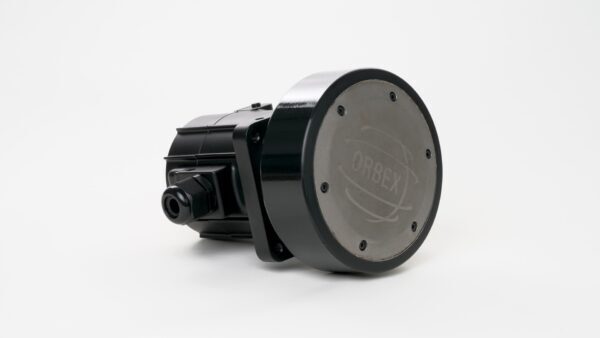
Orbex’s CWD-1000B compact wheel drive with an integrated brake. Image used courtesy of Orbex
Compact Wheel Drives
The CWD-1000 and CWD-500 wheel drives feature an operating temperature of -10 to 40 °C, an ingress protection rating of IP54 (protecting against dust and water splashes from all directions), and a 30,000-hour life cycle.
The 600-watt CWD-500 and the 1,200-watt CWD-1000 have small form factors and minimum axial length, making them both suitable for small installation areas. The standard wheel diameter for each wheel drive is 160 mm, while bigger sizes are available for customers seeking a different application fit. Strong performance under heavy load situations is supported by the design's emphasis on high power and torque density alongside sizable axial and radial load capabilities.
The CWD-500 and CWD-1000's main feature is an inbuilt gearbox that transfers power in a manner that reduces energy loss, exhibiting a 90% reducer efficiency with a 15:1 gear ratio (15 motor revolutions equal one wheel rotation). The 16,384-count encoder integrated with both wheel drives provides high resolution, capturing 16,384 steps per revolution for precise estimation of rotational position and motion. The wheel drives are also designed to keep backlash, or mechanical in the gears, to less than 30 arcminutes to provide precise and continuous motion.