Facebook
 Google
 GitHub
 Linkedin
Siemens Brings AI and Software Workflows to Industrial Engineering
AI-powered visualization and simulation tools from Siemens help engineers accelerate automation development, collaborate more effectively, and test designs faster.
Siemens is adding artificial intelligence and modern software development practices to industrial engineering with updates to its automation and simulation portfolios. SIMATIC AX WinCC Unified Elements brings Git integration, code-based workflows, and AI-assisted visualization development to HMI engineering, while expanded Simcenter capabilities use AI to accelerate simulation and explore new designs. Together, the releases target manufacturers looking to shorten engineering cycles, improve collaboration, and gain faster insight into automation and product development decisions.
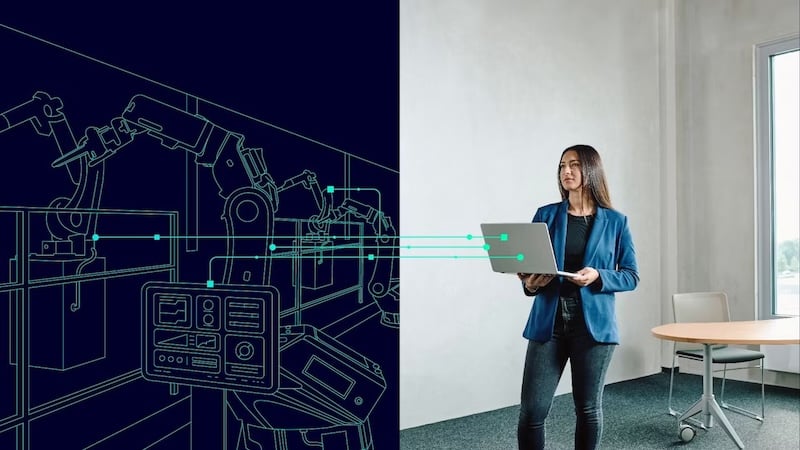
SIMATIC AX WinCC Unified Elements modernize HMI engineering. Image used courtesy of Siemens
SIMATIC AX WinCC Unified Elements Brings IT-Style Workflows to Automation
The first update expands the SIMATIC AX ecosystem, which was mainly used for PLC programming, into visualization engineering with SIMATIC AX WinCC Unified Elements. This brings an IT-style development approach to automation.
Native Git Integration Enables Software-Style Collaboration
Siemens says the software lets engineers build, version, and deploy visualization projects using workflows similar to those in software development. Features include code-based development, built-in Git integration, and support for team collaboration, such as branching, merge requests, commit history, and rollback. Git helps track all engineering changes and lowers the risk of conflicting edits, making it easier to use modern CI/CD pipelines. The platform uses an everything-as-code approach, storing project scripts, visualization objects, alarms, tags, and engineering data as readable files.
YAML-based Project Generation
A key feature is using easy-to-read YAML files to create entire projects. The platform uses AI-assisted engineering, where large language models (LLMs) can directly change or build project structures. This helps automate repetitive tasks and keeps projects consistent. The tool also supports hybrid workflows, so instead of setting up thousands of HMI objects manually, engineers can define project structures by editing code directly.
Open Architecture Built on Visual Studio Code
With an open architecture, users can run custom web controls in the same environment, and teams can customize the IDE with extensions from the Open VSX marketplace. This supports different programming languages and AI assistants. The result is a flexible, secure development environment built to adapt over time. For industrial organizations under pressure to shorten project timelines, the appeal is clear. By combining visualization engineering with modern software practices, Siemens is aiming to make automation development faster, more traceable, and easier to manage across distributed teams.
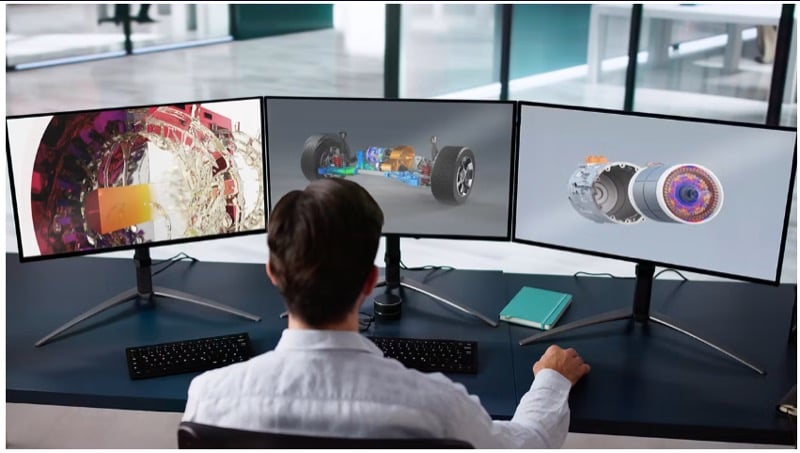
PhysicsAI Generate creates new engineering concepts from design constraints and historical simulation data, expanding design-space exploration through physics-aware generative AI. Image used courtesy of Siemens
Simcenter Expands AI-driven Engineering Simulation
Siemens also announced a big update to its Simcenter portfolio, combining Siemens and Altair simulation technologies into a more unified engineering environment. A key part of this update is Simcenter PhysicsAI, Siemens’ geometric deep learning technology. According to the company, PhysicsAI can build predictive models for simulation data and help engineers test ideas up to 1000 times faster than traditional simulation methods in some cases. With multi-GPU support in Simcenter STAR-CCM+, AI model training for fluid dynamics can be much faster. Together with expanded support in Simcenter Inspire and HyperMesh, these updates aim to make AI more useful for a range of simulation tasks.
A Shared Direction Across Both Launches
While these two announcements target different areas of engineering, they share the same goal. For automation engineers, SIMATIC AX WinCC Unified Elements could make project creation and maintenance smoother by adding Git, YAML, and AI to the workflow. For simulation teams, the new Simcenter features offer faster idea testing and earlier design feedback. Both solutions are aimed at manufacturers who want to bring products to market faster and improve engineering consistency.