Floating neutral

A

Thread Starter

Aman Jethi

since last two weeks I am facing a problem. sometimes N-G voltage is coming around 230 V. test bulb glows fully if held b/w neutral and ground.

But,when this happens tester doesn't glow at one of the phases (sometimes Y or B or R), but machine attached to that phase runs fully.

please throw some light on it.....
 
C

curt wuollet

It would seem that your neutral is connected to the phase where the lamp doesn't glow. Other than that it's pretty hard to say without knowing just how the distribution is set up. The 3 phase machines run because they don't depend on the neutral, only single phase loads would. It would seem that the neutral is not tied to ground so a single phase load may be what is tying it to a phase. If it were here, I'd look for an open neutral wire back to the service, but long ago I've learned that practices vary widely around the world. That would be my first guess as I think an ungrounded neutral is uncommon.

Regards
cww
 
W

William Hinton

Aman,

Yes, I agree with ccw.

I have seen this from various viewpoints; in some facilities they have removed the neutral bond to reduce ground fault current for continuity of service, some have done it to reduce the arc-flash “blast radius” and sometimes the bond simply is removed by mistake or the connection becomes corroded.

There is a simple rest procedure you can use to locate the source of the ground in your facility while equipment is in service. Take a current clamp around all (3) phase conductors leaving the power panel, substation or breaker box. The total current should be very low, typically less than ½ amp or so. The circuit with the highest current is the circuit with the ground forming. You can continue this at the feed to each machine to find the area to concentrate on and test the phases to each (3) phase running motor or load to determine which actual load has the ground.

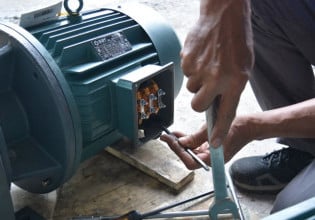
This is a differential current method of locating grounds in an ungrounded power system. I have done this many times and typically find the ground at the motor terminal box where the insulated connections vibrate and wear through the insulation allowing them to ground out on the cover. Other typical areas are terminal boxes with water and motors with windings starting to breakdown and fail.

Sometimes you may read more than system voltage to ground with your volt meter if the ground problem is an arcing ground fault. We have found this with water in an outside light fixture as well.

Many VFDs will fault when the phase voltage unbalance exceeds 10% as it faults for a phase loss. We have had this problem with Siemens, Fanac, Indramat and some Square D drives.

Motors operated from across the line starters do not have this problem as they operate on line to line voltages.

I hope this helps,

William Hinton
Sr. Electrical Engineer
Delphi Automotive
 
Top