Frame 9 VGC

Hi Guys,

Having a long standing issue with our VGC3 Transfer Valve.

Unit fails to operate on initial movement which causes the unit to go into Lean Lean operation. Upon dropping back in load and coming back the valve will operate correctly.

When calibrating/slew test it can take anywhere from 11 to 18 seconds to operate.

Valve has been calibrated. Servo replaced. VGC 1 VGC2 and SRV operate correctly.

Any assistance will be appreciated.
 
@MBartley,

Some things for you to consider....

If the valve is made by Woodward Governor Co. they are known to require more maintenance than other manufacturers' similar valves used in this application. Most Woodward Governor Co. gas control valves require them to be shipped to Woodward for repair/refurbishment.

Most hydraulically-operated gas control valves of GE-design heavy duty gas turbines have a small filter at the manifold block where the electro-hydraulic servo valve is mounted. Sometimes these have a small "button" which pops up to let someone making rounds/inspecting the valve know the filter is dirty and needs to be changed. Often these filters never get changed and they can rupture and send dirt to the servo and actuator. Or they can be so dirty they restrict flow to the servo/actuator.

Are you 100% certain the valve's configuration is correct? Null bias current. Regulator gain. The values in the Mark* should match the values in the Control Specification for the particular valve. The standard null bias current value of 2.67 should be used when replacing a servo if the servo being replaced used something other than 2.67. When replacing servos be sure the valve regulator configuration at least begins with the recommended values, and only changing them with good reason. One of the really good qualities of GE heavy duty gas turbine hydraulically-operated devices is that GE knows how to calculate all of the settings/parameters eliminating the need to "tune" the regulator--just follow the Control Specification settings/parameters and all should be okay.

Whenever replacing an electrohydraulic servo valve on a GE-design heavy duty gas turbine it is VERY important to make sure the polarity of the currents being applied to each of the three servo coils is correct. Positive servo current closes the valve (shuts off the flow of fuel) and negative servo current opens the valve (increases the flow of fuel). This test should be done under the control of a single processor (of a TMR panel) to be sure the currents are the correct polarity. The procedure for servo current polarity testing has been detailed MANY times on Control.com. The blather in GE Control Specifications about jerky movement when stroking the device means the servo currents do not all have the same polarity is bunk and incorrect. I have personally removed many NEW (not rebuilt) servos from the OEM packaging and corrected them using the same colors as on the servo that was being removed--only to find that the polarity of one or two coils is reversed BY THE FACTORY. (This occurs also, and even more frequently, on rebuilt servos....)

Are you monitoring and checking the alarms--BOTH Process- and Diagnostic Alarms--which are annunciated when the machine is running and having the sluggish movement issues? (What are the alarms? Alarms like 'valve not following reference', 'servo current mismatch', 'LVDT mismatch', etc.)

Is the oil regularly tested, and cleaned, if necessary? (When were these machines installed and commissioned?)

VGC3 is usually the last in the series of gas valves, meaning it's the furthest away from the hydraulic supply pressure as it enters the gas valve module. Has anyone inspected the feed and drain lines of VGC3? Is there some kind of module vent fan or module heater nearby VGC3?

Is this machine a "peaker"--meaning it doesn't start and run very often and only when power requirements are high? Or is it a load-following machine that starts and stops when contract conditions require, sometimes multiple times per day? (Usage could affect valve/servo/servo manifold conditions with a heavier than normal varnishing build-up.)

What Mark* turbine control system is in use on the machine? If it's a Mark* VI or -VIe do the servo cards for VGC3 have any Diagnostic LEDs lit amber or flashing? Is it an upgraded Mark* V to Mark* VIe unit? (Did the longstanding problem originate after the upgrade, or after some maintenance outage? If the turbine control system is a Mark* V or -VI or VIe can you take and attach CLEAR photos of the calibration screens showing the plots of servo currents during stroking of VGC3?

When it takes so long for the valve to move when calibrating/stroking what are the servo currents--for each processor doing, meaning what values do the currents for the three processors reach before the valve starts moving?

My money is on a combination of things: Not testing servo current polarity; incorrect valve regulator configuration parameters; valve needs refurbishment/repair/replacement. Any one of these can cause similar problems; two or more can be really problematic.
 
Hi WTF, you have given me quite alot to respond to so i appreciate the time taken.

These valves are woodward. with a G771K200A.

The filters before coming into the hydraulic block are replaced 3 Monthly.

1748296314460.png

Servo was replaced on Friday with a and polarity checked as correct.

G3 GCV Not Following Ref Alarms present.

Oil tested Monthly - Varnishing present however The 3 other valves working correct.

In our case SRV is last in line.

Unit is a peaker.

Control System is MarkV1e.

Card to operate servos is "IS230PCAAH1B" Im unsure of LED's

Is it possible to look at historical Calibration screens or would you suggest doing this again?

1748301084308.png


Any suggestions welcomed.
 
@MBartley,

First of all, thanks for the feedback to some of the questions.

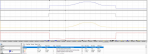
Second, I'm struggling to read the information in the Trend, AND I don't know if this was a manual stroking event or an LVDT calibration event or .?.?.? I also can't see what the vertical scaling of the signals is/are (other than the logic signal).

There appears to be about a few seconds (7 or 8) between when the GCV3 servo reference went from 0 to when it started increasing, and it started increasing slowly, changing to only a value of 2.2042% in about 15 seconds time. And after that it rose up to [some value--don't know the scaling] and flattens out for a few seconds before dropping at about the same rate and timing as the reference decreases.

The current feedback (fagt???) shown on the graph is from only one of the three processors, and it's QUITE unusual.... It starts at -2.0540 and then drops precipitously to around -7.000 and continues dropping to something around -8.00 and remains at about -7.8608 for the ENTIRE time the valve is/should be moving, even when the valve is closing!!!

As was written, negative servo current should serve to open the valve and positive servo current should serve to close the valve (which doesn't need a lot of hydraulic assist to close because there's a giant spring which is always trying to close the valve).

When VGC3 actually started moving something caused a minor change in the servo current for a second of time or so, and the valve appears to have "jumped" from 0 to ??? (a small change) before the valve position actually started ramping open. more or less in unison with the reference ramping up (open).

Again, I don't know what was happening when this trend was recorded or when it was recorded. It would be interesting to see what happens when the machine has been sitting for some time (a "few" days) and then VGC3 was manually stroked open then closed, then another manual open/close stroking very shortly after the first. You've said, if I remember correctly, that VGC3 almost always fails to move open on command on the first attempt, but after that it appears to work fine.

The servo current thing in the Trend REALLY bothers me. What SHOULD happen (and you can prove this by stroking VGC2, for example) is that the servo current should change to some slightly more negative value as the valve is commanded to open and remain stable at that value as the valve actually ramps open, then after reaching full open for a couple of seconds of time the reference should change slightly to cause the valve to ramp closed and remain stable at that value as the valve ramps closed. Since this is NOT what's happening on the initial command to open, either something is mechanically binding--or, the servo currents were not verified correctly.

It's very important to perform the servo current polarity checks with the current from ONE control process at a time. Manually stroke the valve to some intermediate position (50%; or 75%, for example) and then disconnect one of the servo output wires for <S> at the I/O terminal board in the Mark* panel, and then disconnect one of the servo output wires for <T> at the I/O terminal board in the Mark* panel. The valve will lose a couple of percent of position--but if the polarity of the servo current being applied is correct it will stay open. If the valve slams shut when disconnecting one or both wires of the other two processors then the wires of <R>'s servo current output will need to be exchanged (NOT while the valve is being commanded to be open!!!). Repeat this for <S> and for <T>--individually as above--and that is the correct way to verify servo polarity current.

(People think that it takes two of three servo currents to actually open/close a hydraulically-operated device--and that's not true. It only takes one servo current--BUT when the servo only has servo current from one device it WILL NOT go to the commanded position because it lacks sufficient null bias current because the other two servo currents were disconnected. BUT it will remain open, just a couple/few percent less than the commanded (reference) position.)

I'm not saying the polarity IS the problem--but I am saying that it doesn't appear to be correct from the Trend photo. As I wrote, I think there is more than one issue causing this problem, what I can't get my head around is why it happens only on the initial move command to VGC3 and then it works fine after that. Still seems to be something mechanical (or hydraulic) to my mind, but the servo current thing does not appear to be correct based on the information provided. (You said the servo polarities were tested--but there are all manner of ways people think they are testing servo current correctly, and even the blurb in the Control Specification is NOT CORRECT!) but there is really only ONE way to properly verify all three servo currents are correct--and that's when the servo is getting current from only one processor at a time.

Thanks for the data. I can't recall off the top of my head if the AutoCalibrate graph shows the servo current for all three processors during the calibration procedure. If it does, that's what would be most helpful right now.

I want to also stress that "calibration" does NOTHING to the valve operation. The ONLY THING being calibrated is LVDT feedback. Full stop. Period. To say the valve was "calibrated" is not correct. One can ONLY calibrate the LVDT feedback, nothing else.

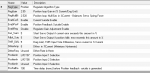
Without seeing the page from the Control Specification for the VGC3 servo regulator I can't tell if what's in the snippet from ToolboxST is correct or not. Someone or something has tweaked the Null Bias Current value from 2.67, but it's not a huge change. (And, by the way--the procedure in the Control Specification for adjusting the Null Bias Current value is ALSO incorrect.... As is the Longname Description for RegNullBias in the ToolboxST configuration snippet. I know there is some procedure for automatically adjusting Null Bias Values, but, in my experience, it doesn't really work well, if at all.)

If you can stroke VGC2 on the machine at your installation and you get good data (run Trender or save the AutoCalibrate screens from the stroking) you will see what a "proper" stroking should look like. I don't know how old the gas control valves are on this machine, but, again, the Woodward gas valves have proven to need frequent, periodic maintenance and refurbishment (there are no user-serviceable parts or procedures that I am aware of from Woodward). This could be one of those valves....
 
@MBartley,

By the way, that near negative saturation current of -8 is indicating that the Mark* is “desperately” trying to move the VGC3 but it took several seconds before it started moving and even then it was still at near negative saturation while the valve was moving (opening and closing…). That seems to indicate a mechanical issue with the valve/actuator and/or a servo polarity issue with at least one of the other servo currents. At least that’s how I am interpreting the information provided.
 
@WTF?

Appreciate the feedback once again. Can confirm the servos are all at correct polarity (I was the one that tested them). Valve was set to 50% open. 6 terminals for the servo motor. LHS servo left connected. -ve post on 2 remaining servos disconnected and removed. Confirmed valve location. Reconnected servo 2, heard valve jolt as servo connected. Disconnected LHS servo. Confirmed valve location. Reconnected servo 3, heard valve jolt as servo connected. Disconnected Middle servo. Confirmed valve location. Reconnected all 3 Servos.

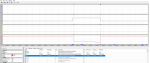
Here is the same screenshot with the first attempt at opening Nov last year.

1748382984405.png

Notice there is no movement at all.

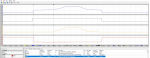
Here is the second operation.
1748383043892.png

Here is the advise provided by maintainer.

" 1. Trip relay valve for any passing VH5-4. Check whether the Trip relay valve spool is moving when pressurized. Typically, it requires 160psig pressure to move the trip relay valve. Check if we are getting 160psig or not. 2. Check if trip solenoid is not passing. 3. Check also the last change filter at actuator. 4. Check the Trip relay supply orifice. "

1748383152851.png
We have woodward coming out next week and we will ask them and get some movement ideally.

It seems mechanical/hydraulic in essence. Sitting next to the valve while attempting to operate it you can hear the valve operating and after the delay it operates smoothly but also doesnt have a large jolting sound as if it was bound up. All valves hydraulic supply and discharge are physically warm to touch with the exception of GCV 3. However inspection everything has shown no issues within the valve. I was really hoping it was control related.
 
@MBartley,

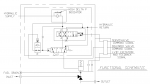
The schematic diagram for the gas control valve really has me confused.... But, that's GE Belfort for you. On the left side of the manifold block is a plugged line labeled "FUEL DRAIN" that looks more like it might some kind of packing leakoff. Also, on the hydraulic actuator there is no indication for any kind of vent on the closing spring portion--a vent that would allow any hydraulic fluid that leaked past the piston ring(s) of the actuator to drain away. I worked on a couple of machines that were unable to reach even FSNL (Full Speed-No Load) because the gas control valve actuator was nearly completely full of hydraulic oil in the closing spring portion of the actuator because the actuator piston ring(s) had leaked and the area was almost completely full of a non-compressible fluid (hydraulic fluid). In this case, though the valves couldn't even be manually stroked to anything above about 18-21% stroke because the fluid in the spring enclosure had nowhere to go (no vent to allow it to be pushed out). The actuators DID have a vent on the spring enclosure, but they were plugged with 1/4-inch pipe plugs.

I have also seen Trip Relay Valves (labeled CV2 in the schematic) that were gummed up with varnish, severely gummed up and wouldn't move. Also, at one site the hydraulic return line was also incapable of allowing much, if any, oil flow--caused by varnish that had built up in a stainless steel elbow where some scarf (metal shavings) had collected. The fact that you say the oil lines to VGC3 (supply and return/drain) are cold to the touch when the other valves supply and return/drain lines are warm to the touch seems to indicate some issue with flow through the manifold which would occur anytime the hydraulic system was in service even if the machine was not running. Which is also something I can't seem to make out in the schematic. Usually there is always a small flow through the servo-valve to prevent it from getting air in it when not being used and keep it ready for use. But, that's GE Belfort for you. Again. There's also that hydraulic return line that is connected to the spring of the trip relay valve.... Huh? What??

When GE purchased the turbine controls retrofit division of Woodward Governor Co. (the engineering retrofit group) there was an agreement that GE would purchase xxx amount of Woodward equipment--Woodward believing that GE would choose Woodward Governor electronic control systems to continue to use for customers that either didn't want GE control systems or wanted something specific (because they already had Woodward equipment) or wanted something a little less expensive than GE control systems. Well, GE didn't view the contract that way and really had no intention of using or buying any more Woodward Governor control systems than they absolutely had to in order to meet customer preferences. So, they had to find another way to satisfy the monetary amount they had agreed to purchase from Woodward and that became the widespread use of Woodward Governor control valves on GE turbines by GE. It also helps that they received a good price for the valves from Woodward and that they didn't have to warrant the valves other than when the machines were new. (The previous gas control valves were designed by GE and built by a third-party manufacturer to GE specifications, and GE also wanted to go to the 'independent gas control valve arrangement' they use these days for DLN-equipped machines. That company now builds electrically-operated control valves which GE were using for a while; I don't know if they still are.) So, there's a reason GE uses Woodward Governor control valves, and it's not because they are well-designed and built or robust (like the original gas control valves GE used for decades). And some GE heavy duty gas turbine owners have bought spare gas control valves to swap out whenever there is a problem with one (and the problems do come up, sometimes in a relatively short period (less than one year)) so they can swap it out quickly and send the one that had issues to Woodward to be repaired and returned, available for the next valve problem....

Please let us know what you learn and how the problem is resolved. A LOT of people read these threads--now and in the future--and it may help more than one person since all of these threads are archived at Control.com.
 
Top