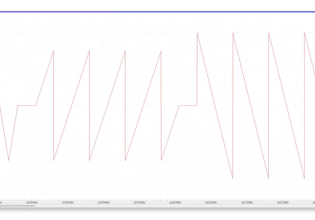
GCV Fluctuations

B

Thread Starter

bkarim55

Dear All;

I know there are a lot of SRV/GCV topics on Control.com. And thanks to the wonderful "Search box" on the right top of each webpage of Control.com.
Another GOOD thing with Control.com, there is NO bills to sign before leaving *** Just a joke and my way to say thank you control.com****

I think each case is a special case and needs to be covered and discussed separately because each time the same topic is re-discussed a new flux of information arrive to complete the original topic.

My concern is about the GCV (Gas Control Valve) instability on GE HDGT Frame 5 double shaft driving centrifugal compressors.
Actually the GCV position is fluctuating between 68 and 73% in few seconds, The P2 (inter-valve pressure) seems steady with just a small fluctuation and same thing with the SRV position. The others parameters looks stable (TNH, TNL, FSR)

At 92% THL the GT goes to exhaust temperature control. Usually at this period of year (cold weather) the GT reaches easily the 98%TNL.
On this machine, one of the 2 LVDTs is gone (dead) not working at all and the second one has been for long time not inspected. So probably the GCV instability is due to the LVDTs.

My questions: Are GCV fluctuations the reason that the GT Control goes under exhaust temperature earlier than usual?? How match the GCV fluctuation tolerance should be?

Regards
karim
 
Firstly, the main thing you don't tell us is what is the Exhaust Temp. doing while all this is happening. You also give some strange data, you say that GCV is fluctuating but P2, SRV and FSR are stable?? If the GCV opens, initially P2 should drop and SRV open to recover P2. If GCV is moving but FSR is not, maybe your theory of one LVDT is possible although I doubt it. Would it be possible to gather some data while all this happening (SRV, GCV, P2, TTXM, TTRXB, LVDT feedback). Also it would be interesting to know what is happening at the Load end while all this happening. are you sure you are not getting load variations that are driving the GCV?

Also, the usual question, any work done recently? When did this start happening? Any change in Gas characteristics at the load compressor?
 
Dear glenmorangie

When the GT control is under the exhaust temperature, TTXM= 523 °C, P2 fluctuate between 12,74 and 13,40 bars and the SRV position is between 46,75 and 47,96%.

Load variations? I don't think so. The GT is driving three BCL CC (Centrifugal Compressors). I think if there are any changes in load it will be seen at first on power turbine speed (TNL) and on the CC gas flow meter. The CC gas flow and the TNL are quite stables (TNL fluctuates between 91,62 and 92,40%).

The other thing is that this GCV INSTABILITY (I prefer using the word instability rather fluctuation) is happening so quick (every 10 - 30 seconds). I think (my opinion) when there are load changes (flow, process, gas properties) this will take a longer response time from GCV.

I know that the GT output, while operating on Exhaust temperature control, is a function of several parameters like filters cleanliness, axial compressor cleanliness, IVG, Fuel system, exhaust back pressure, ambient condition.

What I would like to know if the GCV position instability, in my case the fluctuation is about <b>5% of GCV stroke</b> (between 68 and 73%), could be the main reason to make the GT working on Exhaust Temperature Control?

Regards
Karim
 
To really pinpoint the problem would require a lot more analysis but I really think that you need to eliminate the GCV LVDT problem to start your troubleshooting.

One thing that you didn't tell is the FSR reading compared to the GCV position. When the GCV is moving from 68-73%, what is the FSR% reading?
 
There's been no mention of second-stage nozzles in this thread. Does the unit have fixed or variable second-stage nozzles? Are the second-stage nozzles stable or are they also fluctuating?

On a two-shaft GE-design heavy duty gas turbine with variable second stage nozzles HP speed (TNH) is controlled by the second-stage nozzle position and LP speed is controlled by varying the gas fuel. I know--gas fuel flow has to affect HP and LP speed--but in the control system the two are separated, and while increasing the fuel will have an effect on HP speed the variable second-stage nozzles will be adjusted as necessary to maintain the HP speed which allows the LP speed to vary as required (as fuel changes). The variable second-stage nozzles are, in effect, a "torque divider" controlling the HP speed with some of the torque produced by the HP turbine section and allowing the remaining torque to drive the LP and it's driven device (the compressor in this case). (The HP section produces more torque than required to drive the axial compressor; the remaining torque is used to drive the load compressor by the LP turbine section.)

Next, presuming that when the GCV position is at 68% the actual exhaust temperature (TTXM) is very near the exhaust temperature control reference (TTRX) then it's very conceivable that the unit could shift to exhaust temperature control when the gas valve opens--more fuel equals more exhaust temperature.

Based on the information provided, it would seem there are two problems here: first, the "instability" of the GCV. The cause of that needs to be investigated and understood. The input(s) to the FSR calculation (which drives the GCV) should be investigated and eliminated (but one would think if there were problems with the inputs (speed sensors; LVDT feedback; etc.) there would be Diagnostic Alarms to indicate problems with the inputs. If there are developing problems with the LVDT feedback(s), this might not yet be detected by the Diagnostic Alarm routines.

If FSR is stable but GCV position feedback is changing, one it could be either LVDT feedback (one or more of them has a bad spot causing the signal to fluctuate), or it could be a dirty servo or a problem with the hydraulic actuator (either could be sticking or worn). To check for a servo problem, trend the servo current signals to the servo coils along with the LVDT feedback (presuming the LVDT feedback has been eliminated as a source of the problem). The current signals should be stable. If they go less negative (to open the valve) and the LVDT feedback doesn't change and they even less negative (or even positive) before the LVDT feedback changes and then the current goes more negative trying to close the valve before it moves than then it moves too much again, and so on, it's probably a dirty servo-valve, bad oil or an actuator/valve problem (leaky actuator seals; sticking actuator piston; sticking GCV valve stem/seals; etc.).

The second problem, probably unrelated, is why the unit goes on temperature prematurely (if I understand the information provided correctly). That would be related to factors like fuel make-up (if it might have changed); IGV and/or axial compressor cleanliness; IGV LVDT calibration; inlet air filter cleanliness; etc. Load compressors also suffer from performance decreases, usually due to seal leakage and/or internal clearances increasing. Also, recirc valves develop leaks, as do other system valves.

Again, based on the information provided, it would seem most likely that there are two problems, not necessarily related: GCV instability, and premature exhaust temperature control (Base Load). If the unit is being operated very close to exhaust temperature control AND the GCV/actuator/servo/control scheme has problems, then that could cause the unit to go into exhaust temperature control, and stay there for a while, until the gas fuel flow-rate drops again.

Trending variables is the most help in cases like this--as many as possible, and then start reducing them and adding as necessary until the root cause(s) are arrived at.

Hopefully, bkarim55, you'll write back with details as you progress and eventually solve the issue(s)!
 
Hi!

The GT I'm talking about it is MS5002C. It's a double shaft with variable 2nd stage nozzles installed between HP and LP turbine wheels.

I used my mobile phone and I recorded 60 seconds video of the Mark V Display screen.

And here are below the Min/max values shown on this video:<pre>
GCV 68 73%
P2 (Inter-valve pressure) 12,74 13,40 bars
SRV 46,75 47,96%
FSR 67,70 73,74%
Nozzles AG 1,9 2,1 DGA
TTXM 521 524 °C
(the control is switching between Speed and Exhaust temperature)
</pre>
Regards
Karim
 
Hi Karim (and CSA)

Now we are beginning to see some positive data. Are you sure that the Nozzle Angle was not showing negative degrees (-1.9 to -2.1 Deg)? if that is the case then the change in FSR, GCV and nozzle angle look like you are getting a load increase causing an increase in fuel and Exhaust temperature, not instability in the GCV (GCV position is following FSR%). I don't know how you are controlling your compressor(s). the cause could be a sudden increase in Suction pressure or, if you have recycle valves, maybe some instability there. For me, my next move would be to study your compressor loading and see if it is changing suddenly.

Do you know how to use the VIEW programs to record data? if you don't, drop me an Email to [email protected] and I'll send you some instructions. Some VIEW data would be the best way to try and evaluate exactly what is going on.
 
Dear Bob (and CSA)

Here is below a short overview of how the Oil field (where I am) is operating..
To maintain reservoir pressure and further enhance oil recovery, there are 4 High Pressure Gas Injection Trains which are operating in parallel mode. Each train is composed by 3 BCL Centrifugal Compressors in series driven by a Frame5 Gas Turbine. (See configuration below).<pre>
|CC1|----- |CC2|----- |CC3|-----|
|CC1|----- |CC2|----- |CC3|-----|
Medium pressure->| |--> High Pressure Gas to Injection wells
|CC1|----- |CC2|----- |CC3|-----|
|CC1|----- |CC2|----- |CC3|-----|</pre>

Nozzle angle are <b>positive</b> and the fluctuaton is between <b>1,9 and 2,6 DGA</b>. I sent to you an email with the video showing the Screen Display (apologies if the video quality isn't so good).
I am mechanical and my knowledge on control and programs is a little bit limited but I'm working with a qualified Instrument/Control team. So if you could send me these instructions, about how to use the VIEW programs, it will be very helpful.

Many thanks in advance and Best regards,
Karim: [email protected]
 
bkarim55,

VIEW2 usage and recommendations have been posted several times before on control.com. It's also documented in the Mark V Maintenance Manuals, GEH-5980.

I still believe there are two separate problems--possibly related.

And, as I've been thinking about this issue, it's more than likely that there is an analog signal coming from some injection/compressor control system to the Mark V that's causing the load to change. It's at least worth investigating, and eliminating as a possible cause.

Again, it's very possible there's a problem with the GCV servo (usually caused by dirty oil), or with the actuator, or with the GCV. The CDB signal name of the servo current that's going out to the GCV servo is FAG. You need to monitor that signal, along with the LVDT feedback signal from the one working GCV LVDT. As described in my previous post.

Your I&C personnel need to use VIEW2 at 4 Hz, because servo current values are only updated at 4 Hz (even though it changes as fast as 128 Hz). 4 Hz is still enough to see if the current is increasing before the valve moves (because it's sticking), then the valve moves and the current increases in the other direction before the valve moves again (because it's sticking). The servo spool piece could be sticking, the actuator could be sticking, the GCV valve stem could be sticking.

It's NOT unusual for gas valves to stick, but usually it's because the gas is dirty. It's also not unusual for dirty oil to cause servo and/or actuator problems.

This is just one of the problems. The other seems to be that when the unit is reaching exhaust temperature control faster than it should. An bad or incorrectly calibrated LVDT could cause the unit to be reaching secondary or back-up exhaust temperature control sooner that it should.

The name of primary (CPD-biased) exhaust temperature control is TTRXP. The name of secondary (FSR-biased) exhaust temperature control is TTRXS. Two-shaft fuel control is also usually biased, and the output of that bias is TTRXB (contrary to popular myth, TTRXB is NOT Base Load Exhaust Temperature Control; it's speed biased exhaust temperature control). You need to monitor TTRXP, TTRXS, TTRXB and TTRX as well as TTXM, along with FAG, FSG (the high-selected GCV LVDT feedback), FSR, and someone needs to find the load signal's name and monitor it, also. Again, it's likely a 4-20 mA signal from some other control system that's being used to control the LP load.

It seems like the second-stage nozzle is pretty stable. No mention of variable IGVs, and their angle (whether or not it's stable).

And, someone needs to compare ambient temperature and CPD to past years' loads--or to one of the other GTs to see if the CPD of the machine experiencing problems is realistic or not.

Lastly, running with one of two GCV LVDTs for "long periods" is highly unadvised. And, it could be the cause of all problems--but you would need to shut down, stroke the GCV to see if it's the cause. Or, while shut down you could replace BOTH LVDTs, calibrate them properly, and re-start. VIEW2 data could show if there's an intermittent LVDT feedback problem, or a sticking servo/actuator/GCV.

Without more good data (using VIEW2 at 4 Hz) we can't be of too much more help. VIEW1 could be used, but it's resolution is only once-per-second. The data from either VIEW too can be saved to an ASCII text file, and you could paste the file contents to a reply. We would need to see enough data to see a couple of load swings.
 
bkarim55,

One more thing about second-stage nozzle LVDT calibration: just like SRV LVDT calibration, it's not critical. This is because both are not just position loops; since the SRV is used to control P2 pressure (but primarily as the gas fuel stop valve) it is moved to whatever position is required to make the actual P2 pressure equal to the P2 pressure reference. And, similarly, the second-stage nozzles are used to control HP speed so they are moved to whatever position is required to make HP speed equal to the HP speed reference.

So, for both applications the LVDTs are really just for indication purposes, and of course, the more accurate the calibration the more accurate the indication. But, even if the SRV is at 67% stroke when the LVDT says it's at 52%, or 76%, if the position of the SRV is sufficient to make the actual P2 pressure equal to the P2 pressure reference, then the valve won't be moved just because the indication isn't correct. The same is true for the second-stage nozzle LVDTs; if the indicated position is -0.8 DGA, and the actual position is 1.2 or 1.7 DGA--as long as the actual HP speed is equal to the HP speed reference the second-stage nozzle position won't be changed.

It's only the result of the LVDT calibration (the indicated position) that will be in error if it's not equal to the actual, physical position. This can cause problems if there are other problems requiring people to actually look at the actual physical position of the SRV or the second-stage nozzles, but since problems are few and most people don't bother looking at position/angle the error goes unnoticed, sometimes for years or even decades.

So, it's not likely that it's the actual second-stage nozzle angle that's the problem (positive or negative), it's the amount of change that might be the problem. But, again, as was said previously increasing the fuel to increase the LP speed/power output will also have a knock-on effect on HP speed, but the Speedtronic changes to the second-stage nozzle angle so that more energy is sent to the LP turbine and HP shaft speed remains more "constant." GE two-shaft heavy duty turbine control philosophy (and control configuration) uses second-stage nozzle angle to control HP speed, and GCV position to control LP speed (even though the two are intertwined in actuality, it makes it easier for the control system and people programming and troubleshooting turbine operation if the two are "separate").

Hope this helps! We're all waiting for some useful data!
 
1. Try to confirm whether the GCV is actually fluctuating mechanically or not by watching the GCV spindle with the help of a torch light, mild fluctuation (oscillation type) may be observed if it is mechanically fluctuating.

2. If it is not mechanically fluctuating then the problem is with the position feedback loop (LVDT). Looking your other post's data it seems that GCV is mechanically fluctuating possibly.

3. Now if your GCV is fluctuating mechanically (i.e. actually):
After looking all the fluctuation data i.e. GCV, SRV, Nozzle angle it is clear that at least one among these three has a problem and because of that the other two is fluctuating also (may be problem lies with more than one device).

The problem may be
a. In the control liquid i.e. hydraulic oil circuit. may be choking

b. P to I converter ports choking.

c. Load side fluctuation i.e. compressor side. You may watch the interstage compressor pressure & flow weather there is any fluctuation.

d. Compressor pre-filter DP (if any) may also be watched.

e. Fuel gas quality may be another reason but chance is very rare.
 
Dear CSA , barindra75 and Dear All

I know I'm late, too late, to reply so I'm so sorry:-((

Barindra75, I confirm the fluctuation is mechanically. Using light torch, it's easy to watch the <b>mild fluctuation</b>. Another way to confirm this fluctuation is the analogic pressure gauges installed on the SRV/GCV valve (SRV, P2 and GCV pressure). The GCV gauge reading is the worse one (too much fluctuation).

Here are below few data downloaded under View1. I also used View2 but there too many records (1 record per second on view1 while it's 32 records/second under View2). The changes are pretty same between data recovered from View1 and the ones recovered from View2. <pre>
Time FRS TNH TNL CSGV TTXM FSRN FSRT TTRXP TTRXS TTRXB TTRX FAG FSG
01:45 70.90 99.74 92.70 83.4 477 70.41 82.75 521 530 521 521 -6.12 69.84
01:46 72.31 99.72 92.62 84.5 476 72.25 84.34 520 527 520 520 -4.14 71.32
01:47 72.31 99.72 92.62 84.5 476 72.25 84.34 520 527 520 520 -4.14 71.32
01:48 69.58 99.78 92.73 84.9 476 71.54 85.10 520 528 520 520 -2.20 68.96
01:49 67.13 99.93 92.91 84.9 478 69.02 84.52 519 532 519 519 -2.53 66.50
01:50 64.98 100.09 93.10 84.7 480 65.99 82.86 519 537 519 519 -2.05 64.21
01:51 64.64 100.16 93.16 83.6 481 64.54 81.45 519 540 519 519 -2.05 63.56
01:52 64.64 100.16 93.16 83.6 481 64.54 81.45 519 540 519 519 -2.05 63.56
01:53 68.11 100.14 93.04 84.3 480 65.75 81.01 519 539 519 519 -5.05 67.06
01:54 69.89 100.09 92.87 84.3 478 68.11 81.76 520 534 520 520 -3.41 68.86
01:55 70.18 100.05 92.77 83.6 477 70.12 83.04 520 531 520 520 -3.41 69.35
01:56 69.33 100.05 92.80 83.4 477 70.04 83.79 519 530 519 519 -4.25 68.70
01:57 69.33 100.05 92.80 83.4 477 70.04 83.79 519 530 519 519 -4.25 68.70
01:58 67.37 100.14 92.97 85.0 478 67.50 83.33 519 535 519 519 -5.12 66.50
01:59 67.04 100.14 92.97 84.9 478 67.04 82.76 519 536 519 519 -5.12 66.07
02:00 67.36 100.20 93.00 84.9 478 67.04 82.76 519 536 519 519 -3.22 66.43
02:01 68.04 100.23 92.95 84.7 478 67.52 82.55 519 535 519 519 -3.92 67.16
02:02 68.04 100.23 92.95 84.7 478 67.52 82.55 519 535 519 519 -3.92 67.16
02:03 66.95 100.20 92.97 83.8 478 67.57 82.70 519 535 519 519 -4.50 66.18
02:04 65.45 100.22 93.08 84.3 478 65.85 82.18 519 538 519 519 -4.50 64.60
02:05 64.48 100.24 93.13 84.2 479 64.52 81.26 519 540 519 519 -2.89 63.61
02:06 65.15 100.24 93.13 83.6 479 64.52 81.26 519 540 519 519 -2.56 64.05
02:07 65.15 100.24 93.13 83.6 479 64.52 81.26 519 540 519 519 -2.56 64.05
02:08 66.63 100.08 92.97 84.6 477 66.38 81.34 519 537 520 520 -4.72 65.75
02:09 67.33 100.01 92.93 84.9 477 66.85 81.70 520 536 520 520 -2.82 66.57
02:10 68.59 99.93 92.85 84.9 476 68.19 82.48 520 534 520 520 -4.54 67.55
02:11 69.49 99.89 92.78 84.9 475 69.46 83.41 520 532 520 520 -2.64 68.54
02:12 69.49 99.89 92.78 84.9 475 69.46 83.41 520 532 520 520 -2.64 68.54
02:13 65.96 99.89 92.88 83.5 476 68.38 83.52 519 533 520 520 -4.76 65.25
02:14 63.78 99.93 93.10 83.8 478 65.16 82.46 519 539 519 519 -2.64 62.83
02:15 63.90 99.95 93.17 84.3 479 63.41 81.11 519 542 519 519 -4.29 62.90
02:16 65.43 99.88 93.04 84.2 478 64.73 80.73 520 541 520 520 -4.29 64.43
02:17 67.27 99.79 92.91 83.6 477 66.68 81.25 520 537 520 520 -3.22 66.07
02:18 69.46 99.79 92.91 83.5 476 69.46 82.61 521 532 521 521 -5.93 68.23
02:19 71.70 99.68 92.73 84.7 476 69.46 82.61 521 532 521 521 -4.72 70.50
02:20 72.86 99.59 92.59 84.9 475 72.05 84.29 521 527 521 521 -4.72 71.09
02:21 72.23 99.59 92.61 84.9 475 72.81 85.74 520 525 520 520 -3.04 71.15
02:22 70.03 99.71 92.75 84.9 476 71.30 85.88 520 528 520 520 -3.44 69.45
</pre>

Hope these data will help to get deep RCA

Regards
Karim
 
It is my guess. your fluctuation of TNH is leading than TNL. Also, FSG is fluctuating independently and because of it TNh is fluctuating. I think the GCV is the culprit.

Check the control oil flow path of GCV, for any choking. Also, the P to I converter and its pre-filter (last chance filter) for any choking.
 
bkarim55,

Well, well, well. Data, but not all the data we asked for....

And, at a once-per-second resolution, which isn't very good.

There are some things which can be said, based on the information provided. First, the exhaust temperature (TTXM) is relatively stable; the HP shaft speed (TNH) is relatively stable; and the LP shaft speed (TNL) is also relatively stable. The IGVs (CSGV) are moving, which kind of corresponds to the stable exhaust temperature....

We don't know what the second stage nozzles are doing....

The current for the GCV (FSG) is <b><i>VERY</b></i> high (positive current tends to shut off the flow of fuel); it should be on the order of -0.4 mA to -1.2 mA (per processor). I believe VIEW1 takes the voted value of FSG (each control processor supplies current to its servo-valve coil); so we don't know what the current is for the other two coils....

FSRN is also fluctuating--in tandem with FSG.... And FSR drives the GCV (and FSG). And, for a two-shaft machine TNL is the feedback for FSRN when at operating speed.

FSG, if I recall correctly, is coming from a single LVDT (because the other non-working LVDT hasn't been replaced....).

The value of FSG is very troubling. We need to know what the values of FSG are for all three processors--and the only way to get that information is to use either the Pre-Vote Data Display or AutoCalibrate (which makes most people extremely nervous--even though AutoCalibrate is blocked from doing anything other than monitoring data points when HP shaft speed is above a certain value (which can be site-specific). Also, opening AutoCalibrate when the unit is running results in multiple Diagnostic Alarms--which NO ONE ever bothers to be concerned about until they are asked to open AutoCalibrate when the unit is running and they everyone craps in their pants when Diagnostic Alarms are annunciated....

It's going to be very difficult to capture meaningful data from either display--but there's something amiss with FSG for at least one of the processors, and I suspect for the other two, as well.

And, this leads again to ask: <b>What Diagnostic Alarms are active?</b>

I'm sure there are Diag. Alarms related to the failed LVDT, but, it would sure be GREAT if we knew what the other Diag. Alarms were, because it's very likely there are others, and that they might even be related to the issue being discussed.

Look, it's not unusual for <b><i>mild fluctuations</b></i> in valve position at any stable operation. But, the unusual GCV current value suggest there is some other problem(s).

I still have a very nagging suspicion that this unit (as well as the other units) all get a remote signal (probably 4-20 mA) from another control system (the compressor control system(s)) to control unit load, which in the case of two-shaft machines is usually speed-related. The fact that FSRN is fluctuating likely means that it's being driven up and down, and likely by the external load control signal (which could even be coming from a pair of contacts which is raising and lowering the speed reference, instead of an analog signal which I highly suspect is the source of the speed (load) reference). And, bkarim55 doesn't seem to think this point is relevant--but since he doesn't know it's not this he's going to exhaust every other possibility before getting around to this one. When it would just be easier to ask a technician for help. Once the name of the external speed (load) reference signal name is known, the value can be recorded for troubleshooting purposes--and elimination, if it's not the cause. Troubleshooting is usually a process of elimination, and this is likely no different.

It would also be very helpful to know what the P2 pressure is doing as well as the second stage nozzles. We can see the unit is not operating too near exhaust temperature control, so the TTRXP, TTRXS, TTRXB signals can be deleted in favor of FPG2 (P2 pressure), and TSNV (or whatever the second stage nozzle LVDT feedback signal name is).

So, we need to know the values of all three GCV current signals at different points (and this can't be captured with VIEW1 or VIEW2). There is a VIEWPV, but it's been a long time since I've used it. And, it could be used for many of the signals above. Every one of the VIEW tool applications can have their time periods adjusted; it's one of the command-line parameters. Type VIEW2 /? or VIEWPV /? at the command line for help. I think it's the SCAN switch/option; but you'll have to play with it to get it to capture at a 4 Hz (0.25 second) rate--which is the fastest that servo currents are reported to the CSDB (Control Signal Database). Yes; 32 Hz is too fast, and if you looked at FSG during a one-second period captured at 32 Hz you would see it only changes every quarter-second (in other words, it remains "constant" for eight periods and then changes (if it really changes, which it usually does).

So, bkarim55, we still need more data. Learn to use the troubleshooting tools available with the Mark V (the VIEW tools in this case); it will be very helpful in the long run--and likely in the future, also.

Also, please provide all of the active Diagnostic Alarms; we don't need times and dates or even drop numbers--but we do need the text messages for ALL of the active Diagnostic Alarms.
 
barindra75,

> Also, the P to I converter and its pre-filter (last chance filter) for any choking.

Please--what is the "P to I converter"?
 
>>>!!!CORRECTION!!!<<<

> The current for the GCV (FSG) ...

That <b>should have read</b>: The current for the GCV (F<b>A</b>G) ...

F<b>A</b>G is the servo current signal to each of the three servo coils from each of the three control processors.

> FSRN is also fluctuating--in tandem with FSG.... And FSR
> drives the GCV (and F<b>A</b>G).

> The value of F<b>A</b>G is very troubling. We need to know what the
> values of F<b>A</b>G are for all three processors--

> It's going to be very difficult to capture meaningful data
> from either display--but there's something amiss with F<b>A</b>G
> for at least one of the processors, and I suspect for the
> other two, as well.

My apologies for any confusion.
 
Dear all,

I read all replies and don't find the mention of hydraulic oil as the control of GCV and IGV as the control of exhaust temperature. We had this problem in the same machine MS5002C, but don't reach the control temperature (our MS5002C's control temperature reference is 535°).

I think there are two problems. GCV Fluctuation due to hydraulic oil supply.Machine under control temperature due to malfunction of IGV. BUT in this period of year with 99% of TNL don't reaches 500°, and why your exhaust temperature reference is 524°?
 
> Please--what is the "P to I converter"?

I beg pardon, it is I to P converter. Normally we call it in industry as MOOG valve. It converts the mA current into a proportionate oil pressure.
 
MOOG is a manufacturer of electro-hydraulic servo-valves, commonly referred to in the GE-design heavy duty gas turbine community as servo valves.

Servo-valves translate a bipolar current into hydraulic flow to the actuator to open or close the device (fuel valve; IGVs; etc.). The polarity and magnitude of the current determines the direction of hydraulic flow and the hydraulic flow-rate, respectively.

When the controlled variable (position; flow; etc.) is equal to the reference there will be no flow through the servo valve--which means the device will remain in its current position and the flow through the hydraulically operated device will remain at its current rate. This is called steady-state operation.

Because of the use of a fail-safe spring in the servo it is necessary to add a little "extra" current to the turbine control system servo-valve output to overcome the spring tension and maintain zero hydraulic flow (under steady state operation). This extra current is called "null bias current", and it is a very slight negative current because negative current causes the device to increase position and/or flow, and positive current causes the device to decrease position and/or flow.

The servo-valves used in GE-design heavy duty gas turbine control systems are supposed to be adjusted to the manufacturer to require -0.8 mA, +/- 0.4 mA, of current to overcome fail-safe spring tension and keep the device in a steady position (no hydraulic flow through the servo-valve). Since, in a TMR (Triple Modular Redundant) control system each servo-valve has three independent coils, the total null bias current must be divided equally between the three coils, so that means -0.267 mA of null bias current is typically added to the output of each control processor's servo-valve output for normal operation.

Since servo current is expressed in percent in the Mark V, Mark VI and Mark VIe, and since 10 mA = 100%, -0.267 mA equals -2.67%. So, when the unit is operating at steady state conditions each processor should be applying approximately a steady -2.67% of servo current to each coil of the three-coil servo-valve.

The data provided by bkarim55 shows that the current varies significantly above and below -2.67% during what appears to be steady state operation--but we don't know what the turbine load reference is doing. The exhaust temperature is relatively stable, and the IGVs are moving such they seem to be trying to control exhaust temperature, which is well below the exhaust temperature control reference, so the unit is operating at Part Load, below Base Load. (It's also not known if the unit has IGV Temperature Control, and if so, it is being used.)

And, again--the data provided is from only ONE of the three processors (because VIEW1 can only report one processor's values--in this case I think it's the median value).

Usually when one sees fluctuating servo current like this--presuming the same thing is happening for all three processors (which we DO NOT YET KNOW)--it indicates some kind of mechanical binding, either in the servo valve itself (the spool piece is not moving freely) or in the hydraulic actuator or the valve or the valve stem seals. When it takes extra current to overcome mechanical binding and the the device maybe moves a little too far and sticks again and then the current has to change a little too much in the opposite direction to get the device to finally move, and then it moves a little too far and sticks again--this shows up in the higher-than-normal servo currents being required to effect a move, which is then a little too much, and then the current has to change in the opposite direction by a little more than normal to get the device to move again, and so on.

I'm NOT saying 100% this is the problem--but the servo currents seen in the small sample of once-per-second data seem to point at this as a problem. We know that the GCV is only operating on one LVDT, and sometimes, if the unit operates for long periods of time at the same load and if the LVDT core is bent even just a little bit it will wear out the inside of the armature and feedback will be a little erratic. This will also cause a similar problem, because feedback changes more than normal for a given position change.

But, it's not usually a Speedtronic turbine control system problem--and if it were, there would like be Diagnostic Alarms to indicate a control system problem. And WE DO NOT YET KNOW what Diagnostic Alarms are active.

But, the large swings in GCV servo current are not typical of a normally running unit. The original poster can compare them to other units operating at his plant for confirmation.

Finally, the LP shaft speed is fairly constant, and exhaust temperature is fairly constant--what was also DO NOT KNOW is is the output of the unit (the compressor variable (speed; flow; pressure) constant? The original poster has said that P2 pressure fluctuates slightly, and that should not be happening as the SRV should be responding to changes in P2 pressure fairly quickly (at the rate of 128 times per second, to be exact) to keep P2 pressure equal to the P2 pressure reference. When the HP shaft speed is relatively constant (as it is) the P2 pressure reference should be relatively constant, and if the GCV opens and closes the P2 pressure would decrease and increase, respectively (if the SRV didn't respond quickly enough)--but the SRV regulator on the TCQA card is checking 128 times per second to see if the P2 pressure is equal to the P2 pressure reference and adjusting the SRV servo current to make the P2 pressure equal to the P2 pressure reference. So, in theory, the P2 pressure should be relatively stable even if the GCV position is not.

GE and packagers of GE-design heavy duty gas turbines use P2 pressure transmitters with very fast response times because the control loop (the regulator) is so fast. Many times people replace these transmitters with so-called "SMART" transmitters, which are less expensive and easier to calibrate. BUT, SMART transmitters are not nearly as fast as the transmitters they are being used to replace, and the problem being reported sometimes occurs as a result.

These things are never very simple; and it can sometimes take a long time to get to the bottom (the root cause) of the problem. And trying to do a "deep dive RCA" on a World Wide Web forum can be very time-consuming and very frustrating--for everyone involved. There are lots of variables, and many times the original posters believe some of the questions being asked are irrelevant (even if they're not) and so we don't always get complete answers or full data, which makes understanding and troubleshooting very difficult. Most people think, "Oh, someone somewhere has certainly heard of our problem--we only need to ask ]and provide very little information] and someone can tell is precisely what our problem is!" And that's patently false. Unless someone is very, Very, VERY lucky.

So, again, we are at an impasse, as we so often are. Waiting for complete answers and good data.
 
Dear Responders,

I have observed a similar situation, where the pressure at the fuel tip nozzle changes based on the NOX control split. This caused a back pressure (so to speak)that is reflected in the control valve.

Normally,if the pressure regulator bypass valve is adjusted properly, that excess pressure in the fuel line would have been relived, and returned to the inlet.

I am curious to how NOX is controlled and the fuel nozzle type.

Oh! Effect, CPD is maintained and TTX low.
 
Top