Facebook
 Google
 GitHub
 Linkedin
Currently, I am working with speed control for a motor and a payload for an inertially stabilized platform.
In each image below, there are 3 phases, in the first phase, the motor is held at angle 0, before changing into speed control mode and finally the stop mode.
As I was tuning the PID parameters, I encoutered a phenomenom that I could not explain thoroughly. When I use PI with very small values for Kp and Ki, the response is quite "strange" as you can see in the first image. However, as I increased the values of Kp and Ki, and added Kd as a damper, the response looked much better. I deduce the difference in transient response may stem from the static friction and spring-like characteristics in mechanical structures, but I cannot completely explain the reasons in detail.
I hope that members in the forum can take a look at my case and explain the phenomenom of these transient responses to me. Thank you a lot. Wish you a good day !
FIRST IMAGE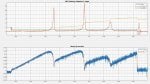
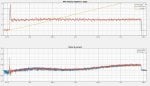
In each image below, there are 3 phases, in the first phase, the motor is held at angle 0, before changing into speed control mode and finally the stop mode.
As I was tuning the PID parameters, I encoutered a phenomenom that I could not explain thoroughly. When I use PI with very small values for Kp and Ki, the response is quite "strange" as you can see in the first image. However, as I increased the values of Kp and Ki, and added Kd as a damper, the response looked much better. I deduce the difference in transient response may stem from the static friction and spring-like characteristics in mechanical structures, but I cannot completely explain the reasons in detail.
I hope that members in the forum can take a look at my case and explain the phenomenom of these transient responses to me. Thank you a lot. Wish you a good day !
FIRST IMAGE
SECOND IMAGE