Two sensors on Bearing #1.
One sensor on Bearing #2.
Two sensors on Bearing #3.
And all of these five sensors are part of the Turbine group of vibration sensors. (Per the original poster, there are four more sensors, two on the DE of the generator, and two on the NDE end of the generator--and they are part of the Generator group of vibration sensors.)
But, back to the Turbine group of sensors.
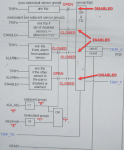
This is how I read/interpreted the Block Help the original poster posted. Because ADJ_SEL was NOT EQUAL to "1" the output of that comparator is "0". Because the GT_REDPAIR is "2"--which is GREATER THAN "0" the output of that comparator is "1". Those two values will affect the associated contacts as shown in RED (either OPEN or CLOSED) which ENABLES or DISABLES the output of the four determinations described in the four blocks (and in parentheses above the blocks) and are either blocked from getting to the (group trip) OR & TD block which sets TRIP_G and TRIP_T (and we DON'T KNOW what those outputs actually do from the information provided--they probably trip the machine, but we don't absolutely know for certain because we can't see the whole application code in the Mark* VIe).
It does say "any trip if any alarm from another sensor"--which to me means, for example, if the non-redundant sensor of Bearing #2 is indicating trip and if any Bearing #1 sensor OR and Bearing #3 sensor is in alarm then the machine would be tripped. (Which makes sense because if Bearing #2 is rocking and rolling it kind of makes sense Bearing #1 and/or Bearing #3 is going to see some of that vibration being transmitted from Bearing #2. But, that's not 2 of 2.
Nowhere does it require 2 of 2 sensors on a particular bearing--any alarm AND any trip of a pair of sensors will trip the machine, and more than 2 sensors of any group being disabled will also trip the machine (which could be both sensors of a pair, but trying to operate with both sensors of one bearing would be ... not very smart--but I'm sure someone, somewhere would try it).
MOST GE trip schemes employ multiple sensors; in the old days it used to be three switches (temp switches; pressure switches; etc.). One as an alarm switch, and the other two were trip switches. So high (alarm) and high-high (trip), or low (alarm) and low-low (trip). If the switches were all calibrated and working correctly, an alarm AND either trip would result in a machine trip. I don't have any application code to look at, but there was a case when, if I recall correctly, that if both trips were indicating a trip but not the alarm, the unit would trip. That's really two out of three (in my book, anyway). If either trip indicated but NO alarm, that was alarmed as "switch trouble."
As CSA used to say, GE was all about reliability, and that included redundancy--often in multiple forms.
Ehhh, ba-deep, uh ba-deep uh ba-deep, that's all folks! This is a dead horse.
Two sensors on Bearing #1.
One sensor on Bearing #2.
Two sensors on Bearing #3.
And all of these five sensors are part of the Turbine group of vibration sensors. (Per the original poster, there are four more sensors, two on the DE of the generator, and two on the NDE end of the generator--and they are part of the Generator group of vibration sensors.)
This is how I read/interpreted the Block Help the original poster posted. Because ADJ_SEL was NOT EQUAL to "1" the output of that comparator is "0". Because the GT_REDPAIR is "2"--which is GREATER THAN "0" the output of that comparator is "1". Those two values will affect the associated contacts as shown in RED (either OPEN or CLOSED) which ENABLES or DISABLES the output of the four determinations described in the four blocks (and in parentheses above the blocks) and are either blocked from getting to the (group trip) OR & TD block which sets TRIP_G and TRIP_T (and we DON'T KNOW what those outputs actually do from the information provided--they probably trip the machine, but we don't absolutely know for certain because we can't see the whole application code in the Mark* VIe).
It does say "any trip if any alarm from another sensor"--which to me means, for example, if the non-redundant sensor of Bearing #2 is indicating trip and if any Bearing #1 sensor OR and Bearing #3 sensor is in alarm then the machine would be tripped. (Which makes sense because if Bearing #2 is rocking and rolling it kind of makes sense Bearing #1 and/or Bearing #3 is going to see some of that vibration being transmitted from Bearing #2. But, that's not 2 of 2.
Nowhere does it require 2 of 2 sensors on a particular bearing--any alarm AND any trip of a pair of sensors will trip the machine, and more than 2 sensors of any group being disabled will also trip the machine (which could be both sensors of a pair, but trying to operate with both sensors of one bearing would be ... not very smart--but I'm sure someone, somewhere would try it).
MOST GE trip schemes employ multiple sensors; in the old days it used to be three switches (temp switches; pressure switches; etc.). One as an alarm switch, and the other two were trip switches. So high (alarm) and high-high (trip), or low (alarm) and low-low (trip). If the switches were all calibrated and working correctly, an alarm AND either trip would result in a machine trip. I don't have any application code to look at, but there was a case when, if I recall correctly, that if both trips were indicating a trip but not the alarm, the unit would trip. That's really two out of three (in my book, anyway). If either trip indicated but NO alarm, that was alarmed as "switch trouble."
As CSA used to say, GE was all about reliability, and that included redundancy--often in multiple forms.
Ehhh, ba-deep, uh ba-deep uh ba-deep, that's all folks! This is a dead horse.
I will try to test this matter next week when I go to work and try to reach practical results by giving values to the sensor readings and see which of these possibilities will lead to trip the unit, and of course I will do this on any stopped unit

 Facebook
 Google
 GitHub
 Linkedin