Facebook
 Google
 GitHub
 Linkedin
Schneider and Weidmüller Simplify Motor Control Wiring
Snap-in wiring technology cuts TeSys Deca contactor installation time by up to 75% while supporting automated control cabinet assembly.
Schneider Electric has teamed up with industrial connectivity expert Weidmüller to deliver a labor-saving, safety-enhancing motor control product that can cut installation time by up to 75%: the snap-in integrated TeSys Deca contactor. This is the first time Schneider has incorporated snap-in technology into its products, and it is intended to support automation readiness for panel builders and original equipment manufacturers across North America.
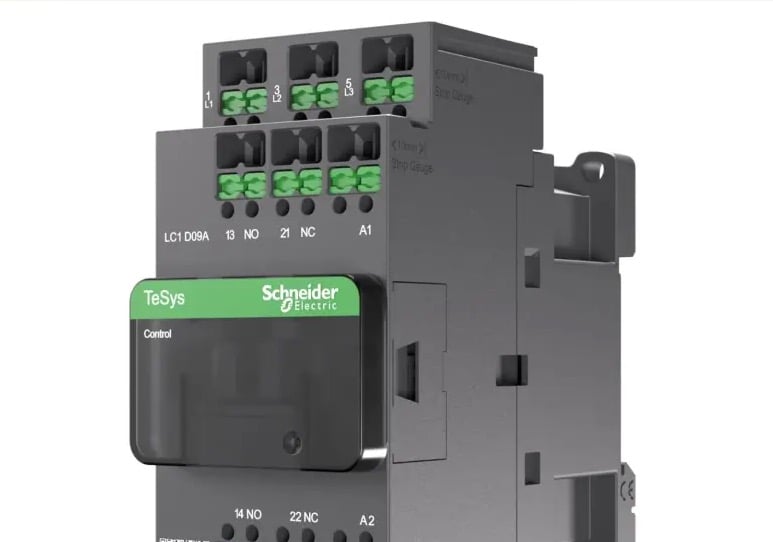
While Schneider’s TeSys Deca contactor provides the "muscle" for motor control, the SNAP IN technology's "Ready-to-Robot" design transforms control cabinet construction. Image used courtesy of Schneider
Wiring with a SNAP of your Fingers
Weidmüller's SNAP IN technology won the Best of Industry Award 2024 in the Automation category, which is a testament to its innovative design. The technology is based on a unique “mouse-trap” principle that involves inserting a stripped conductor directly into an open connection point. With a “snap,” the connection is locked into place. Hearing the “click” noise signals to users that the conductor is connected safely. To release the conductor and free the connection point, users simply press the pusher.
Customers can also use a push-in connection for greater conductor pull-out forces. When the conductor is inserted (fine-stranded conductors with ferrules or ultrasonic-welded conductors), the compression spring ensures a firm connection between the conductor and the busbar via contact force. Other connection options from Weidmüller include crimp, tension clamp, and screw.
Automating the Wiring Process
Weidmüller’s “Ready-to-Robot” philosophy is embedded within its hardware portfolio. The OMNIMATE 4.0 platform brings SNAP IN technology straight to the PCB at the device level. This makes it possible to quickly and automatically assemble intricate controllers and sensor components, using digital twin data to verify that robotic grippers can easily access even the most densely packed connection points.
The SNAP IN-integrated PROeco 2nd Generation power supplies remove labor-intensive, manual wiring of high-voltage lines, doing away with conventional tension-clamp or screw inputs. The RockStar Heavy Duty Connectors also feature the “click-and-go” connectivity solution, providing hassle-free, secure connectivity alongside ruggedized outer casings (up to IP69K ingress protection) against dust, high-pressure water jets, and extreme temperatures.
Video used courtesy of Weidmüller
The high-level standardization this ecosystem provides is what really adds value for control engineers. Engineers can get to grips with a single wiring strategy in the form of snap-in to implement across PCB, power, and field-level components. Through the Weidmüller Configurator and EPLAN, a detailed digital twin supports each component. The precise coordinates needed for a robot to find and wire terminals independently of human instruction are provided by this digital data. Manufacturers can avoid the current skilled labor shortage and transition to an entirely automated, lights-out assembly workflow that ensures consistent connections by eliminating the physical complexity and tactile variability of conventional connections.
Schneider Electric’s TeSys series
Schneider has chosen to work with Weidmüller, integrating its snap-in click-and-go technology into its new TeSys series of motor control offerings. This is the first time that snap-in technology will be featured in Schneider’s product lines, and the TeSys Deca contactor will be the first product to integrate it.
With AC, DC, and low-consumption DC circuit options, the TeSys Deca contactors provide advanced control in a compact form factor (45–55 mm). The patented EverLink terminal technology (40 to 65 A) maintains permanent tightening regardless of conductor creep, which helps reduce manual maintenance (where a team needs to go through control cabinets and retorque each loose screw) and mitigates heat-related failures associated with loose connections and subsequent electrical heat buildup. Additionally, the series allows for quick setup and easy direct mounting to circuit breakers thanks to its flexible multi-connection options, which include spring, screw, and Faston terminals.
For Schneider and Weidmüller, the TeSys Deca contactor-SNAP IN integration stands as a substantial leap towards advanced, modernized motor control for OEMs across North America. Together, the duo seeks to enhance productivity, promote automation, and improve safety for OEMs and their teams on the facility floor.
Related Content