Facebook
 Google
 GitHub
 Linkedin
Aubo Launches G Series Cobots for Heavy-Duty Automation
New G Series cobots from Aubo combine payloads up to 40 kg, joint torque sensing, and EtherCAT control for welding, logistics, and assembly.
Collaborative robots have traditionally focused on lighter-duty applications, but growing automation demands are pushing payload requirements higher. Aubo Robotics’ new G Series addresses that shift with the G35 and G40 cobots, offering payload capacities up to 40 kg, integrated joint torque sensing, EtherCAT-based motion control, and adaptive force feedback. Designed for welding, logistics, automotive assembly, machine tending, and other demanding industrial environments, the robots combine heavy-load handling with the flexibility and safety advantages associated with collaborative automation.
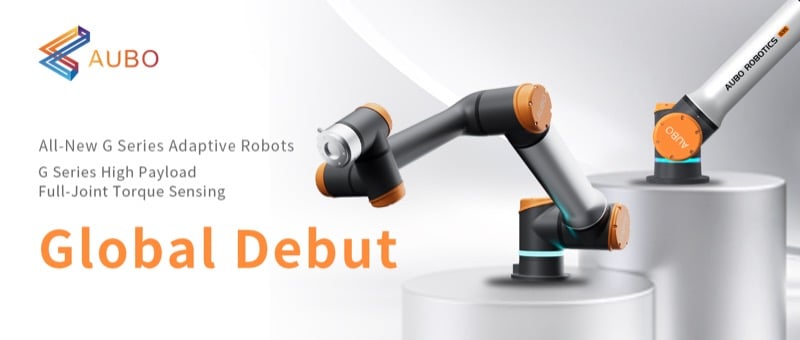
The new adaptive G35 and G40 collaborative robots. Image used courtesy of Aubo Robotics
G35 and G40 Expanded High-Payload and Built-In Torque Sensing
The G35 collaborative robot can handle payloads up to 35 kg with a working radius of 2,100 mm. The G40 supports payloads up to 40 kg and has a more compact reach. Both models are lightweight, with the G35 weighing 115 kg and the G40 weighing 109 kg, giving a payload-to-weight ratio of up to 1:2.73. Their base diameter is only 315 mm, making them easier to install in tight spaces.
Each joint in the G Series has a torque sensor that supports adaptive automation. According to Aubo, the system can detect force changes with up to 5% full-scale accuracy. By tracking joint torque, the robot can adjust its position and force in real time, keeping processes steady and protecting parts from damage.
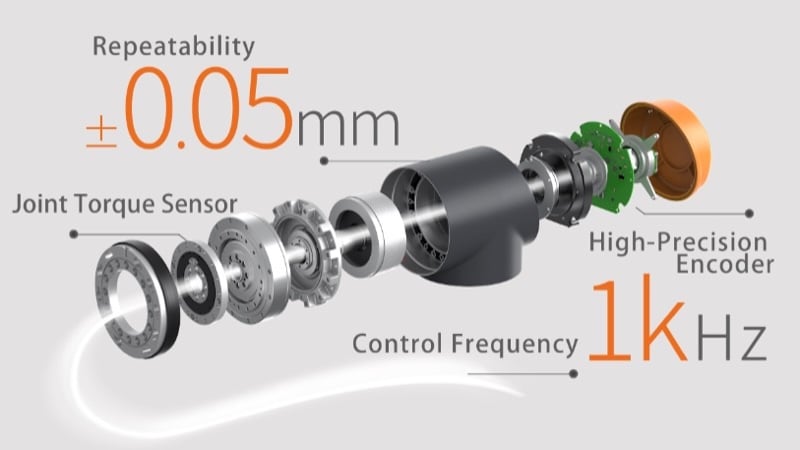
The G Series incorporates full-joint torque sensing and EtherCAT-based motion control. Image used courtesy of Aubo Robotics
EtherCAT Architecture Improves Motion Performance
The G Series uses a high-speed EtherCAT communication bus and advanced motion control. The robots have a control frequency of 1 kHz, joint speeds of up to 336° per second, and end-effector speeds of up to 6.4 m/s. In some applications, they can work up to 47% faster than similar models. Vibration suppression technology helps reduce oscillations during fast movements, improving positioning stability and repeatability to ±0.05 mm.
Multiple Teaching and Control Options
To make setup and operation easier, the new robots come with the G-Pendant, a wired teach pendant with a physical emergency stop button for precise positioning tasks. For more mobility, Aubo offers the G-STICK handheld controller. This wireless device works up to 10 meters away and can be paired with popular tablets using a special mounting kit. The robots run on AuboStudio software, which supports Android and HarmonyOS.
The G Series now uses a 96 V control system, replacing the older 48 V platform. This higher voltage makes power transmission more efficient and reduces heat loss during heavy use. The robots are available with a standard controller for production or a compact Mini controller for tight spaces. The system supports cable lengths up to 40 meters, giving more flexibility for longer manufacturing lines.
Target Applications in Harsh Industrial Environments
For welding, the robot offers IP67 protection and an explosion-resistant design, along with adaptive motion control for stable operation in tough environments. The robots can handle extreme temperatures, making them suitable for high-temperature machining and cold storage applications. In logistics, their high payload and fast joint speeds help improve stacking stability and cycle times. Automotive manufacturing tasks like heavy component handling, assembly, and painting can also benefit from these robots.
As manufacturers look for more flexible automation, industrial robots like the new G Series, which combine high payloads, smart sensing, and adaptive control, are likely to become even more important on the factory floor.