 Facebook
 Google
 GitHub
 Linkedin
Node-RED: Accessing the Edge With a PLC Module
Machine designers and OEMs have several practical, economical options to achieve edge connectivity using Node-RED, one of which reduces complexity by using traditional modular PLC control.
Intelligent features are being added to industrial machines, equipment, and processes at an unprecedented rate. The challenge is no longer just capturing data, but transferring that data to applications that can drive insights and actions. Making this data economical and accessible without interfering with or compromising operational integrity is a top design goal for OEMs, integrators, and end users.
Many options are available to make the connection from the factory floor to modern data flows, so a thoughtful approach is required. Most factories are comprised of equipment and machines from a variety of vendors with multiple vintages. It’s crucial to select the right implementation strategy, especially for smaller applications and machines, to maximize capital investment while enabling visualization, analytics, cloud connectivity, and protocol bridging.
Solutions Abound: No Need for a Code Red!
An effective and increasingly popular data connectivity solution is a free, open-source, low-code visual drag-and-drop programming tool called Node-RED. This tool allows users to create event-driven “flows” to connect hardware devices, APIs, and online services by linking functional nodes instead of writing individual lines of code. Node-RED runs on Linux to create data handling applications that run locally on low-cost Android, Arduino, Raspberry Pi, and PC hardware, or even in the cloud.
For industrial applications, Node-RED can be used at the network edge to enhance and transmit sensor and control equipment information up to enterprise or cloud formats using secure MQTT and HTTP communications, enabling real-time data visualization from both modern and legacy equipment.
However, because Node-RED is open source and also popular in non-industrial applications, selecting the right platform and implementation strategy is critical to achieving reliable, secure performance in industrial environments. There are several possible architectures for using Node-RED in an industrial environment.
Because it can run on consumer-grade Linux-based microcontrollers or PCs using containerization or virtualization technologies, it may be tempting to go this route and network the implementation to an industrial-grade PLC. However, this approach adds an extra level of hardware design and OS management, and many users will rightfully be reluctant to trust non-industrial hardware for critical always-on applications.
A few PLCs include on-board provisions to run Node-RED. While these are a viable option, the designer will need to evaluate whether these platforms, generally being more costly and complex, actually provide the best overall value for a variety of applications.
Optimizing Implementation for Industrial Applications
There is one very compelling option for implementing Node-RED in a way that avoids those less-than-industrial-grade platforms, and certainly doesn’t require abandoning any existing PLC investments.
A Node-RED module that plugs directly into a PLC backplane provides an edge computing environment that runs alongside deterministic logic, not as a replacement or an additional burden. It runs a full Node-RED runtime on embedded Linux, providing real-time data flows, cloud connectivity, protocol bridging, and lightweight analytics, all within a familiar PLC form factor that conforms to industrial certifications.
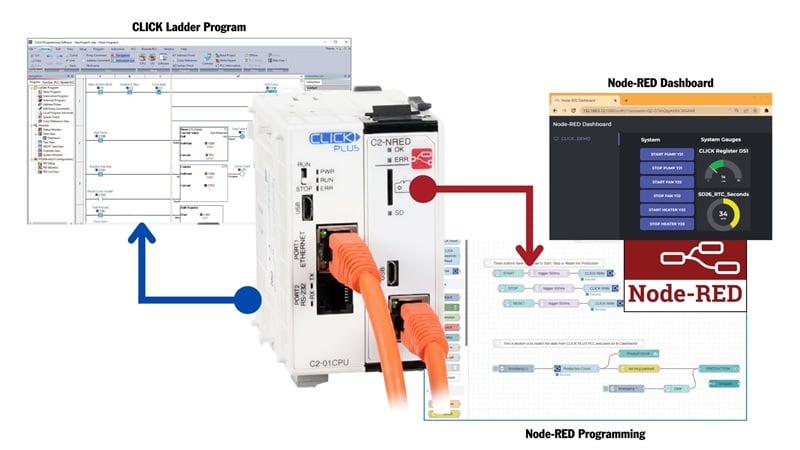
Figure 1. The C2-NRED module for the CLICK system by AutomationDirect is an example of Node-RED installed directly into the PLC.
Such a PLC module communicates directly over the backplane to exchange plant floor (OT) data with the CPU, while simultaneously connecting to IT enterprise systems, MQTT brokers, or cloud platforms via an onboard Ethernet port. The integrated approach lets small and mid-sized machine builders add genuine edge capability (dashboards, alerting, condition monitoring, OEE calculations, etc.) without the cost and complexity of a separate edge gateway or industrial PC (IPC).
Security Starts With Separation
Open environments provide optimum flexibility as new protocols and services emerge, but industrial applications always require secure, hardened options that stand the test of time. Implementing an architecture that incorporates network segmentation, whether physical or logical, is essential for cybersecurity. A dedicated Node-RED module achieves this by being coupled with the PLC over the backplane, yet logically isolated from it.
With a dedicated Ethernet port, separate from the PLC or SCADA system, a Node-RED module can operate on a completely different subnet or VLAN, establishing a functional DMZ between the OT control network and the enterprise IT network or cloud. Cybersecurity is simpler to implement because the security team can easily apply firewall rules without touching the control network.
To support applications with stringent cybersecurity requirements, a Node-RED module should include built-in encryption. For most industrial edge deployments, native TLS/SSL encryption with certificate-based authentication provides secure communications for MQTT and HTTP traffic to enterprise systems and cloud platforms like AWS IoT, Azure IoT Hub, or an on-premises broker such as Mosquitto.
In addition to encrypted communications, restricting communication between devices via an “allow list” (IP whitelist), incorporating user accounts with username and password authentication, logging to an event record for monitoring and auditing purposes, and establishing methods for certificate management are all ways edge devices can manage access, add value, and exceed entry-level security requirements.
An Accessible Approach
While a standalone IPC can be configured as a Node-RED gateway and provides useful flexibility, this approach requires deploying a more costly hardware platform (especially for industrial-rated hardware). The end user is responsible for maintaining and updating the Linux OS in its separate software environment.
An industrial-rated Node-RED module, on the other hand, is coupled with the PLC for installation simplicity, but it remains logically separate from the PLC so that the scan cycle and control determinism are never compromised by the Linux OS. The Node-RED module runs an embedded Linux environment hosting the Node-RED runtime, fully configured and supported via the PLC vendor’s IDE. All cloud and MQTT traffic is handled on the Node-RED module interface, while the PLC CPU communicates with HMIs and field devices on the control network. There is no direct IP path between the two networks.
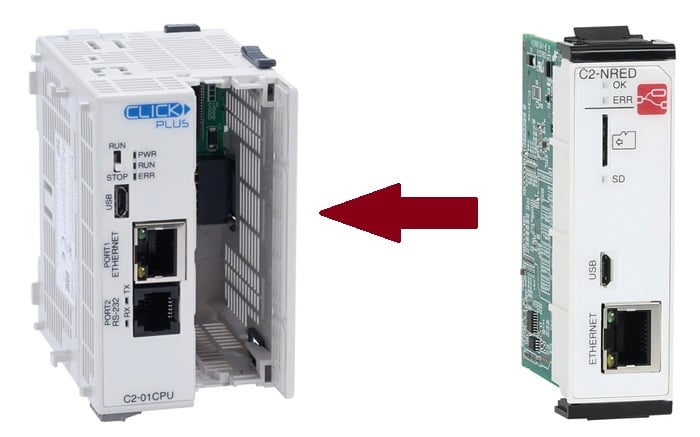
Figure 2. PLC modules rely on a modular architecture that shares data across the backplane while maintaining complete separation between deterministic control and edge computing resources.
With this approach, the Node-RED module flow editor opens directly from within the PLC programming software as a browser-based tool, so engineers work from a single environment to configure both the PLC logic and the edge data flows. Firmware updates for both the PLC and the Node-RED module are managed from the same software interface.
Configuring the Module
Node-RED is configured in two places, with a clear division of responsibility.
The PLC programming IDE handles module-level configuration: network/IP settings, DNS, whitelists, user accounts, certificates, and RTC/clock sync. This is also where the PLC project backup file is managed.
The browser-based Node-RED flow editor is where the actual application is built. The program links various nodes that read PLC data, transform it, and route it to cloud endpoints, dashboards, databases, or other systems.
Because the Node-RED module gains access to the PLC data through the backplane, there is no need to revise the architecture or control program for edge connectivity. OT developers work in a familiar ladder logic environment while gaining easy access to the data and connectivity layer with Node-RED. Security certificates are saved with the project, making them easy to restore after firmware updates or when replicating the machine.
Custom Scripting
Users can also write custom JavaScript to meet unique requirements, extending the platform's functionality even further. The visual flow editor is essentially a graphical way to construct JS logic without writing code.
For most use cases, engineers never touch JavaScript directly. It becomes relevant in Function nodes, which are custom blocks within a flow that house JavaScript subroutines directly when the pre-built nodes don’t cover a specific data transformation or logic need.
One example of custom JS logic might be limiting a weather API response to 12-hour blocks of temperature data before writing it back to the PLC. That kind of custom filtering or parsing is where a Function node and a few lines of JavaScript may be the right tool; however, it’s optional and task-specific, not a prerequisite for using Node-RED.
Multi-Protocol Support
Protocol support often determines whether an edge device can actually connect to the installed base it needs to serve. A machine on a factory floor might need to simultaneously communicate with Modbus RTU sensors, an Ethernet/IP PLC from another vendor, an OPC UA server on the SCADA system, and an MQTT broker in the cloud.
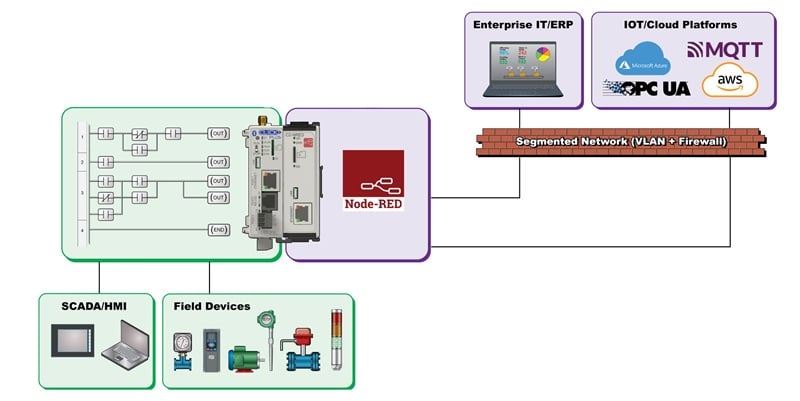
Figure 3. A Node-RED module provides a platform for integrating OT communication protocols with higher-level IT enterprise and cloud computing platforms.
An edge device acts as a protocol bridge, simplifying the overall system architecture and reading data from field devices before forwarding it to cloud platforms via MQTT or HTTPS. For OEM machine builders whose machines land in varied customer environments, this is a significant practical advantage.
Cracking the Edge Code
Expanding beyond the network edge doesn’t need to be difficult or costly. Many strategies take a deliberate middle ground, providing genuinely open connectivity with a structured, supportable runtime environment rather than a blank Linux canvas. Node-RED has emerged as a powerful and accessible platform for integrating both legacy and modern equipment with enterprise and cloud applications.
When paired with industrial-grade hardware designed specifically for factory environments, Node-RED can deliver secure and scalable edge connectivity that supports protocol translation, visualization, and analytics. For value-oriented machine builders, the modular Node-RED approach is a convenient, flexible, and economical way to add modern analytics and functionality, without abandoning the existing PLC investment or introducing unnecessary risk to existing control systems.
All images used courtesy of AutomationDirect