 Facebook
 Google
 GitHub
 Linkedin
Industrial Shields Brings Arduino Control to a New PLC Platform
The Ardbox Q pairs an STM32 controller with a Linux-powered Qualcomm processor, bringing real-time machine control and edge computing into one industrial PLC.
Industrial Shields’ Ardbox Q brings Arduino-based control into a DIN-rail PLC that combines real-time machine control with Linux computing and edge AI. Built around the Arduino UNO Q platform, the controller uses a dedicated STM32 microcontroller to manage physical I/O and control cycles. Meanwhile, a separate Qualcomm processor runs Debian-based Linux for data processing, dashboards, communications, and local applications. Available in analog and relay configurations, the Ardbox Q supports programming through the Arduino IDE, Python, Node-RED, and Docker. Its combination of control and computing could appeal to smaller OEM machines, monitoring systems, and custom automation projects that need local data processing without a separate industrial PC.
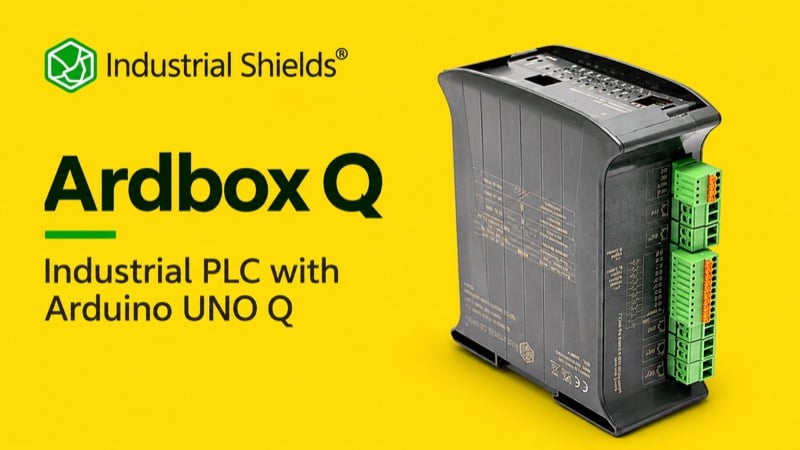
Industrial Shields' Ardbox Q combines Arduino UNO Q-based real-time control and Linux processing in a DIN-rail industrial PLC. Image used courtesy of Industrial Shields
Arduino-based controllers have always been an interesting option for industrial automation, although competing with established PLC platforms from Siemens and Allen-Bradley is another matter. The Ardbox Q takes a different approach by combining traditional control functions with the computing capabilities normally handled by an industrial PC or edge gateway. It's an interesting direction for Arduino-based hardware, particularly for smaller machines and custom automation projects.
Two Processors, Two Configurations
The Ardbox Q uses an STM32U585 microcontroller with an Arm Cortex-M33 core for real-time control and physical I/O, while a separate Qualcomm Dragonwing QRB2210 quad-core processor runs Debian-based Linux. The Linux side handles data logging, dashboards, communications, and local AI applications. Keeping these tasks separate is an important part of the design. If a Linux application crashes, the STM32 can continue running the machine's control cycle without depending on the Linux processor.
Programming is handled through the Arduino IDE for machine control and Python, Node-RED, or Docker for Linux applications. Arduino App Lab can bring both sides into one project. The controller also includes dual-band Wi-Fi 5, Bluetooth 5.1, and a front-mounted USB-C port.
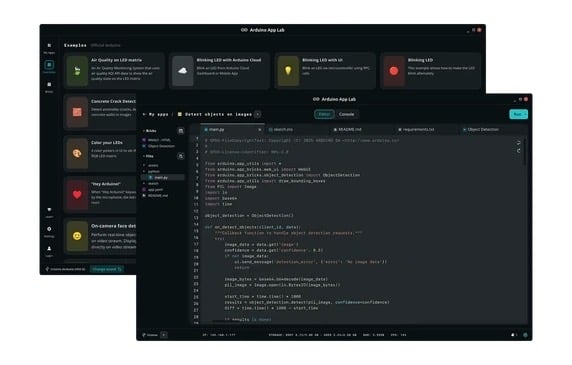
Arduino App Lab provides a development environment for managing real-time control code and Linux-based applications on the Ardbox Q. Image used courtesy of Industrial Shields
Industrial Shields offers two I/O configurations. The Ardbox Q Analog has four digital inputs, six configurable analog/digital inputs, three digital outputs, and six 0–10 V analog/PWM outputs. The Ardbox Q Relay uses the same input arrangement but provides eight relay outputs and two analog outputs, making it better suited for switching pumps, valves, and other on/off loads. Both models are available with 2 GB RAM and 16 GB eMMC storage or 4 GB RAM and 32 GB storage. They measure 100 × 45 × 115 mm and operate from 0 °C to 60 °C. Pricing starts at €255 for the analog version and €225 for the relay version.
Can Arduino Compete with Traditional PLCs?
Arduino has been around for a long time and is popular for prototyping and custom electronics, but can it handle industrial automation? Established PLC manufacturers offer extensive programming environments, industrial communication networks, safety options, and long-term support, which truly matters when equipment is expected to run around the clock for years.
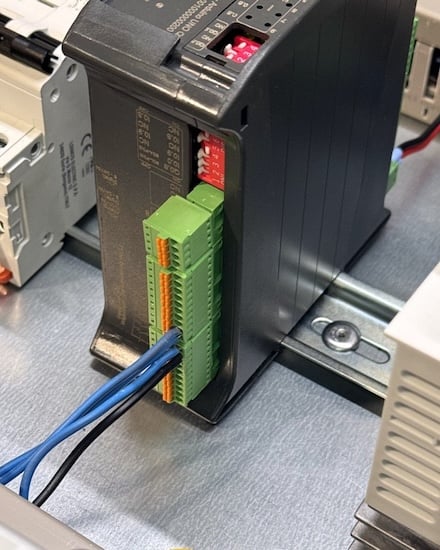
The Ardbox Q connects to field equipment through its industrial I/O terminals, supporting applications such as predictive maintenance, remote telemetry, and machine monitoring. Image used courtesy of Industrial Shields
The Ardbox Q does offer some practical advantages. Having real-time control and Linux processing in one enclosure could be useful for smaller OEM machines, remote monitoring systems, or applications that need to collect and process data locally. For example, the controller could read equipment data through Modbus RTU while running a Node-RED dashboard or sending selected information to an MQTT broker.
There are still some things worth verifying before putting the Ardbox Q into a production machine. Industrial Shields lists a 0 °C to 60 °C operating range, which should cover many control cabinet installations. However, engineers would still need to verify the required certifications, communication capabilities, and long-term support for their application, which is where big-name control companies are already established.
Can It Hold Its Own on the Factory Floor?
The Ardbox Q isn't likely to convince a plant standardized on ControlLogix or Siemens S7 controllers to start replacing them: programming support, maintenance familiarity, and compatibility with existing equipment usually matter more than the controller's price.
Still, this is a more serious approach to industrial automation than simply putting an Arduino board inside an enclosure. Separating real-time control from Linux processing addresses a legitimate engineering concern, and the ability to run local applications without another computer has some appeal. Whether it can compete with established PLCs will depend on reliability, support, and how well it holds up in actual production environments.