Facebook
 Google
 GitHub
 Linkedin
Accessible Automation in Materials Science With 3D-Printed Robotics
Meet FLUID, a 3D-printed, open-source robot from Hokkaido University. FLUID serves as an affordable and accessible way for researchers to automate experiments and advance materials science.
Automation is rapidly transforming science, but access to high-tech lab tools still comes at a steep cost. For many researchers around the world, especially those in smaller institutions or developing regions, the price tag attached to automation equipment makes modern experimentation feel out of reach.
Researchers from Hokkaido University are breaking down these barriers with their newly developed Flowing Liquid Utilizing Interactive Device (FLUID), an affordable, open-source robot built using 3D-printed parts and accessible electronics. FLUID is designed to give labs a practical path to automation without the budget strain of traditional systems.
Researchers at the Hokkaido University have designed FLUID to be an affordable, open-source robot benefiting researchers in materials science. Video used courtesy of Hokkaido University
Flowing Liquid Utilizing Interactive Device (FLUID)
At the heart of FLUID robotic system is a modular design built for flexibility. The system uses four interchangeable units, each armed with a syringe, motors to control movement, valves for directing flow, and sensors that track syringe levels. These modules connect to microcontroller boards, which sync with a standard computer via USB for full operational control. Every syringe movement, valve twist, and fluid interaction can be fine-tuned digitally and monitored in real time. This precise liquid handling allows researchers to carry out complex chemical processes.
To showcase its potential, the Hokkaido team used FLUID to synthesize materials by mixing cobalt and nickel through a method called coprecipitation, a critical process in battery and catalyst research. The demonstration confirmed that the FLUID robot could reliably perform tasks usually reserved for expensive equipment.
A 3D-Printed Open-Source Robot
One of FLUID’s standout features isn’t just in its hardware; it’s the philosophy behind it. The full set of blueprints, software, and instructions is open to the public. That means any lab with a 3D printer and access to basic electronic components can build its own version of the robot. This kind of accessibility changes the game for underfunded labs and specialized research. By using only common parts and open-source software, the team has created a scalable platform that doesn’t lock scientists into proprietary systems or sky-high costs.
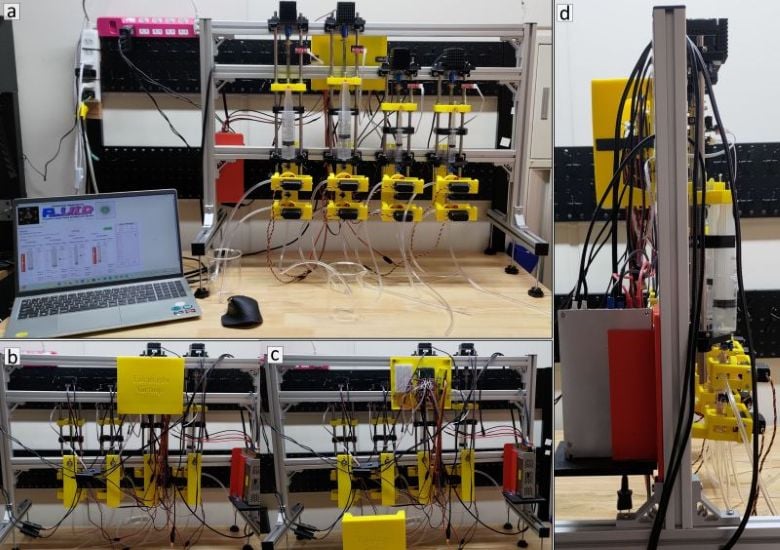
Various views of FLUID showing the robot’s wiring and modular design. Image used courtesy of Hokkaido University
Cost-Effective, Accessible Research
FLUID is still evolving. Its creators are already working on upgrades that would allow the robot to monitor chemical conditions like temperature and acidity, features crucial for expanding its use into new areas like pharmaceutical testing or organic synthesis. Software improvements are also on the horizon. Future versions will include automation macros for repeatable procedures and enhanced data tracking tools to support cleaner experimental records. These changes are designed to enhance lab workflows and increase reproducibility, which is often a hurdle in high-volume experimentation.
With FLUID, researchers at Hokkaido University are democratizing scientific automation. With its open-source framework and budget-friendly design, FLUID puts powerful research tools into the hands of the masses, making room for more innovation, no matter where it starts.
Related Content