Facebook
 Google
 GitHub
 Linkedin
Apera Vue 9.50 Enhances Robotic Vision With AI Precision
Vue 9.50 uses AI-powered 4D vision to enhance bin picking, automate calibration, and reduce downtime in robotic work cells.
Apera AI continues to evolve its product and solution offerings by releasing its newly updated Apera Vue 9.50 4D vision software. The company has developed the software to provide near-human-like vision and perceptive capabilities to respond dynamically and in real time for real-world robotic applications, including but not limited to assembly, bin picking, and other pick-and-place applications.
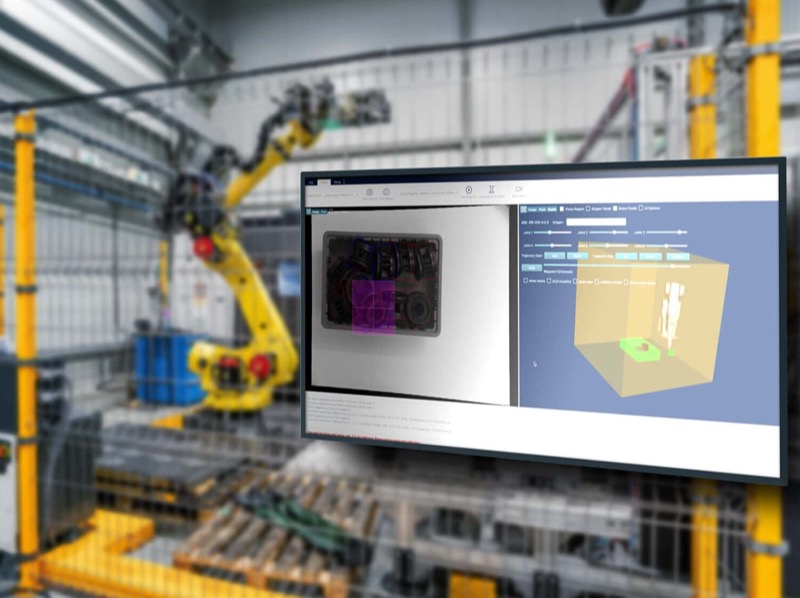
Apera’s Vue software can identify parts/products to pick within 0.3 seconds while initiating the required movement of an industrial robot, which means customers could achieve 2,000 picks per hour, says Apera. Image used courtesy of Apera
Optimizing Calibration Accuracy
The Apera Vue 9.50 software comes with a ChArUco calibration board kit, which provides customers with ArUco marker and checkerboard detection, where the former uses specific 2D binary-encoded reference patterns for rapid identification by machine vision systems. The calibration kit is intended to smooth the relay between machine vision data and robot motion by fine-tuning hand-eye calibration in the field, while reducing time wasted on re-calibration.
The calibration boards are robust, consisting of a rigid aluminium composite to provide durability in harsh industrial settings. Flexibility is a key element of the calibration kit, allowing customers to mount VuePort cameras directly to a robot’s end-of-arm tooling (EAOT) or its J6 flange.
The calibration kit links up to Vue’s Accuracy Insight guided analysis tool for added precision. Users can access functions to validate stereo calibration, robotic EOAT, and vision system alignment, as well as the performance of the chosen robot model. The validation procedure is accessible, offering supportive guidance and a step-by-step approach. The Vue 9.50 software allows users to relax the robot hand-eye calibration variance to correct misalignment. Vue 9.50 also offers users integrated workflows and reference checkpoints to identify and target robot positions in various poses. Lastly, it allows users to review robotic task accuracy through the Vue interface without using time-consuming documentation or adding more tooling.
Two Stand Out Features
Traditionally, bin picking systems are quite inflexible. This rigidity means that when alterations in the physical environment cause a bin on the workstation to move, an experienced engineer would have to come onsite to re-teach the robot concerning the bin location through its controller and recalibrate the robot-vision system setup. Vision software code may also need re-jigging to consolidate accurate positioning.
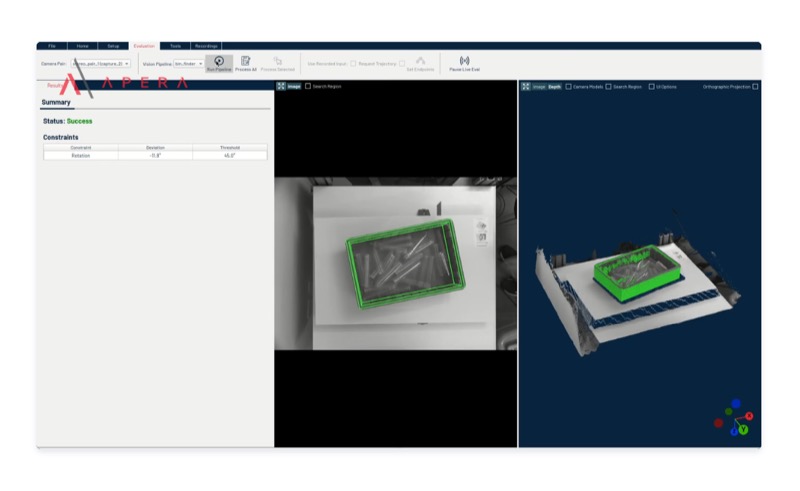
Bin localization can be triggered by the Vue user interface or through the robot via a standard API ( application programming interface), with no modifications needed to the current pick line code. Image used courtesy of Apera
Apera Vue 9.50 leverages AI-backed 4D vision to automate bin finding and repositioning without human retraining, targeting, and adjusting to bin shifts in X, Y, and yaw. This increases the system's resilience and decreases downtime by doing away with the requirement for a specialist to step in for minor bin changes or misalignments.
The Vue system’s bin localization capabilities function independently of the primary picking process, saving revised bin placements for later use and enhancing reusability. To maintain safety, previously recorded data is erased in the event of failed bin correction, minimising unpredictable robot behaviour. Vue 9.50 is designed to reduce impact on cycle time with bin detection operating only when bin changes are observed. Furthermore, bin placement correction data is retained with session records and remains after system restarts.
Customers also benefit from vision-guided Tool Centre Point (TCP) calibration, allowing for proper alignment of the wrist of the robot with the TCP via part localization, 3D vision, and robot pose. Apera says their setup allows submillimeter accuracy and eliminates imprecision, manual labor, and time consumption associated with the Four-Point method. This latter method depends upon the operator's touch and visual sensitivity, so that human error could lead to inaccurate calculations of TCP.
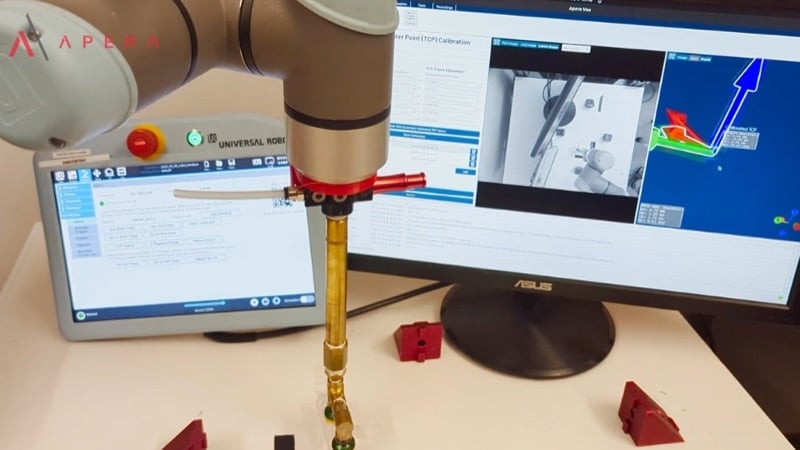
Customers can use “TCP Classroom” guides and intuitive UIs to execute calibrations with greater confidence and fewer errors. Image used courtesy of Apera
The Vue 9.50 software also offers users a new Recording & Playback System designed to help customers improve troubleshooting and optimization. When anomalies such as cycle time issues or vision errors occur, it conveniently gathers visual data and provides in-app playback for rapid insight generation into what caused the occurrence. This system allows users to analyze and refine pipeline optimization parameters and readily extract footage for sharing with support teams to resolve issues in a timely manner and drive performance enhancements.