Facebook
 Google
 GitHub
 Linkedin
Automate Highlight Series: Sonair Brings Sound Sensing to AMRs
Check out the amazing power of high-frequency sound, used to detect a complete 3D environment and developed to increase safety in sensing for autonomous robots.
Although the Automate trade show is now several weeks past, our editorial engineering team got to meet with so many excellent companies and professionals that they deserve unique articles. Thanks for reading our Automate Highlight Series, and we look forward to seeing you again at a future show!
Sonair made some noise at the recent Automate show in Detroit, although nobody could even hear it! The Norwegian sensor company demonstrated a technology that puts a twist on traditional AMR navigation systems by offering a more cost-effective and comprehensive approach to 3D obstacle detection in environments shared by humans and rolling robots.
Ultrasonic Technology: 2D Versus 3D
Ultrasonic technology relies on the emission of high-frequency sound waves and their reflections back to a sensor to determine the presence, distance, and sometimes even the characteristics of objects. It is often compared to a bat using echolocation: sending out high-pitched squeaks and listening to the echoes, building a rough picture of the surroundings and a potential meal.
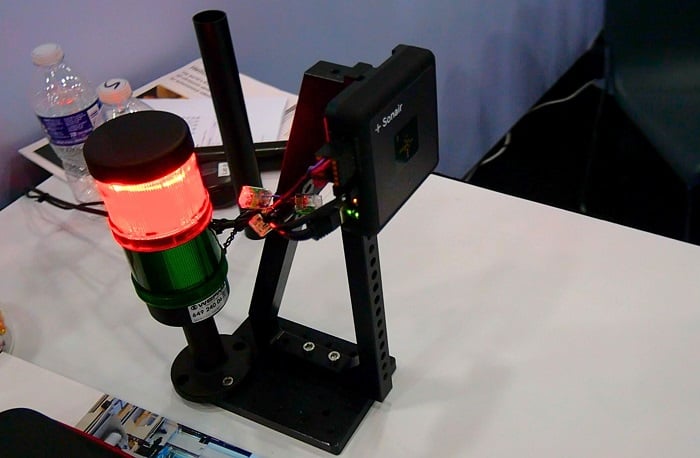
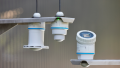
At the show, Sonair’s sensor was paired with a visualization of the safety zone and a stack light indicator.
In industrial and robotic applications, traditional 2D ultrasonic sensors typically provide a single-point or a single-plane "slice" of information, focusing on distance with a limited angular spread. They are often used for simple proximity detection, like parking sensors in cars or basic collision avoidance for AGVs.
3D ultrasonic technology, the power behind Sonair's new acoustic detection and ranging (ADAR) sensor, takes this process a step further. Instead of just a single plane, it creates a ‘volumetric’ perception of the environment. The ADAR sensor uses an array of transducers with signal processing to allow ADAR to detect surroundings in 3D, providing a better picture of the spatial information. A single ADAR sensor can deliver a 180-degree field of view, which can be visualized as half of a complete sphere with a radius of up to 5 meters.
Comparing Ultrasonic to Vision and LiDAR
While vision systems (cameras) and Light Detection and Ranging (LiDAR) are prevalent in AMR perception, ultrasonic technology, particularly 3D ultrasonic, offers distinct advantages.
Robustness in Challenging Environments: Unlike vision and other optical sensing methods, ultrasonic sensors are largely unaffected by lighting conditions, dust, fog, or reflective or transparent surfaces that can hinder camera and LiDAR performance. Sound waves do, of course, struggle to detect some materials that reflect sound waves perfectly away from the sensor or soft/fuzzy materials, however, these cases are rarely encountered in AMR operation. Additionally, the high 70 kHz frequency used by the ADAR sensor can detect softer objects than most other ultrasonic technologies.
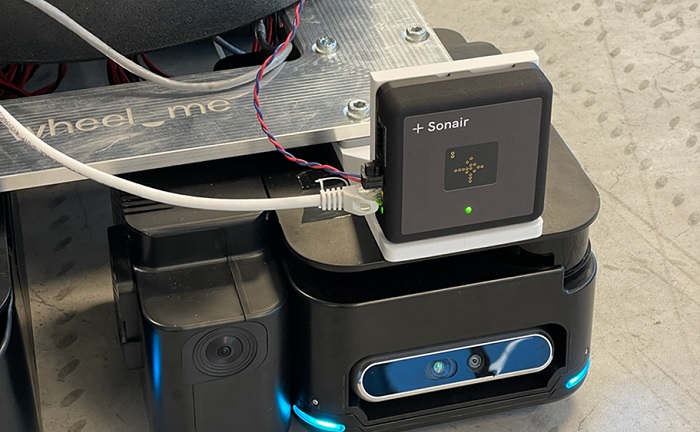
Sonair’s ultrasonic sensor on an AMR. Image used courtesy of Sonair
Cost-Effectiveness: Sonair claims that ADAR can reduce the overall cost of sensor packages for AMRs, which is one of the most costly hardware components. These savings could potentially equal a 50-80% reduction compared to traditional LiDAR-based solutions.
Simpler Data: While LiDAR (point clouds) and vision (object recognition) generate millions of data points and require substantial processing power, 3D ultrasonic sensors can provide more targeted data points for object detection, reducing the burden on the processor, allowing either faster operation or the capacity to perform other actions while performing the scanning operation.
Better Human Detection: A typical 2D LiDAR safety scanner detects obstacles (like a person’s legs) in a single horizontal plane, which means that they are mounted at an optimal height from the ground, but they might miss some objects placed higher or lower. Sonair's 3D ultrasonic technology can detect people and objects in three dimensions, offering a more complete detection capability in shared workspaces.
The demo of the technology at the booth showed that a single sensor can reliably detect objects with an astounding 180-degree field of view both horizontally and vertically in front of the sensor! Imagine that: detecting an object that is beside the sensor instead of in front of it. I didn't believe it until I tried it myself.
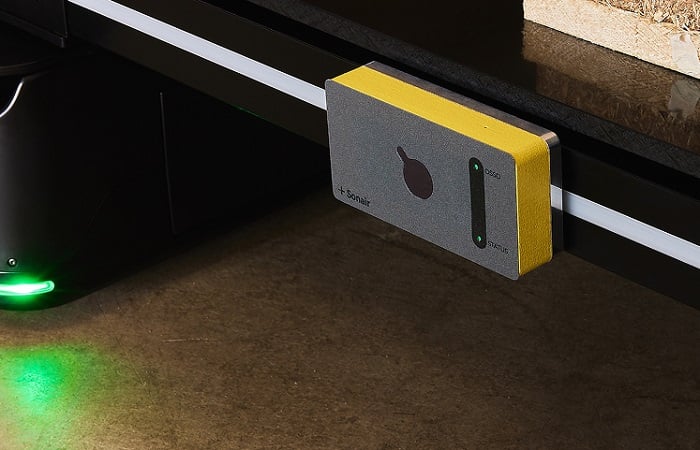
Sonair’s new safe ultrasonic sensor. Image used courtesy of Sonair
Safe Ultrasonic Sensor Certification
The emphasis on "safe" certification is very important for any robot operating alongside humans (collaborative). Autonomous robots must adhere to safety standards to prevent hazards, including the ANSI/A3 R15.08-2-2023 American National Standard for Industrial Mobile Robots. Sonair is anticipating compliance with ISO13849:2023 performance level d/SIL2 by the end of 2025.
For AMR manufacturers (and any other industrial company, for that matter), the use of certified sensors simplifies the decision process of component selection, ensuring compliance with relevant standards. These certifications provide independent verification of components, but they must still perform the end data collection goal with speed and reliability.
Sonair's ADAR sensor, the world's first safe 3D ultrasonic sensor for autonomous robots, brings a new opportunity to the market to diversify sensor types, allow more cost-effective options, and, hopefully, increase the adoption of AMRs by companies that can benefit from the technology.