Facebook
 Google
 GitHub
 Linkedin
Universal Robots Debuts AI Trainer with Real-World Feedback
With force-aware learning, UR AI Trainer enables robots to train using real-world data, improving automation performance.
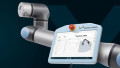
Universal Robots has announced its newest tool for training AI, the UR AI Trainer. The UR AI Trainer was released at NVIDIA GTC in San Jose, CA, earlier this month, and is the first step in moving robotic control from pre-programmed applications to fully automated, AI-developed routines. This tool has been made possible through the collaboration of Universal Robots and Scale AI.
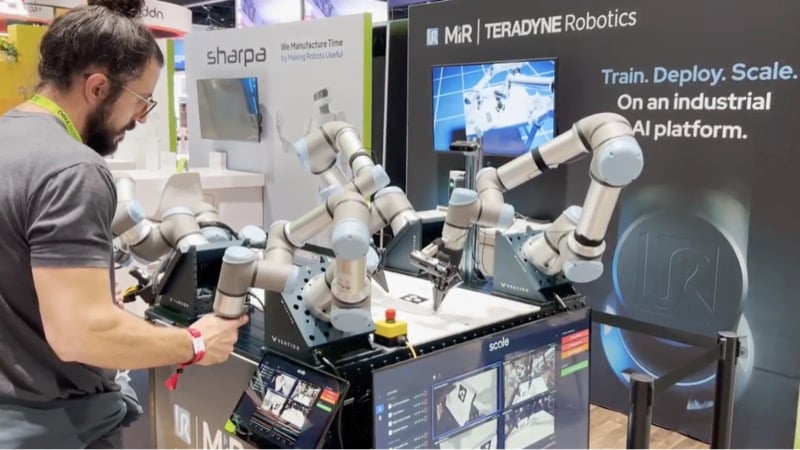
Universal Robots unveiling the UR AI Trainer at NVIDIA GTC. Image used courtesy of Universal Robots
The Lab to Factory Gap
In the hallway of the New Mexico Tech physics department, there is a sign that reads, “The difference between theory and reality is that in theory, there is no difference, but in reality, there is.” Unfortunately, many good ideas never bridge the gap between the laboratory and the real world. Likewise, simulations and training modules developed in the lab or in the training room often fall short when applied on the factory floor.
One of the primary goals of this partnership is to bridge the lab-to-factory gap, especially in AI training. Often, robot training routines do not accurately reflect what is happening in the real manufacturing world. Hodge-podges of hardware, low-fidelity data capture, and other such problems plague training routines. Often, training routines rely entirely on visual data and lack a way to capture or simulate physical feedback.
UR AI Trainer
The UR AI Trainer is different. Rather than relying solely on visual data, it uses Direct Torque Control and force feedback to assist in robot training. Direct Torque Control is Universal Robots’ solution for programming robots to take full advantage of torque, force, and other mechanical measurements to determine object grip strength, work around humans, and handle other challenging tasks. Besides showing what robots should “look like” during motion, the Direct Torque Control shows robots what they should “feel like” while interacting with the real world. This is rolled into the UR AI Trainer so it can be more effective at training robot motion control.
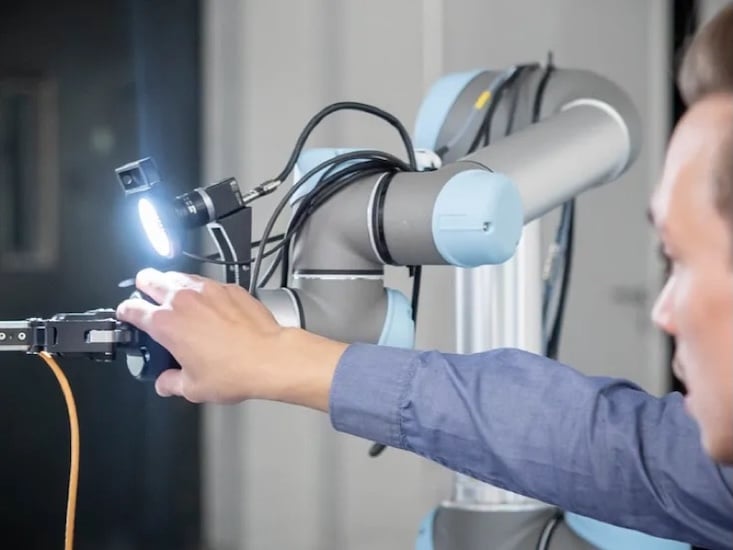
Direct Torque Control allows robots to be “force aware”. When combined with UR AI Trainer, this shows how robots should “feel”, not just how they should “look.” Image used courtesy of Universal Robots
UR AI Trainer is implemented by an operator guiding a “leader” robot through a series of tasks, and then the other robots mirror these actions. During motion, the leader robot records all motion, force, and visual data and compiles them into a Vision-Language-Action (VLA) dataset for use by other robots.
The Future of AI Training
Who better to decide how a machine should operate than another machine? The UR AI Trainer is the first step in having machines train machines. Many robotic cells are simple to program through “teach” pendants, trained motions, and so on. AI can determine optimized tool paths, balance speed and control, and develop smart workflows, all while adhering to preset safety rules. Most of the processing power can run on the AI’s native computer, without significantly boosting processing on the robots themselves.