Facebook
 Google
 GitHub
 Linkedin
Autonomous Robots Install Solar Panels 3 Times Faster
Rosendin demonstrated its autonomous robotic solar panel installation system at a massive solar farm in Texas.
Installing solar panels at a solar farm is a time-consuming and labor-intensive task. As demand for renewable energy increases, developers are seeking faster, safer, and more efficient methods, including robotics. Rosendin, an electrical contractor experienced in solar project development, is among several companies developing robotic solar panel installation solutions.
Watch the autonomous robotic installer in action. Image used courtesy of Rosendin
Last month, Rosendin demonstrated its autonomous robotic system at the Sequoia Solar project, under construction west of Dallas. The giant solar farm will have 1.8 million solar panels on 5,300 acres. Rosendin states the three-piece system can save labor, enhance safety, and triple installation speeds compared to conventional manual methods.
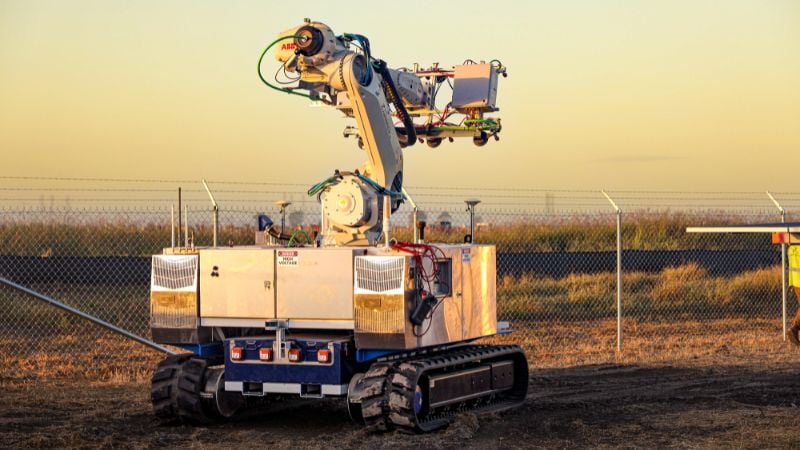
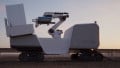
Robotic solar panel installer. Image used courtesy of Rosendin
The Rosendin Robotic System
Rosendin’s autonomous robotic system uses two robots to carry the solar panels to the installation site and a third to place the panels. The robots are equipped with LiDAR to detect and avoid obstacles and navigate across uneven, rocky, or muddy terrain. It uses GPS and KMZ to position the panels with a 2 mm precision. While the system is autonomous, it does require electrical teams to work with the robots.
The two carrier robots can hold about 30 to 35 panels, each of which can measure up to 4 by 8 feet and weigh between 80 and 100 pounds. The robot placing the panels uses an arm with air knives and eight suction cups to lift each panel and set it in place. Skilled workers help guide the panel and then fasten the hardware and the electrical connections.
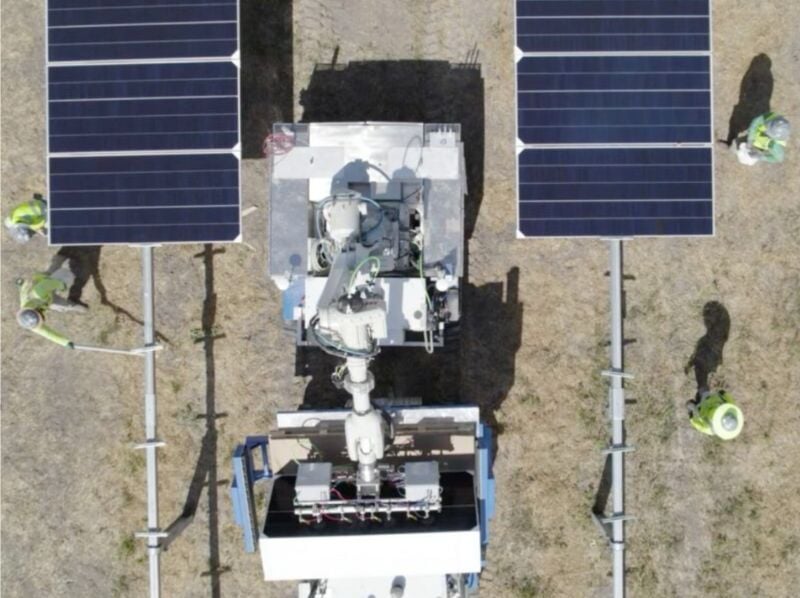
Aerial view of the robot placing the solar panels. Image used courtesy of Rosendin
The robots can operate continuously and in high temperatures and navigate sites with up to a 30% incline. The system uses a hybrid of gas and battery power. Rosendin developed the robots in partnership with ULC Technologies.
Testing the Robots
The Rosendin autonomous robots have been tested numerous times at solar construction sites. At a Texas solar farm, the robotic system demonstrated that a two-person crew could work three times faster than a three- or four-person manual crew. The demonstration achieved a rate of 350 to 400 solar panels per eight-hour working shift. In another ten-hour shift, the robots and a two-person crew could install about 600 solar panels.
In a typical manual installation, installing 600 panels would require workers to walk about 4.5 miles each and lift the heavy panels over their heads. In contrast, the robotic system’s crew walked about .45 miles a day and does not have to carry panels.
David Lincoln, Rosendin's senior vice president, said in a press release that the next version of the autonomous robot could include a monitoring system and central control, allowing several robotic installation teams to operate simultaneously.
Rosendin and Renewable Energy
Rosendin, an electric contracting company, has worked extensively with solar and renewable energy projects in the U.S., Puerto Rico, and Guam. Notable projects include the Townsite Solar + Storage in Nevada, the Athos Renewable Energy Project in California, and the Aktina Renewable Power Project in Texas. The company provides services ranging from project feasibility to construction, operations, and maintenance.