Facebook
 Google
 GitHub
 Linkedin
Banner Launches 3-Axis Vibration Sensors for Predictive Maintenance
The new QM30VT3 sensor series from Banner Engineering features 3-axis vibration monitoring, making the shift from reactive to predictive maintenance simple.
Banner Engineering’s latest vibration sensor series, the QM30VT3, is designed with predictive maintenance in mind. The series senses complex vibration waveforms in all three dimensions, making it possible to detect problems early on. The QM30VT3 samples at twice the speed of Banner’s previous model, the QM30VT2, an upgrade that makes it suitable for higher-speed equipment.
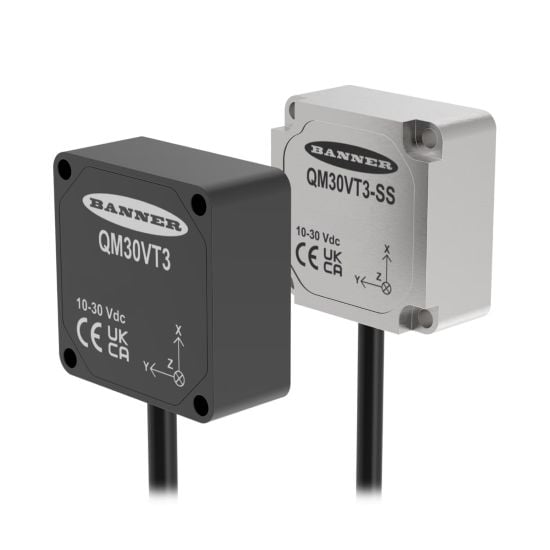
The Banner QM30VT3 series features 3-axis sensing and high-speed sampling. Image used courtesy of Banner Engineering
3D Vibration Sensing
Vibration sensing involves measuring an object’s mechanical vibration using acceleration and plotting it against time. During normal operation, this is the baseline vibration signature. The signature can also be run through a fast Fourier transform (FFT) to plot the same signal in the frequency domain. This gives valuable information about how the vibration occurs: does it match the rotational speed of a motor, for example.
The ability to perform this type of measurement in three dimensions means more data is captured. This means a better understanding of a machine’s vibration and the earlier problems that can be detected.
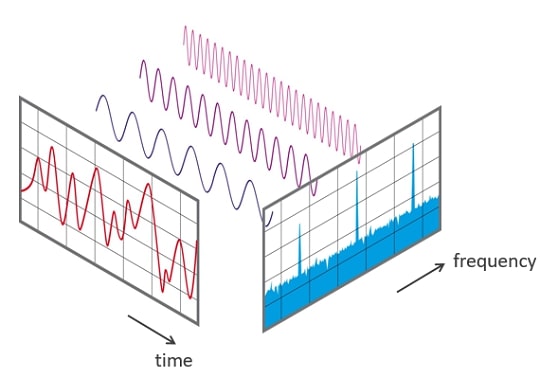
Demonstration of time domain versus frequency domain of a complex signal. Image used courtesy of Wikimedia Commons
QM30VT3 Vibration Sensors
Banner’s QM30VT3 3-axis vibration sensors are designed to be used in predictive maintenance applications. Each sensor is equipped with Banner’s VIBE-IQ, a machine-learning routine that automatically analyzes vibration data. The analysis includes establishing vibration baselines in three dimensions, setting alert thresholds, and making complex data waveforms easier to understand. From there, technicians and engineers can take predictive maintenance actions as recommended.
For advanced applications, users can view the time waveform, FFT data, and others. There are also advanced tool kits, such as High-Frequency Enveloping (HFE) and Frequency Maximum (FMax), for tackling complicated vibrational analysis. HFE is particularly useful for determining wear in races for slow-moving equipment. FMax allows for high-speed data sampling near frequencies of interest, boosting the resolution in this range.
The QM30VT3 samples at twice the speed of the series’ predecessor. Sampling speed directly impacts the frequency of vibrations that can be detected, as supported by the Nyquist Theorem. In the case of the QM30VT3, it can detect vibrations from 6 Hz to 5300 Hz, making it suitable for most AC and DC motors found in the industry.
Connectivity is made possible through Modbus compatibility, and each sensor is stamped with a reminder of axis directions (x, y, and z).
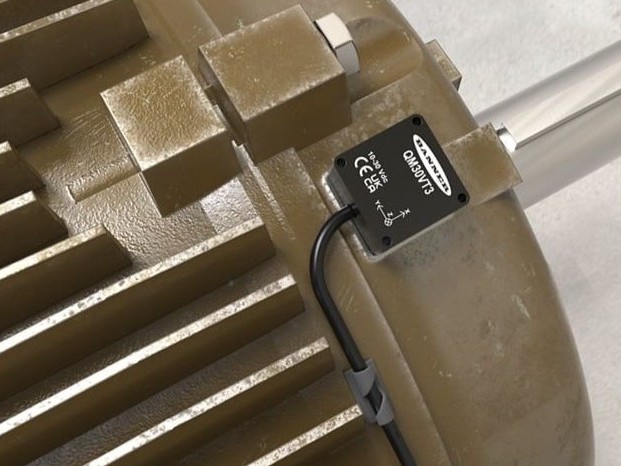
The Banner QM30VT3 is attached to a motor for measuring vibrations in three dimensions. Image used courtesy of Banner Engineering
Vibration Monitoring
Vibration monitoring is essential for the health and wellness of motors, pumps, and other machinery that run continuously. After a baseline has been established, vibrational analysis can look for irregularities in the vibrational signature. This can indicate bearing wear, out-of-balance gears and pulleys, or cavitation in a pump line, all of which are early signs of potential damage.
The ability to measure these vibrations in three dimensions can help technicians isolate a problem, especially if multiple sensors are implemented. The signals can help triangulate the physical location of the issue as well as confirm that it corresponds to motor speed, pressure conditions on a pumped fluid, and so on.