Facebook
 Google
 GitHub
 Linkedin
Belden Debuts ProLinx Edge Gateway for Smarter OT Connectivity
Explore Belden's ProLinx Edge Gateway, which unifies EtherNet/IP and Modbus TCP conversion with Docker-based edge applications in one rugged platform.
Industrial networks are getting harder to manage as more devices get connected. Some equipment runs on newer industrial Ethernet protocols. Other machines still depend on legacy OT systems. However, companies still want to collect more data, run analytics closer to the machine, and feed information into digital twin or asset monitoring platforms. Belden is targeting that mix of problems with the ProSoft Technology ELX3 ProLinx Edge Gateway.
The new gateway combines OT protocol conversion with lightweight edge computing in a single device. Instead of using one device for protocol translation and another for local applications, the ELX3 is designed to handle both jobs at the machine level.
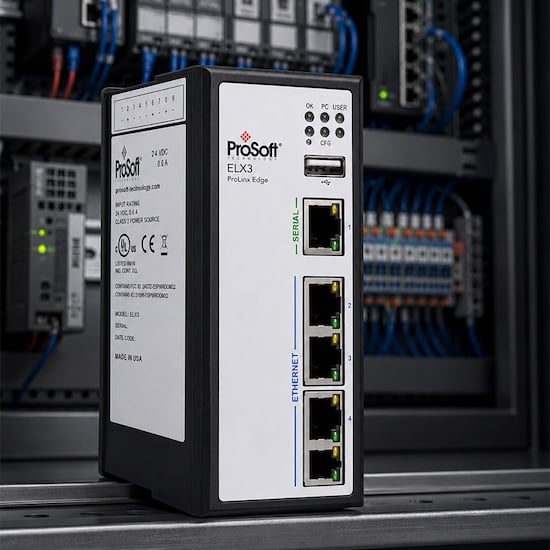
Belden’s ProSoft ELX3 ProLinx Edge Gateway combines OT protocol conversion and Docker-based edge computing in a rugged industrial platform. Image used courtesy of ProSoft
Protocol Conversion at the Edge
One of the core functions of the ELX3 is protocol conversion between EtherNet/IP and Modbus TCP/IP. That matters because many industrial facilities still use equipment from different generations and vendors. Getting those systems to communicate often requires dedicated gateway hardware. Belden’s approach is built around the ProSoft ELX-EIP-MBTCP protocol gateway container. It allows EtherNet/IP and Modbus TCP/IP devices to exchange data without forcing operators to replace existing equipment, making the gateway useful in plants where legacy automation systems and newer IIoT devices need to feed into the same data environment.
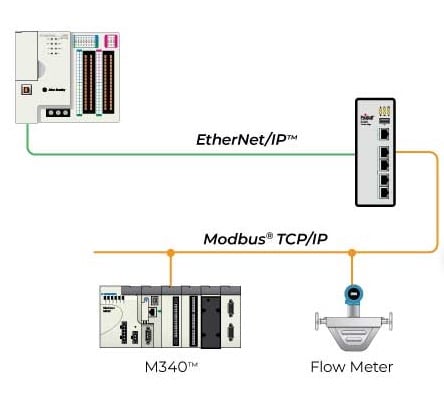
The ELX3 supports EtherNet/IP-to-Modbus TCP/IP protocol conversion, allowing dissimilar industrial devices to exchange data across the same network. Image used courtesy of ProSoft
Docker Support Adds Flexibility
The more interesting part of the ELX3 is its support for Docker containers. Docker support gives users a way to run custom code directly at the edge. Instead of sending all machine data upstream for processing, users can deploy lightweight applications on the gateway itself. Those containers can support tasks such as machine learning, predictive maintenance, digital twin connectivity, asset monitoring, custom protocol drivers, or near-real-time analytics.
That flexibility is important because edge computing needs vary from one facility to another. One site may need basic protocol conversion. Another may want local analytics or a custom data pipeline. The ELX3 is designed to support both without changing the hardware platform.
Built for Harsh Environments
The gateway is also built for industrial conditions rather than office network environments. It supports redundant 12 to 24 V DC power connections and includes four Ethernet ports with 10/100/1000 Mbit/s support. The hardware is rated for Class I, Division 2 environments and operates across a temperature range of -40° C to +70° C.
Belden also highlights resistance to shock, vibration, and EMC conditions. That often matters for edge devices because they are often placed close to machines, panels, and process equipment rather than in clean IT rooms.
Where It Fits
The ELX3 is aimed at industrial users trying to connect mixed OT systems while adding more intelligence closer to the machine. Belden points to use cases in oil and gas, power distribution, warehousing, logistics, automotive, food and beverage, metals, mining, water and wastewater, and machine building.
The broader value is consolidation. The gateway can translate protocols, host edge applications, and support future protocol containers from one hardware platform. That makes it a practical fit for industrial operations that want more data and local decision-making without adding another layer of separate devices to the network.
Related Content