 Facebook
 Google
 GitHub
 Linkedin
KUKA, ABB, and Kawasaki Unveil New Robotic Solutions
Recent updates from three automation leaders focus on AI-powered vision, robotic picking, and compact palletizing for manufacturing and logistics.
KUKA, ABB Robotics, and Kawasaki Robotics have introduced new robotics solutions aimed at improving how manufacturers handle vision-guided automation, product sorting, and end-of-line palletizing. The releases include KUKA's iiQKA.AI Vision software, ABB's AI-enhanced Fashion Inductor, and Kawasaki's CP110L palletizing robot.
While the products handle different jobs, they address some familiar challenges on the manufacturing floor. Integrating vision systems, handling inconsistent products, and finding enough space for robotic equipment can all complicate automation projects. These new offerings take different approaches to those problems, with KUKA and ABB focusing on software and AI integration while Kawasaki concentrates on mechanical design and palletizing performance.
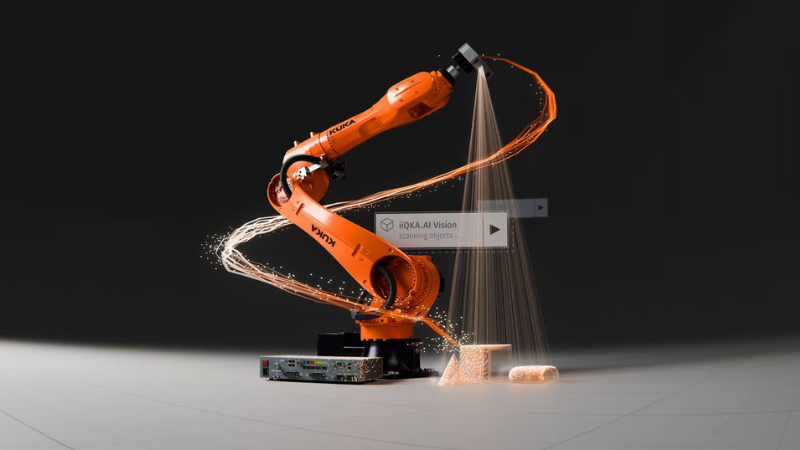
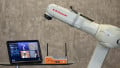
KUKA’s iiQKA.AI Vision software uses AI-powered 2D and 3D image processing to support robotic applications such as bin picking, assembly, and quality inspection. Image courtesy of KUKA
KUKA Brings Image Processing Into the Robot Controller
KUKA has introduced iiQKA.AI Vision, an integrated vision solution supporting 2D and 3D image processing for applications such as bin picking, assembly, quality inspection, and depalletizing. The software runs directly on the KUKA AI Extension Platform, which uses an NVIDIA Jetson Orin module for local AI processing. This eliminates the need for a separate vision-processing computer or cloud connection, although cameras and other vision hardware are still required.
One of the more useful features is its integration with KUKA's iiQWorks engineering software. Engineers can configure vision applications using drag-and-drop tools, predefined templates, and guided setup procedures. The system handles object recognition, position detection, and gripper-point calculations, then passes that information directly to the robot.
From an integration standpoint, keeping the vision processing and robot programming within the same software environment makes a lot of sense. Anyone who has worked through communication issues between a robot controller and a separate vision system knows how much time that can eat up. Having fewer systems to configure and troubleshoot could make vision-guided applications considerably easier to get running.
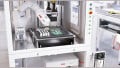
ABB Robotics’ Fashion Inductor uses AI-powered vision and robotic picking to automate the handling and sorting of apparel in logistics operations. Video courtesy of ABB Robotics
ABB Robotics Takes on Fashion Logistics
ABB Robotics has upgraded its Fashion Inductor module with AI Robot Trainer, a vision-based system designed for sorting and handling apparel. The existing module can process up to 1,300 items per hour per cell, with picking accuracy targets above 99.5%. ABB reports that the new AI tools can reduce engineering and commissioning effort by up to 75%.
The system includes pretrained vision models for apparel handling, automatic path planning, and a digital twin that connects AI Robot Trainer with RobotStudio and ABB's Application Controller Platform. It also supports cell-specific retraining, enabling engineers to use operating data to identify picking problems, update AI models, and deploy improvements back to the robot.
Fashion logistics is a good example of why traditional robotic picking can be difficult. Unlike machined parts or packaged products, clothing doesn't always present the same shape or orientation. What's interesting here is the ability to retrain the system as products and operating conditions change. Rather than treating commissioning as a one-time event, ABB is building model updates into the normal operation of the cell. How well that works on a busy sorting line will be worth watching.
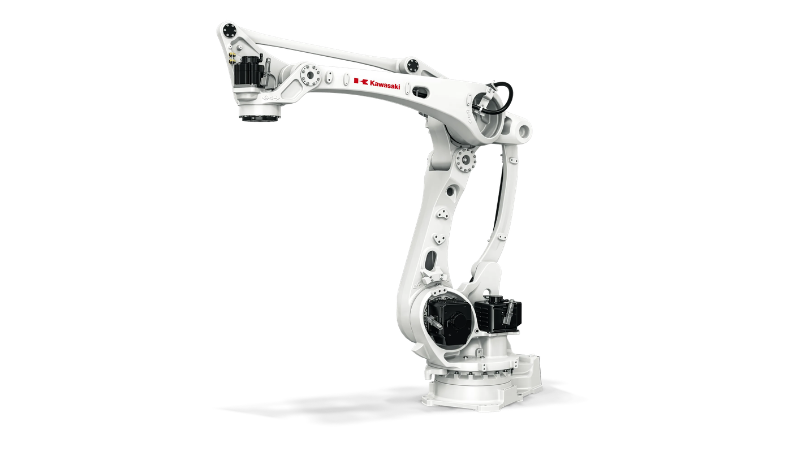
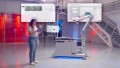
Kawasaki Robotics’ CP110L is a four-axis palletizing robot with a 110 kg payload capacity and a maximum reach of 2,505 mm, designed for industrial palletizing. Image courtesy of Kawasaki Robotics
Kawasaki Targets Space-Constrained Palletizing Cells
Kawasaki Robotics has introduced the CP110L, a four-axis palletizing robot designed for packaging and end-of-line automation. The robot has a 110 kg payload capacity, a maximum reach of 2,505 mm, and can handle up to 2,200 cases per hour under specified conditions. It also offers ±0.05 mm repeatability.
The CP110L requires just 2,242 mm of ceiling clearance, which shouldn’t be a problem for most manufacturing facilities, and has a 453 mm interference radius around its rotating axis. Kawasaki has also routed cables and hoses through the robot's wrist, keeping them out of the way during operation. Another useful addition is regenerative braking, which allows the robot to recover some of the energy generated as it slows down.
From a manufacturing standpoint, I can see the CP110L being particularly useful for companies looking to automate palletizing without making major changes to their existing production lines. Floor space is usually spoken for long before anyone starts planning a robotic palletizer, and overhead clearance can be just as limiting. Of course, the robot's footprint is only part of the equation. Engineers still have to account for guarding, conveyors, end-of-arm tooling, and pallet dimensions, but having a more compact robot gives them a little more room to work with.
Kawasaki is also showcasing the IRIS RPZ-U palletizing system, which combines IRIS Factory Automation's modular platform with Kawasaki's RS025N robot. The RS025N has a 25 kg payload capacity and a maximum reach of 1,885 mm. Unlike the larger CP110L, this setup offers a turnkey option for manufacturers looking to add palletizing automation without developing an entire robotic cell from scratch.
Advancing Robotic Automation
Of these three releases, KUKA and ABB show where robotics software is heading, particularly when it comes to making vision systems easier to configure and maintain. Kawasaki takes a more traditional engineering approach by improving payload capacity, speed, and packaging within a smaller working area. The software developments are especially interesting because programming and troubleshooting can consume just as much time as the mechanical installation. Still, Kawasaki's CP110L is a good reminder that better automation doesn't always require AI. Sometimes getting the right robot into an existing production line, without rearranging half the equipment, is the bigger improvement.